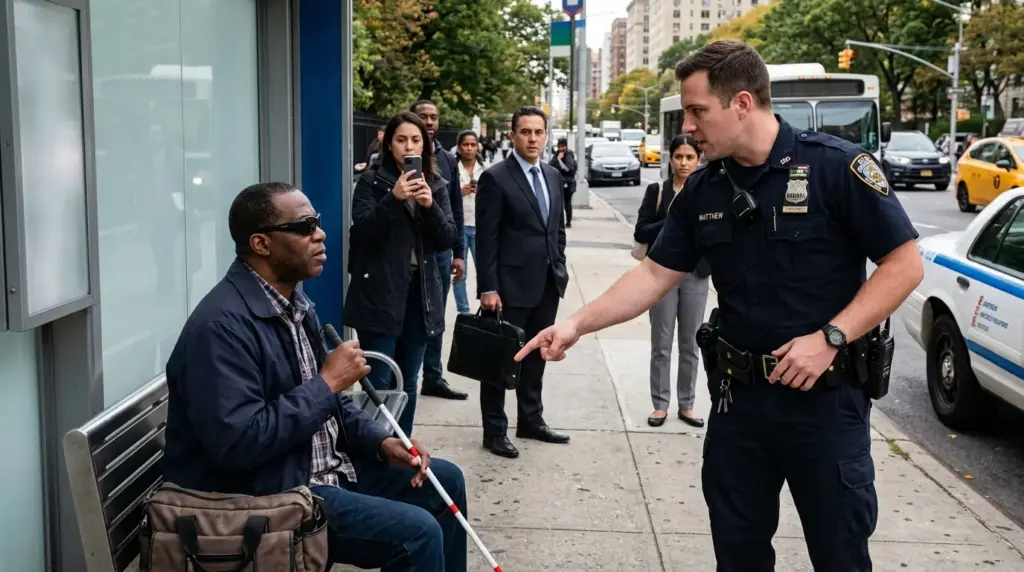
Sergeant Williams stepped closer, and Elijah heard his footsteps circle around him. “Officer Matthew, where is this weapon you’re talking about?”
“In my trunk,” Matthew said. “It’s some kind of stick.”
“Go get it,” Williams ordered, and his tone made clear it wasn’t a suggestion.
Matthew left, and Elijah stood there in handcuffs, unable to see the sergeant or anyone else in the room. He heard murmuring, heard other people moving around, heard the sounds of a busy police station operating around him, and he waited, hoping that someone would finally listen and understand that he was telling the truth.
Matthew returned carrying Elijah’s white cane and set it on the booking desk. Sergeant Williams picked it up and examined it closely, turning it in his hands.
The cane was clearly marked with red reflective bands, had a rubber tip designed for tactile feedback, and bore a small engraved plate that read: “Property of Elijah Turner. If found, please call the State Commission for the Blind,” with a phone number below.
Williams looked at Matthew with an expression that had shifted from skeptical to angry. “This is a standard mobility cane for the blind. It has reflective safety bands and a registration number. What part of this looks like a weapon to you?”
Matthew’s face flushed. “He was holding it in a suspicious way. The call said a Black male with a weapon.”
“The call said a stick,” Williams corrected, pulling up the dispatch record on his computer. “And this is clearly a white cane, not a weapon.” He turned to Elijah. “Mr. Turner, I’m going to remove these handcuffs. I apologize for what’s happened here.”
The metal restraints clicked open, and Elijah rubbed his wrists. Williams handed him the cane, and Elijah’s hands closed around it with visible relief. He extended it immediately, tapping the floor to orient himself, using the familiar tool to build a mental map of the space around him.
“Where are my glasses?” Elijah asked quietly.
Williams looked at Matthew. “You took his glasses?”
“To verify he wasn’t faking,” Matthew said, but his voice had lost all its earlier confidence.
Williams walked to Matthew’s patrol car and retrieved the dark glasses from the front seat. When he returned and handed them to Elijah, the sergeant’s jaw was tight with barely controlled anger. Elijah put the glasses on, and the relief on his face was immediate. His damaged eyes stopped trying to process the painfully bright lights of the police station.
“Mr. Turner,” Williams said carefully, “can you tell me exactly what happened at the bus stop?”
Elijah recounted the entire encounter in precise detail: the aggressive approach, the demand to hand over the weapon, the refusal to believe he was blind, the accusations of casing the area for a robbery, the forceful removal of his cane and glasses, the arrest.
As he spoke, Williams pulled up something on his computer, and his expression grew darker.
“Officer Matthew,” Williams said, his voice cold, “Mr. Turner’s name just came up in our database. Do you know why?”
Matthew shook his head.
“Because he’s listed as a member of the city’s ADA compliance board. He advises the mayor’s office and the police department on disability accessibility issues. He’s also a counselor at the Veterans Disability Resource Center.” Williams turned the computer screen toward Matthew. “He’s been blind since childhood. It’s documented in every city database we have.”
The color drained from Matthew’s face.
Williams wasn’t finished. “There’s more. I just received an email from the chief’s office. Apparently, a video of your arrest has already gone viral—3 million views in the last hour. The mayor’s office is demanding an explanation for why one of our officers arrested a disability advocate and took his mobility cane.”
Elijah spoke quietly, but with devastating precision. “Officer Matthew, I’ve been blind for 43 years. I’ve used a white cane for 40 years. I teach other blind people how to use canes safely. I sit on the board that reviews police department compliance with disability laws. And today, you decided that none of that was real because you couldn’t believe a Black man was telling you the truth about his own body.”
He paused, letting the words settle.
“I’ve been stopped by police before. I’ve been questioned. I’ve had officers ask to see my identification. But I have never had an officer call me a liar, accuse me of faking a documented disability, take my medical device, and arrest me while I stood there unable to see where I was or what was happening to me.”
Williams pulled Matthew aside and spoke in a harsh whisper that Elijah could still hear. “You arrested a blind man. You took his cane. You removed his protective glasses. You did it all on camera. And you did it to someone who literally advises this department on how not to do exactly what you just did.”
Matthew tried to respond. “I didn’t know—”
“You didn’t ask,” Elijah interrupted, his voice cutting through the room. “You saw a Black man with a cane and assumed criminal. You heard me say I was blind and assumed liar. You had every opportunity to verify my condition, to look at the cane closely, to ask basic questions, to call the number engraved on my cane, to check city records. You did none of those things because you had already decided what you believed.”
Williams turned back to Matthew. “You’re suspended, effective immediately. Badge and service weapon on the desk. The chief wants to see you first thing tomorrow morning, and I guarantee that meeting will not go well for you.”
Matthew placed his badge and gun on the desk with shaking hands, his career visibly crumbling in real time.
Elijah stood with his cane in hand and his glasses back on his face, and he delivered the final blow with cold, measured certainty:





