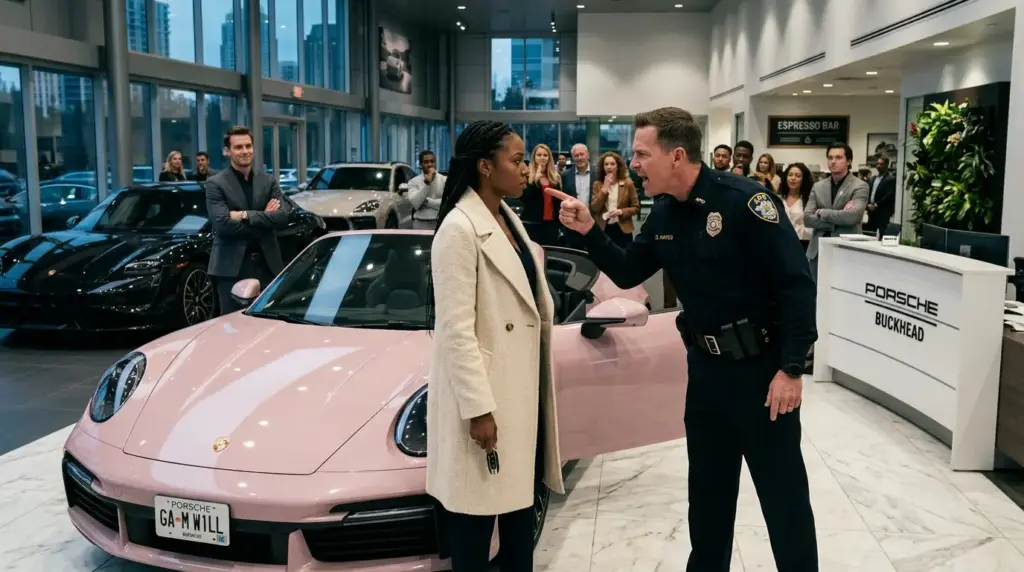
Maya watched Hayes carefully. Earlier that evening, he had controlled every room he entered: the showroom, the arrest, the humiliation. But now the balance had shifted, and everybody inside the cruiser could feel it.
Hayes finally spoke without turning around: “You don’t understand how this works, Collins.”
“No,” Collins answered honestly. “I don’t think I do anymore.”
Hayes laughed softly to himself, but there was no amusement in it. “That’s because nobody explains it when you first put on the badge. They tell you about honor, service, duty. Then twenty years later, you realize the city runs on favors and fear.”
Collins shook his head slowly. “That still doesn’t explain what happened back there.”
Hayes finally turned toward him. “You think I woke up this morning planning to arrest an innocent woman?”
Maya spoke before Collins could answer: “No. I think you woke up terrified somebody would find what was hidden inside that Porsche.”
Hayes looked at her through the darkness of the cruiser, and for the first time since the showroom, there was no anger left in his eyes—only exhaustion. Outside, thunder rolled low across Atlanta.
Collins reached for the keys hanging beside the steering column. “Sergeant, federal agents already know she’s innocent. If we keep driving around with her cuffed in the backseat, we become part of this.”
“We already are,” Hayes muttered.
Silence followed. Then Maya quietly asked the question neither officer wanted to face: “Who else is involved?”
Hayes leaned back heavily against the seat. Rainwater slid down the side window beside him while distant train horns echoed through the industrial district. “You ever hear people talk about corruption like it’s one bad cop taking cash in an alley somewhere?” he asked quietly. “That’s television. Real corruption wears suits, eats at steakhouses, donates to campaigns.”
Maya said nothing. Hayes rubbed both hands over his face before continuing.
“Victor Salazar didn’t survive because he had guns. He survived because important people needed him.”
Collins frowned. “Judges?”
Hayes gave a slow nod. “Developers,” he added. “Bank executives, politicians, cops. Everybody taking a piece while pretending to hate the man in public.”
“And now federal agents have proof,” Maya said.
“That recording changes everything,” Hayes admitted quietly.
The rain intensified outside, drumming against the cruiser hard enough to almost drown the silence inside. Then Collins finally made his decision. He reached back toward Maya.
“Turn around.”
Hayes looked at him sharply. “What are you doing?”
“She shouldn’t still be cuffed.”
“You don’t get to decide that.”
“No,” Collins replied steadily. “But I get to decide whether I help bury an innocent person.”
The statement landed heavily inside the cruiser. Maya slowly turned her wrists despite the pain cutting into them. Collins unlocked one cuff first, then the other. The click of metal opening sounded strangely loud.
For the first time in nearly an hour, blood began flowing properly back through Maya’s hands. She rubbed her wrists carefully while studying Collins. “Thank you.”
Collins nodded once, uncomfortable with gratitude.
Hayes stared ahead silently. “You just made yourself part of this.”
“No,” Collins answered. “You did that when you arrested her without probable cause.”
Hayes almost smiled at that. Almost.
Then his phone buzzed again. All three of them looked down instantly: Agent Claire Monroe. Hayes stared at the screen for several seconds before finally answering.
“Monroe.”
The woman’s voice came through, calm and controlled: “You’re making this harder than it needs to be, Daniel.”
“You already opened the compartment.”
“Yes,” Monroe replied. “And now I’m looking at enough evidence to dismantle three departments and put several elected officials under investigation.”
Hayes closed his eyes briefly.
Monroe continued: “Here’s the part you need to understand: Maya Williams is no longer your problem. She’s now a federal witness.”
Maya felt the atmosphere inside the cruiser shift immediately: witness. Not suspect, not detainee—witness.
Hayes lowered his voice: “You’re moving too fast.”
“No,” Monroe corrected him. “You’re finally running out of time.”
Outside, headlights suddenly appeared at the far end of the industrial street: black SUVs, three of them, moving slowly through the rain. Collins saw them first. “Sergeant…”
Hayes didn’t need the warning; he already knew. Federal agents.
The SUVs rolled closer before stopping twenty yards ahead of the patrol car. Their headlights washed across wet pavement and broken warehouse windows. Nobody inside the cruiser moved.
Then Monroe’s voice returned through the phone: “Step out of the vehicle, Daniel.”
Hayes stared through the windshield at the waiting SUVs. “You tracked my cruiser.”
“We tracked the phone you confiscated from Maya.”
That almost made Maya smile despite everything.
Hayes lowered the phone slowly into his lap. “You know what the worst part is?” he said quietly. Nobody answered. He looked toward Maya through the darkness. “I really did think humiliating you would buy me enough time to fix this.”
Maya held his gaze steadily. “People like you always think someone weaker should pay for your mistakes.”
That hit harder than shouting ever could have.
Outside, SUV doors began opening one by one beneath the rain. Then Collins quietly reached for the door handle. “Sergeant,” he said carefully, “whatever happens next, don’t make it worse.”
Rain poured harder as the doors of the black SUVs swung open one after another. Federal agents stepped out into the wet Atlanta night wearing dark jackets marked “FBI” and “Financial Crimes Task Force.” Their movements were calm, organized, and deliberate, which somehow made the situation feel even more dangerous.
Inside the patrol car, nobody moved. Sergeant Daniel Hayes sat frozen in the passenger seat, staring through the windshield as if he still believed there might be some path left to escape everything collapsing around him.
Officer Collins slowly opened his door first. Cold rain and city noise rushed into the cruiser immediately. Maya watched Collins step out with both hands visible, careful and respectful, like a man trying to separate himself from a disaster before it swallowed him, too.





