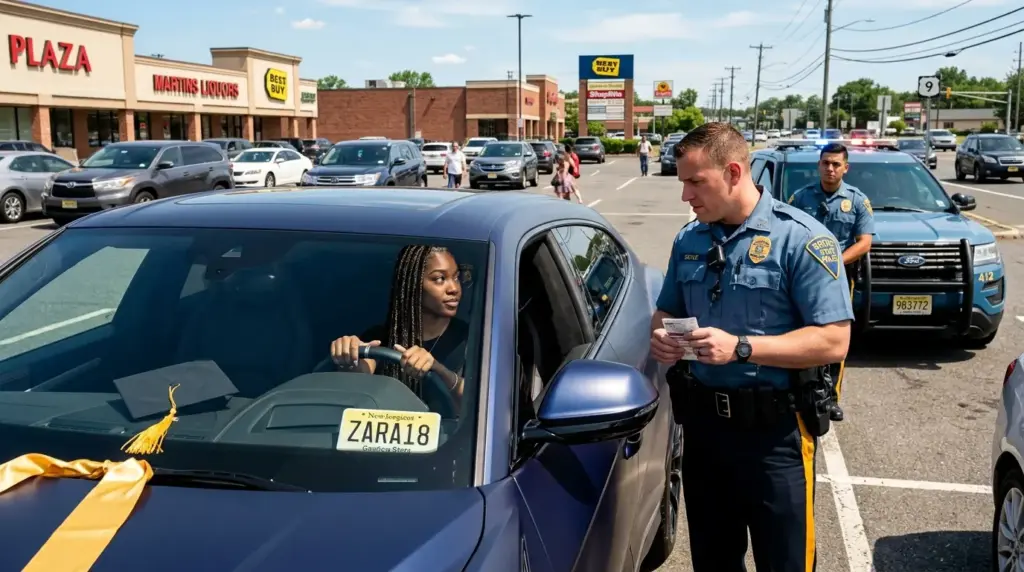
His hand moved to the light bar anyway. He keyed his radio first. “Dispatch, Unit 14. I’m conducting a stop on Route 9 at the Plaza Shopping Center. Vehicle is a Lamborghini Urus, midnight blue, personalized plate ZARA18. Registration comes back to a Coleman at a Sycamore Ridge address, but I’ve got a Black female behind the wheel. Looks about 17, maybe 18. Circumstances feel off. I’m going to have a conversation.”
“Copy, Unit 14. Do you need backup?”
He glanced at the car pulling smoothly into the parking lot ahead of him. “Nah, I’ll handle it.” He switched the lights on.
Rookie Officer Pete Navarro had been riding with Doyle for eleven weeks: long enough to understand that questions were not always welcome, and short enough that he hadn’t yet decided what to do with that understanding. He was 23 years old, fresh out of the academy, still sharp enough around the edges to feel uncomfortable with things that made him uncomfortable. And as the patrol car rolled into the Harlo City Plaza lot behind the Lamborghini, he was feeling uncomfortable.
“She was driving fine,” Navarro said.
“She was driving too fine,” Doyle said. “Like she was working at it.”
Navarro looked at the car: the matte midnight blue paint, the personalized plates, the gold ribbon still draped across the hood, slightly lopsided from highway wind. “There’s a graduation cap on the passenger seat.”
“I see it.”
“And the plate, Pete…” Doyle’s voice was patient, the way a teacher’s voice is patient when a student asks the wrong question. “In ten years on this stretch of road, how many teenage Black girls do you think I’ve seen driving $200,000 cars that were actually theirs?”
Navarro didn’t answer, because he couldn’t answer, because the answer required him to accept a premise he wasn’t sure was a premise.
“These people always have a story,” Doyle said, climbing out of the cruiser. “Father’s name, birthday present…”
“The registration matches.”
“They practice it. You’ll hear it again.” He adjusted his belt. “Just let me work.”
Navarro got out on the passenger side and took his position near the rear of the Lamborghini as he had been trained. He kept his hands on his belt and tried not to look at the graduation cap on the passenger seat. The tassel was gold. The cap was sitting brim up, the way someone places something they intend to pick up again soon. He kept his eyes on Doyle’s back and tried to believe this was routine.
Zara saw the lights in the rearview mirror and her body knew before her mind fully processed it: the familiar cold drop in the stomach, the tightening across the shoulders, the sudden, sharp awareness of her own hands and what they were doing.
She checked her speedometer: 44 in a 45 zone. She checked her mirrors: the lane change she had made two blocks back had been fully signaled. She had done nothing. She knew she had done nothing.
She also knew, with a clarity that had been installed in her not through any single conversation, but through years of accumulated knowledge—the kind that Black children absorb the way they absorb everything, gradually and without formal instruction—that having done nothing was not the same as being treated as though you had done nothing.
Comply. Survive. Document. Fight later.
She signaled, slowed, and turned into the parking lot of the Harlo City Plaza, pulling into a space near the entrance in a way that was visible and non-threatening: car in park, engine off, dome light on even in full afternoon, window down, both hands on the steering wheel at ten and two, fingers spread wide.
She noticed, without moving her head, that the parking lot sat 0.4 miles from Fort Caldwell’s Gate 2. If you looked left, the long straight line of the perimeter fence and the guard post structure at the entrance were visible. This information registered and then settled somewhere quiet in her mind without attaching itself to any particular hope.
She watched in the side mirror as the lead officer approached: larger, older, deliberate. The second officer stayed back near the trunk of the cruiser, hands on his belt, not quite looking at her. The flashlight hit her face before she could see the lead officer’s face clearly, creating an asymmetry that was its own kind of tactic. She kept her expression neutral.
“License and registration.”
No greeting, no explanation for the stop, no “Good afternoon.” Just the command, flat and direct.
“Officer,” Zara said, keeping her voice steady and audible, “may I reach for my purse? My license is inside.”
“Slowly.”
She moved with deliberate, visible slowness: both hands into view, into the passenger seat, zip of the purse, license extracted between two fingers, then across to the glove compartment. “I’m reaching for the registration now.”
Both documents slid through the window. The officer took them and held his flashlight over them. The name on the license: Zara Janelle Coleman, 18 years old as of that morning, Sycamore Ridge address. The registration: Lamborghini Urus, registered to Raymond J. Coleman, same address.
He studied both for a period that was longer than necessary by approximately forty seconds.
“This your car?”
“Yes, sir. It’s registered to my father, but he gave it to me this morning for my birthday. I turned 18 today.”
The answer landed in Doyle’s mind and did something that was not quite registering: it confirmed the shape of what he had already decided. Because in his experience, that self-sealing word, fathers, did not give teenage daughters $200,000 cars. Not the daughters he saw. The answer was too neat, too prepared, too smooth for someone who had genuinely just received this vehicle. It sounded to him exactly like a story someone would rehearse if they needed a story. And so he filed it under “prepared narrative” and moved forward.
“Step out of the vehicle.”





