Kessler looked him up and down—slow, head to boots: the worn hoodie, the resoled boots, the truck at the far end of the lot that didn’t match a single other vehicle in that line.”Which student?””Zoe Bell. Fourth grade. Mr. Patterson’s class.”Kessler didn’t move. A reasonable officer would have said, “All right, sir, have a good one,” and walked away. Diane Kessler had a story she told herself every morning, and the story needed a villain, and she’d already cast him.”I’m going to need to see some ID.”A few of the nearby parents glanced over. Marcus felt it. He’d felt that particular kind of attention his whole life: the way a room recalibrates when a badge points at the one Black man in it.He kept his voice easy. “Sure. Can I ask what this is about?”

Kessler’s jaw tightened. In her experience, people who belonged said, “Yes, ma’am,” and handed things over fast. People who asked what it was about were people with something to hide. She had that backward, of course. She had a lot of things backward, but she didn’t know that yet.”It’s about you standing outside an elementary school in a hoodie watching the doors. That’s what it’s about. ID. Now.”Marcus reached—slowly, deliberately, two fingers, the way his father had taught him when he was fifteen years old. His father had sat him down at the kitchen table and explained, in a voice that never rose, exactly how a Black man survives a moment like this one: “Never make them reach. Never move fast. Keep your hands where they can see. And whatever they say to you, however wrong it is, you stay calm, because your calm is the only thing in that moment you get to control.”He pulled out his wallet. He handed it over. Two fingers.And that was his first mistake—though it wasn’t a mistake at all. Because inside that wallet, tucked behind his driver’s license, was a badge.Kessler flipped the wallet open. She saw the license first: Marcus D. Bell, Ashford County address. And then, behind it, she saw the gold shield and the words that should have ended this whole thing right there: United States Marshals Service. Deputy United States Marshal.She stared at it for two full seconds, and then she smiled. Because in Diane Kessler’s story, the story she told herself every morning, this was not the moment she’d been wrong. This was the moment she’d been right. This was the man with the card. The trickster. The one who thinks he can flash something shiny and walk right past her, the way that man walked past her all those years ago while her sergeant watched and laughed.

“Oh,” she said, loud enough now for the whole courtyard. “This is good. Y’all want to see this?” She held the badge up in the air, turning it so the sun caught the gold. “This man’s got himself a little federal badge. A US Marshal.”She laughed—a hard laugh, a laugh with no floor under it.”In a gray hoodie and busted boots, driving that truck. Sir, come on. I’ve been doing this a long time. You bought this online? What, twenty bucks?””That badge is real,” Marcus said. His voice did not change. “Officer, I’m going to ask you to do one thing: call it in. Run the number on the back. It’ll take you ninety seconds.””You want me to waste dispatch’s time on a toy?””It’s not a toy. Run the number.”A crowd was forming now. Real, this time; not glances, but bodies. A mother had stopped with her hand on her car door. Two dads by the fountain had gone quiet. Near the school entrance, a young teacher named Hannah Voss had come out to help with dismissal and had stopped dead on the top step, watching, a strange cold feeling crawling up the back of her neck.

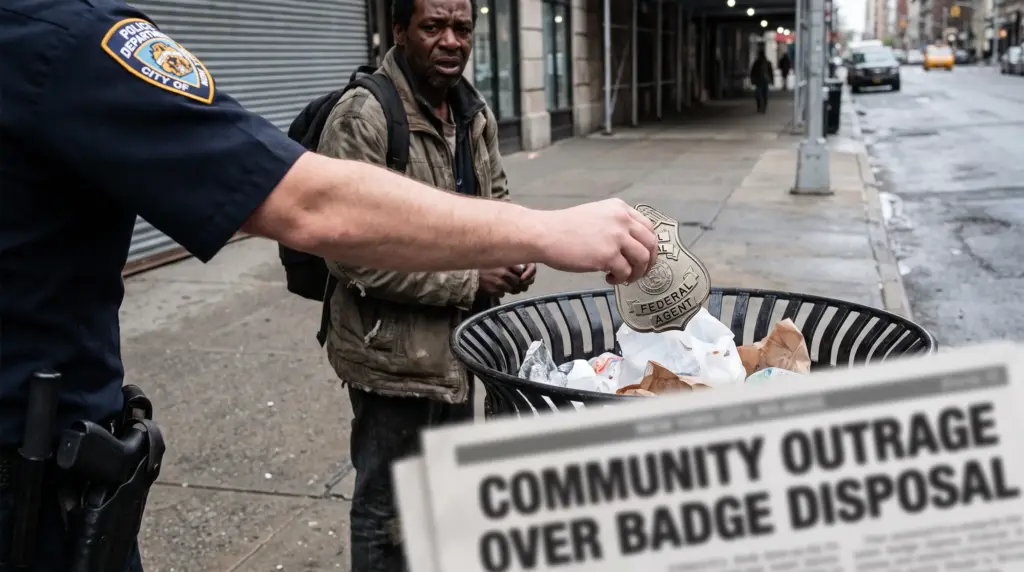
Kessler didn’t call it in. She grabbed his shoulder and spun him toward the brick wall, and she started patting him down—rough, fast, performing for the crowd. And she pulled his wallet fully out and shook it, and out came a folded photo of Camille. Out came a school lunch receipt. Out came the small pink backpack he’d been holding for Zoe, which he’d set on the wall, and she swept it off onto the ground.And then she looked at the badge in her hand one more time. Held it up one more time.”You know where this belongs,” she said.”Don’t,” Marcus said. And for the first time, one single degree of something entered his voice: not fear, a warning. “Officer, do not.”But Diane Kessler had a story she told herself every morning, and in that story, this was her big moment—the moment she finally wasn’t fooled—and she wanted the ending.She walked three steps to the trash can by the courtyard entrance—the big green one, half-full of napkins, juice boxes, and a browning apple core—and she held the badge up high so the whole courtyard could see.”That’s where this belongs,” she said. “Right there in the trash, just like the lie you walked in here with.”