What the physical evidence could not do on its own was fill in the years behind it. That was what Sykes provided. Trevor Sykes requested a meeting with Dana’s office the following Monday. He arrived with a personal attorney and a prepared statement and the notebook photographs on his phone, which he transferred to a department-issued evidence drive while Dana’s lead investigator sat in the room and watched. He answered every question he was asked. He did not minimize what he had done. He explained the street fee system as Briggs had described it to him when Sykes was still in his first year on the job, the selection criteria, the routes, the body cam protocol, the split. He explained that he had told himself for a long time that the distinction between initiating and enabling was a meaningful one. He said he had stopped believing that somewhere around the 11th month, but that by then the calculation of staying quiet had become its own kind of trap, and he had not known how to step outside it until the moment he realized that the trap was about to close on him entirely.
His cooperation completed the timeline in a way the physical evidence alone could not have achieved. It filled in the conversations, the agreements, the specific instructions Briggs had given before each stop, and the accounting that happened afterward. It established that this had not been opportunistic. It had been organized, maintained across years with the same deliberateness Briggs brought to his paperwork, the deliberateness of someone who understood that systems could be worked in both directions. The report modification data and the ATM records and the notebook photographs and the eight prior complaints with their matching selection profiles formed a case that was, by the time the prosecutor reviewed it, built entirely from sources that had existed before Desmond Avery arrived in Harbor Point. His account was corroborating evidence. It was not the foundation.
The indictment came back on a Tuesday morning in November. Briggs was arrested at his home before he reached the precinct for his shift. The charges were extortion under color of law, theft, falsification of official records, obstruction of justice, and witness intimidation. The last charge stemming from the phone call he had made to the prior complainant in the week before the ceremony. Sykes was charged as an accessory and as a participant in the camera deactivation scheme.
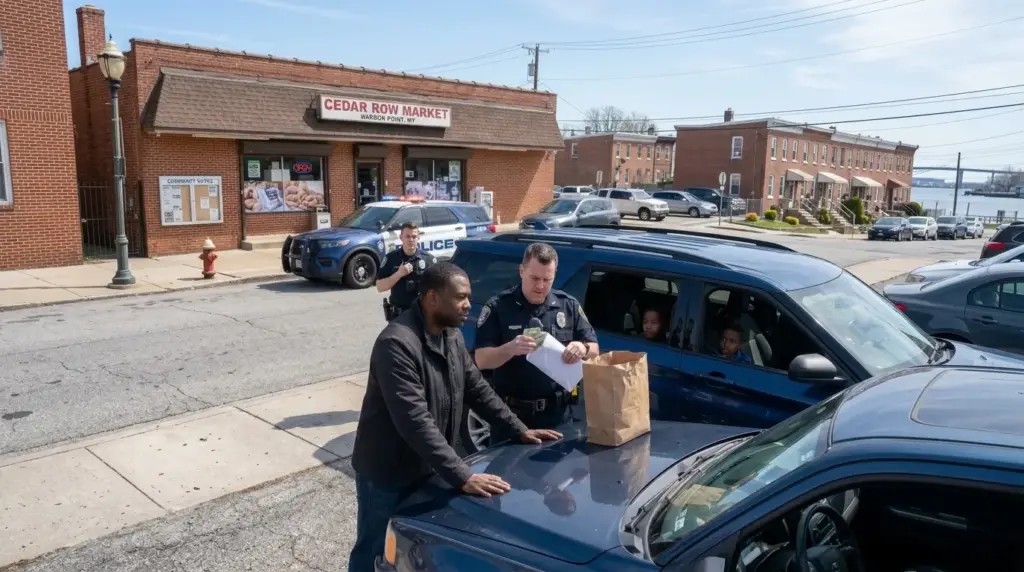
The trial lasted nine days. Briggs’ defense argued voluntary payment at every opportunity, that the individuals involved had offered money in exchange for leniency, that no explicit threat had been made, that the officer had exercised discretion within parameters that, while unconventional, did not constitute criminal extortion. The argument collapsed entirely on the fourth day of testimony when the prosecutor played the dashcam recording from Cedar Row. The courtroom was quiet while Briggs’ voice came through the speakers. “I can let you go home tonight with a parking infraction on your record, or I can find something in that vehicle that means you don’t see your kid again until morning.” The defense did not attempt to characterize that as voluntary. There was no characterization available. Briggs was convicted on all five counts.
He was sentenced to seven years with the possibility of parole reviewed at five. He lost his position, his certification, and his pension. Sykes received 18 months and a permanent bar from law enforcement employment. He served the sentence. He did not return to Harbor Point.
Desmond had not appeared at the trial as anything other than a witness. He gave his testimony on the third day, answered every question he was asked, and did not editorialize. He described what had happened on Cedar Row with the same flat accuracy he had brought to the notes he wrote at the kitchen table that first night, and he left the courtroom when he was excused and went back to work.
What he asked for after the verdict was not coverage and not a statement and not a ceremony. He asked that all eight prior complaints be formally reopened and reviewed. He asked that the individuals involved be contacted directly by Dana’s office and informed of the outcome. He asked that any funds or property that could be traced and verified be returned or compensated, and he asked that the official record for each of those cases be amended to reflect that the complainant’s account had been accurate.
That last item took the longest. The bureaucratic mechanism for formally correcting a closed complaint record was not designed to move quickly, and the language that ended up in each file was negotiated carefully to ensure it was precise without being reversible. But it was done.
By January, all eight files had been updated. The delivery driver, the night shift nurse, the graduate student, the older man, and the four others whose names had spent over a year in the category of unverified allegations were now documented as people who had told the truth and had not been believed, and the record said so plainly.





