Not because I wanted to replace the old one.
Because I wanted to create something that belonged entirely to the life I was living now.
Rowan helped me select the wood.
We spent several weekends working on it together.
Our friendship had developed slowly.
Coffee after work.
Long conversations about restoration projects.
A shared love of old bookstores.
Occasional dinners that neither of us initially called dates.
She knew what had happened in my marriage.
But she never treated me like a damaged project requiring repair.
One evening, while we were sanding the tabletop, she asked a question.
“Are you afraid of trusting someone again?”
I stopped working.
“Sometimes.”
She nodded.
“That’s understandable.”
I looked at her.
“Does that bother you?”
“Only if you expect me to be someone else.”
“What do you mean?”
“I’m not Sloane, Eli.
I can’t answer for what she did.”
I considered that.
She smiled.
“And I don’t want you to spend the rest of your life preparing for somebody to hurt you.”
That conversation stayed with me.
Trust, I realized, wasn’t about guaranteeing that another person would never disappoint you.
It was about recognizing character over time.
It was about honesty when the truth was uncomfortable.
It was about allowing people to reveal themselves through consistent actions rather than beautiful promises.
Several months later, I asked Rowan on an actual date.
She laughed.
“I was beginning to think you’d never ask.”
“I wanted to be certain I wasn’t asking for the wrong reasons.”
“And now?”
“Now I know I’d like to spend more time with you.”
She smiled.
“That’s a pretty good reason.”
We began seeing each other.
Slowly.
Without rushing toward grand declarations or trying to recreate the life I’d lost.
By the time Eva organized the camping trip, Rowan and I had become comfortable with the quiet parts of being together.
That mattered more to me than I could explain.
We arrived at the campground in the late afternoon.
The forest smelled of damp earth and pine.
Ben started setting up the tents.
Lena unpacked food.
Eva immediately began criticizing Marcus’s fire-building technique.
“You’re supposed to build a campfire, not construct a wooden monument.”
Marcus looked offended.
“It’s called preparation.”
“It’s called wasting kindling.”
Everyone laughed.
I stood beside the truck, watching them.
Rowan approached carrying two folding chairs.
“You okay?”
I nodded.
“Yeah.”
“You’re sure?”
I glanced toward the clearing.
A year earlier, the sight of a campfire surrounded by friends might have sent me into a spiral of painful memories.
Now it felt different.
Not because I had forgotten.
Because those memories no longer controlled me.
“I’m sure,” I said.
She handed me a chair.
“Good.
Because you’re responsible for making coffee tomorrow.”
“That’s a serious responsibility.”
“I have high standards.”
“I’ve noticed.”
She grinned.
That evening, we sat around the fire telling stories.
Ben admitted he had once spent an entire night in a tent he’d assembled backward.
Eva told everyone about the time I accidentally painted our father’s truck with a spray gun.
I protested that she was exaggerating.
She produced photographic evidence.
Everyone laughed until their stomachs hurt.
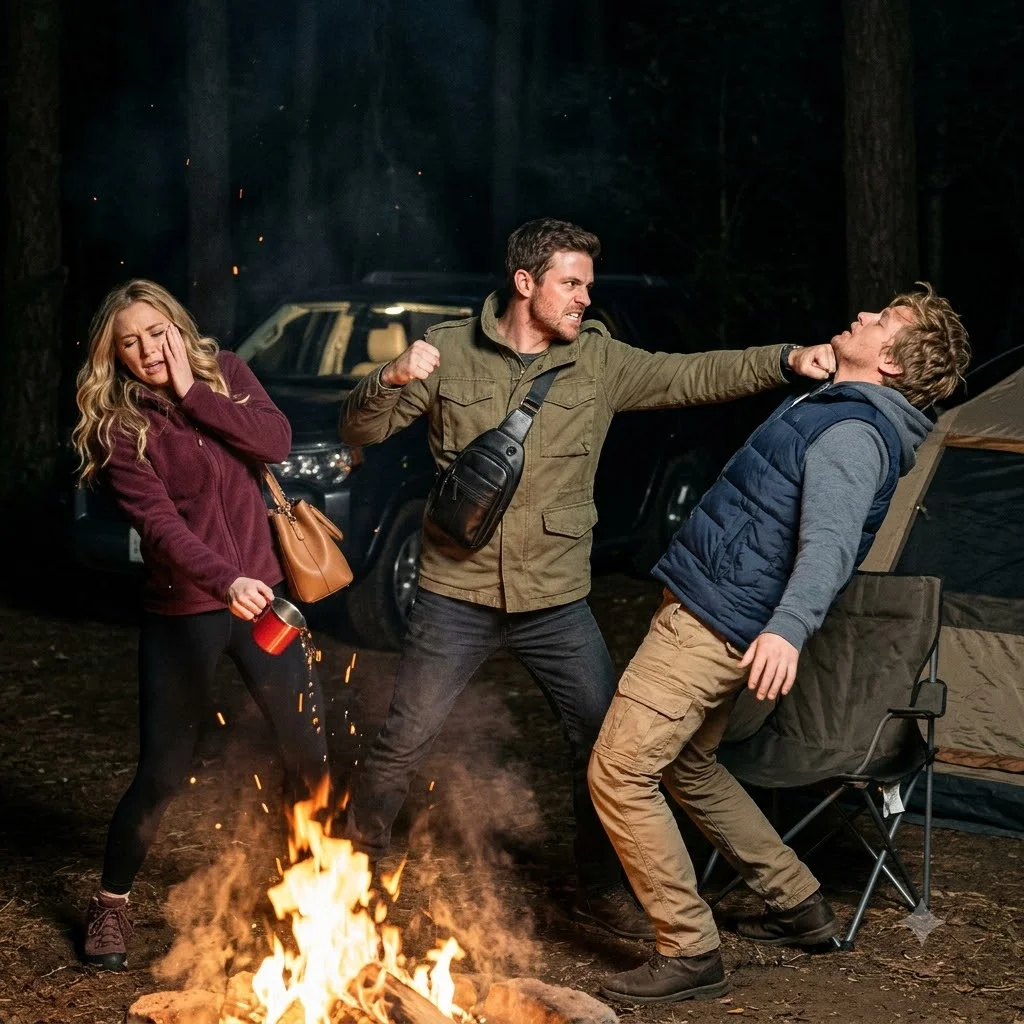
As darkness settled over the campsite, I leaned back and watched the flames.
For a moment, another campfire appeared in my memory.
Sloane laughing.
Carter smiling.
Friends looking away.
The humiliation.
The betrayal.
The terrible certainty that something was wrong.
I remembered how helpless I’d felt during the weeks before that trip.
How much I’d wanted to believe I could save my marriage if I simply worked harder.
How afraid I’d been of losing the life we’d built.
And then I thought about everything that had happened afterward.
The truth.
The divorce.
The sleepless nights.
The financial struggle.
The first morning I woke without reaching for a second coffee cup.
The first evening I laughed without feeling guilty.
The first time Rowan reached for my hand and I didn’t instinctively wonder what she wanted from me.
Healing hadn’t arrived all at once.
It had come through ordinary moments.
Small choices.
Honest conversations.
And the realization that I was allowed to be happy again.
Rowan moved her chair closer.
“Penny for your thoughts?”
I smiled.
“Just thinking about how different things are.”
“In a good way?”
I looked at her.
“In a very good way.”
She rested her head against my shoulder.
For a while, we watched the fire together.
Eventually, everyone began heading toward their tents.
Eva yawned.
“Don’t stay up too late, you two.”
“No promises,” Rowan replied.
Eva laughed and disappeared into the darkness.
Soon, we were alone beside the dying fire.
The logs collapsed into glowing embers.
A few sparks rose into the night.
Rowan took my hand.
“Can I ask you something?”
“Anything.”
“Do you regret going on that first camping trip?”
I considered the question.
For a long time, I’d believed that night was the worst thing that had ever happened to me.
And in many ways, it was.
But it also ended the lies.
It forced me to see the difference between loving someone and allowing them to destroy my life.
It reminded me that dignity didn’t require an audience.
And that sometimes the strongest answer to cruelty was refusing to become cruel yourself.
“I regret what happened,” I said.
“But I don’t regret learning the truth.”
Rowan nodded.
“That makes sense.”
I looked toward the flames.
“You know what the strangest part was?”
“What?”
“I spent months thinking I’d lost everything.”
She squeezed my hand.
“And now?”
I looked at the woman beside me.
At the peaceful forest.
At the friends sleeping nearby.
At a future that no longer needed to resemble my past.
“Now I realize I lost a marriage that had stopped being honest.
I didn’t lose my chance to have a good life.”
Rowan smiled.
“That’s a pretty important difference.”
I nodded.
“It is.”
The last flame disappeared.
I remembered the night Sloane had asked where I was going.
Back then, I’d answered, “You’ll find out.”





