The halogen lighting of Labor Ward 4B smelled of antiseptic soap, synthetic iodine, and scorched linen.
At nine o’clock that evening, Maya had gripped the stainless-steel rails of the gurney until her knuckles turned the color of bone. Her water had broken three weeks early, bursting across the hardwood floor of their brownstone like a dropped vase. The contractions arrived not in gradual swells, but in rhythmic, violent shears that made her vision whiten at the edges.
“Breathe through the wave, Mrs. Vance,” the nurse had repeated, adjusting the elastic straps of the fetal monitor across her distended stomach. The machine chattered out an irregular cadence—thump-thump-thump—like a small bird trapped inside an engine compartment.
“Where is he?” Maya had gasped, sweat plastering coils of dark hair to the temples of her face. Her voice cracked around the dry oxygen blowing through the nasal cannula. “Call him again. He was only supposed to be at the dispatch depot in Queens. It’s twenty minutes across the bridge.”
The nurse had reached for the desk phone, dialed the number written in permanent marker across the intake chart, and waited. Seven rings. Then the automated mechanical voice of the cellular carrier: The party you are trying to reach is unavailable.
Marcus Vance did not miss calls. He was a freight-forwarding broker who treated unreturned messages as lost equity. He kept two phones in his tailored pockets and a third docked in the console of his German sedan. When he had kissed Maya’s forehead three hours earlier, his palms had been dry and his voice unhurried: Just locking down the autumn manifests, baby. Keep your feet up. If the twinges start again, page me twice. I’ll run every red light on the expressway.
By eleven, the monitor’s steady rhythm began to slip. The green line dipped, stuttered, and dropped into prolonged valleys.
“Variable decelerations,” the attending resident muttered, rapping his gloved fingers against the monitor’s glass display. He pulled the curtain back, calling out to the hallway: “Let’s prep an IV drip of pitocin. We need her dilated. Where’s the husband for the surgical consent form?”
Maya reached for her phone on the rolling metal tray. Her fingers shook so violently the screen blurred into a smear of greasy light. She didn’t call his office; she opened the family location-sharing utility she had installed when they bought the delivery vans two winters ago—an administrative app Marcus believed was tied solely to company insurance.
A pulsing blue beacon hovered over Manhattan.
Not the industrial yards of Maspeth. Not the freight terminal on the river.
The beacon was stationary at Fifty-Seventh and Sixth Avenue. Room-level resolution inside the marbled tower of the Hotel Bel-Air Luxe.
A fresh contraction hit her, ripping a guttural moan from the center of her chest. But beneath the agony of tearing muscle, a cold, predatory lucidity took root. She ripped the pulse-oximeter clip from her index finger. The machine let out a flat, electronic shriek.
“Mrs. Vance! You cannot get out of bed!”
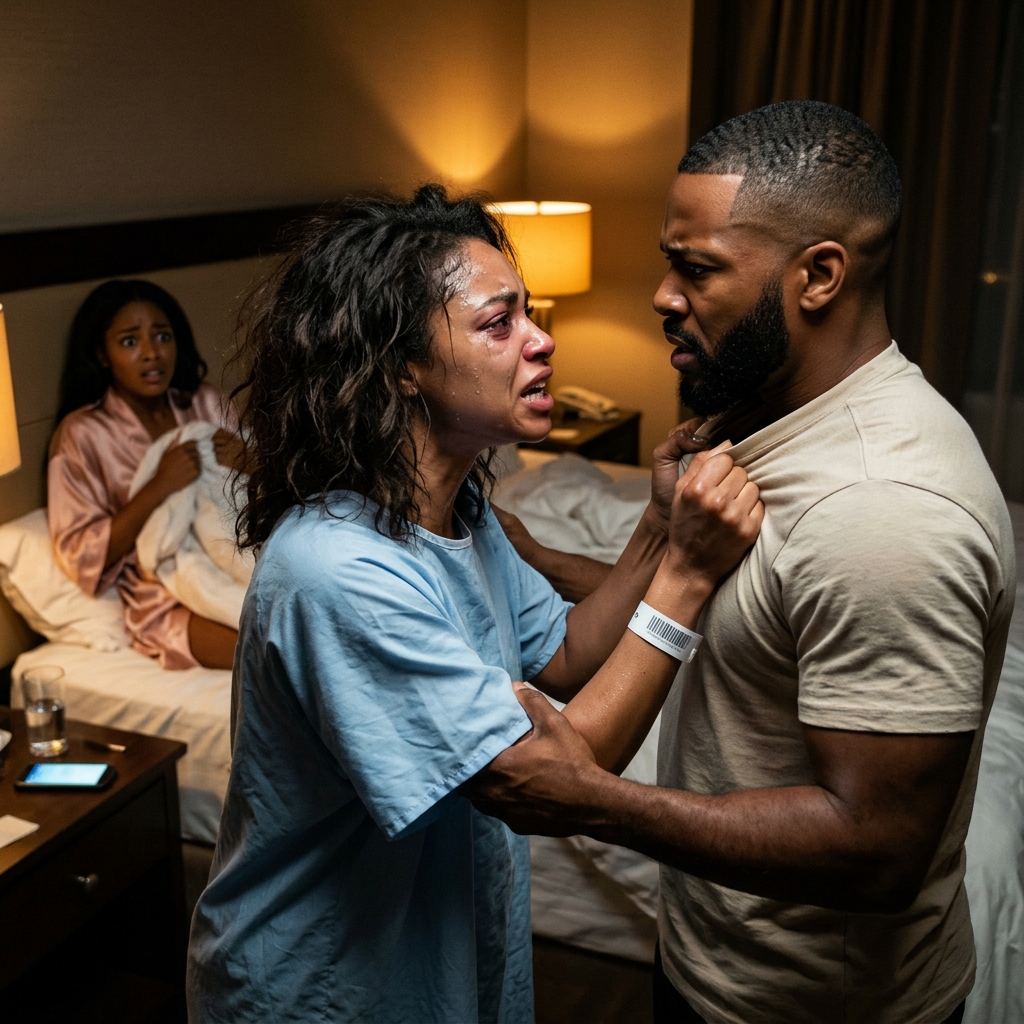
Maya didn’t answer. She swung her swollen legs over the mattress, her bare feet hitting the freezing linoleum. Her pastel-blue hospital gown trailed behind her, unfastened at the upper shoulder, the white plastic barcode bracelet around her left wrist catching the fluorescent glare. She snatched her trench coat from the wardrobe hook, threw it over her trembling shoulders, and limped past the nurse’s station while the emergency alarms were still sounding.
She didn’t wait for an elevator. She took the fire stairs, one excruciating riser at a time, her teeth grinding against each other until she tasted blood, walking straight out into the midnight rain.
Suite 1402 of the Hotel Bel-Air Luxe smelled of amber resin, cooling tallow candles, and room-service champagne.
The bedroom was illuminated only by the warm chiaroscuro glow of a single brass bedside lamp, casting long, sharp shadows across the tufted leather headboard. The king-size bed was a battlefield of disheveled, high-thread-count white linen.
Marcus Vance sat propped against the pillows, the cotton of his beige crewneck t-shirt pulling tight across broad, vascular shoulders. His skin fade was immaculate, the line of his trimmed beard sharp as a draftsman’s rule. Beside him, draped in a blush-pink silk robe that slipped off one bare shoulder, Chloe rested her head against his bicep. Her black hair spilled across his chest like spilled ink.
“You really don’t have to go back to the depot tonight?” Chloe asked, tracing the vein along his forearm with a polished acrylic nail.
Marcus smiled—a slow, easy curling of his lips that had disarmed dock foremen and city inspectors for a decade. He lifted his glass of sparkling wine, took a sip, and set it on the dark wood nightstand.
“I told you,” he murmured, his voice a rich, comforting baritone. “The freight business runs itself when you set the parameters right. I’m my own master now. No partners. No leashes.”
Chloe tilted her chin up, looking at him through heavy lashes. “My father still thinks you’re stringing me along, Marcus. He says men in logistics always have three lives. One in every port.”
“Your father doesn’t know me,” Marcus said softly, turning to press a warm, possessive kiss against her forehead. “I’m thirty-three years old, Chloe. I’m done running the streets. We find the brownstone in Westchester by spring. We sign the papers, we set the date, and I make you an honest woman. I’m not married. I’ve never been married. It’s just you.”
A heavy, metallic thud rattled the outer door of the suite.
Marcus went still. His eyes shifted toward the foyer, the relaxed warmth in his posture evaporating into guarded tension. “Did you order late room service?”
“No,” Chloe whispered, pulling the lapels of her silk robe tight against her throat.
Before Marcus could slide off the mattress, the door latch clicked, and the heavy mahogany panel swung inward, rebounding against the brass wall stop with a violent crack.
In the threshold stood Maya.





