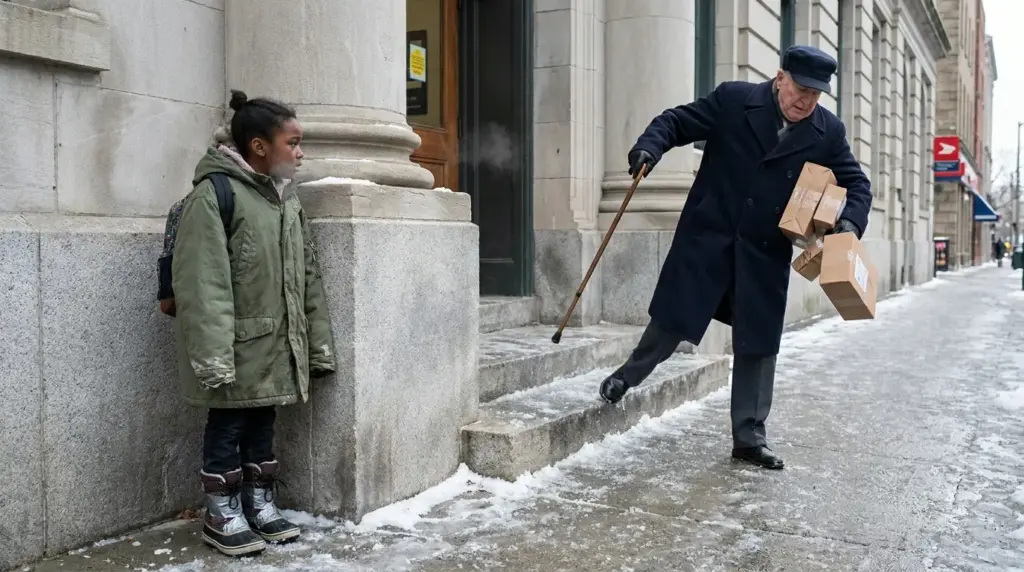
But that girl, Sadie Faulkner, 9 years old and light enough that the wind off the harbor pushed her half a step sideways every time it gusted, did not know that the man whose arm she was holding had once argued a case before the Supreme Court of Canada that changed the way this country understood corporate accountability. She did not know that his name had appeared in the National Post in the Globe and Mail more times than he could remember, or that the law firm he had built over 40 years still bore his name on the brass plaque beside the door of its Toronto office. She only knew that his right foot had slipped on the second step, that his left hand had grabbed the railing a moment too late, and that the stack of parcels he had been carrying was already falling. She caught two of them before they hit the ground.
The third landed softly in a snowbank beside the steps, and she picked it up and brushed the snow off the brown paper with her sleeve. That single moment, ordinary and unremarkable and noticed by no one, would set in motion a story that neither of them could have imagined standing there on those icy steps in the pale December light. Halifax in early December had a way of making itself felt before you even opened your eyes in the morning. The cold came off the Atlantic and settled into the old stone and brick of the waterfront buildings, into the iron railings along the harbor walk, into the bones of the fishing boats rocking at their moorings in the gray chop. The sky was low and white, the kind of sky that could not decide whether it wanted to snow or simply hang there looking heavy.
And the wind found its way through every gap in every coat and every loose window frame in the old South End row houses where the rent was still cheap enough for people who worked with their hands. Sadie Faulkner knew that cold. She knew it the way a person knows a room they have lived in for a long time, every corner of it, every draft. She was standing across the street from the post office that morning with her back pressed against the brick wall of a closed shoe repair shop.
Her hands pulled inside the sleeves of a parka that had belonged to her older cousin and still smelled faintly of cigarettes and cheap laundry soap. Her boots were held together at the sole with a strip of silver duct tape that she replaced every two days when it peeled away from the damp. Inside her backpack, which she carried everywhere because leaving it anywhere meant losing it, were a change of socks, a toothbrush with frayed bristles, a composition notebook with a cracked spine, a blue ballpoint pen that still had ink. And a small wooden horse her father had carved for her from a piece of driftwood the summer before he died. She carried no food.
She had eaten half a bread roll the previous evening that a woman outside Tim Hortons had given her without being asked. And before that, a package of saltine crackers she had found unopened on a bench at the bus terminal. Hunger had become a thing she managed the way a person manages a dull headache, not by fixing it, but by learning to think around it. She had been on her own for 11 days. Her mother, who had held two jobs and sometimes three for as long as Sadie could remember, had been arrested outside a convenience store on Gottingen Street for something Sadie did not fully understand.
And the woman from community services who had come to the apartment the next morning had spoken in a calm, careful voice about temporary placement and emergency foster care and a process that would take a few days. Sadie had nodded politely and packed her backpack and left through the back door of the building while the woman was on the phone in the kitchen. She had heard stories from the older kids at school about emergency placements, about houses where you shared a room with four other children, and the doors did not always lock, and the people were sometimes kind and sometimes not. And she had decided, in the quiet way she decided most things, that the street was a trouble she understood, and the other was a trouble she did not. She was not waiting for anything in particular that morning outside the shoe repair shop.
She was watching the post office, because the post office had a heated vestibule where you could stand for 10 or 15 minutes before someone told you to move along. And she was timing her next visit, spacing them out so the same clerk would not recognize her twice in one day. She had learned, in 11 days, how to be invisible, how to move through the city in the gaps between people’s attention. How to sit in the library until closing without drawing a question. How to sleep in the stairwell of a parking garage on Spring Garden Road, where the security guard changed shifts at midnight, and the new one did not check the upper floors.





