Hattie brought soup, thick and golden with chunks of potato and leek. She brought a plate of roasted chicken with root vegetables and a warm bread roll on the side. She brought a glass of milk for Sadie and a cup of black coffee for Leonard and refilled the bread basket without being asked. She did not ask Sadie any questions. She did not ask Leonard any questions either.
She moved through the small warm room like a person who had decided long ago that the people at her tables were her people and that her job was to feed them and let them be. Halfway through the chicken, Sadie set her fork down. She had eaten more in the last 20 minutes than she had eaten in the last 4 days and her stomach, which had grown accustomed to emptiness, was protesting the sudden kindness in small uncertain ways. She folded her hands in her lap. She looked at her plate.
She looked at Leonard. “Sir,” she said, “can I ask you something?” “You can ask me anything,” Leonard said. “Why are you doing this?” Leonard did not answer right away.
He set his own fork down. He picked up his coffee, took a slow sip, and returned the cup to its saucer with the careful precision of a man who had spent a long life handling things that could break. He looked at Sadie across the white tablecloth and the thin winter light through the window caught the silver of his hair and held it for a moment. “That’s a fair question,” he said, “and it deserves a straight answer.” He paused.
“When I was about your age, Sadie, I lived in a small town on Prince Edward Island that most people have never heard of. My father had left when I was four and I don’t remember much about him except the sound of the door closing. My mother worked at a fish plant. She stood on her feet for 10 hours a day in rubber boots in a building that was cold in winter and smelled terrible in summer. And she came home at night with her hands cracked and raw and she made me supper and helped me with my homework and she never once let me see her cry.
Though I know now that she must have. We did not have much. There were weeks, more than I like to count, when the cupboard had nothing in it but oatmeal and powdered milk. And there were mornings when my mother packed my school lunch with bread and margarine and nothing else and told me it was a sandwich.” He stopped.
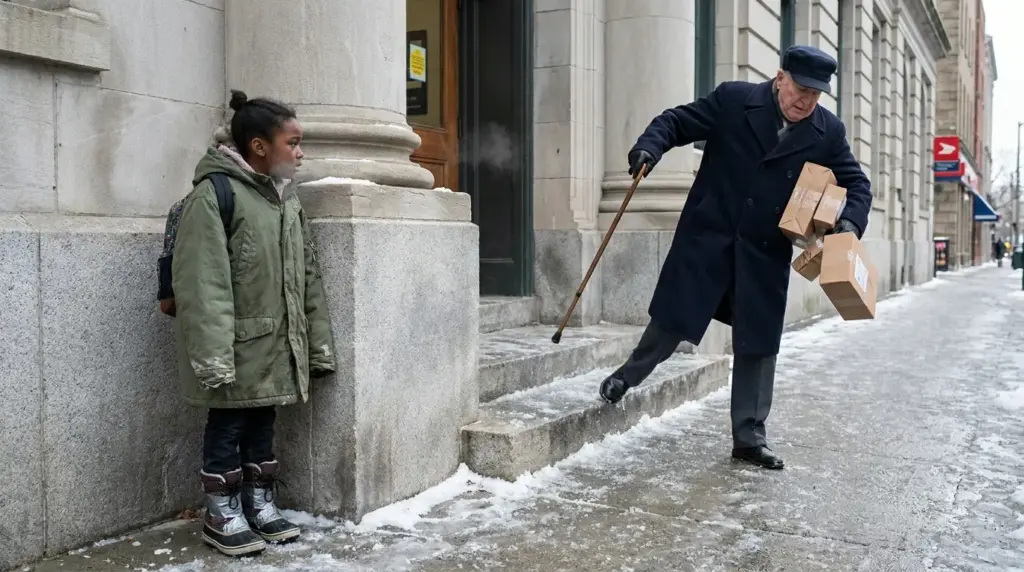
He took another sip of coffee. Sadie did not move. “One winter afternoon,” he continued, “I was walking home from school and I passed a woman on the road who had dropped a bag of groceries in the snow. The bag had split. Apples and cans and a carton of eggs were scattered across the shoulder of the road and she was trying to pick them up, but she had a bad hip and she could not bend far enough.
I was 9 years old. I was hungry. Some of the apples were bruised and she would not have missed one if I had slipped it into my coat pocket. Nobody would have known. Nobody would have blamed me.
He looked at Sadie very steadily. I did not do that, Leonard said. I picked up every apple. I carried her groceries to her door. And when we got there, she invited me inside and gave me a bowl of fish chowder that I can still taste if I sit quietly and close my eyes.
He paused. Her name was Mrs. Chicken. That was her real name, Edith Chicken. I know it sounds like something from a children’s book, but that was her name. And she fed me supper three nights a week for the next 5 years.
She is the reason I went to university. She is in most of the ways that matter, the reason I am sitting here today. Sadie was very still. You did for me this morning, Leonard said quietly, what I did for her a long time ago. So I am doing for you what she did for me.
That’s all it is. Sadie looked down at the white tablecloth for a long time. The story had settled into a place inside her that did not yet have words for what it was feeling. She thought about apples in the snow. On a road in Prince Edward Island 60 years ago, she thought about a small boy choosing to give back what no one would have known he had taken.
She thought about Mrs. Chicken, whoever she had been, who had opened her door to a hungry child and changed the entire course of a life she could not possibly have foreseen. She thought about her own father, who had sat on the back steps of their apartment one evening and said to her in his plain, unhurried voice, “You just be good to people, Sad. That’s all there is. You be good to people and the rest of it sorts itself out.” “Sir,” she said, and her voice was very small.
“I don’t know how to say thank you for this.” “You don’t have to,” Leonard said. “You already said it on the steps.” They finished their meal slowly. Hattie brought a small bowl of vanilla ice cream for Sadie without being asked, and Leonard did not protest.