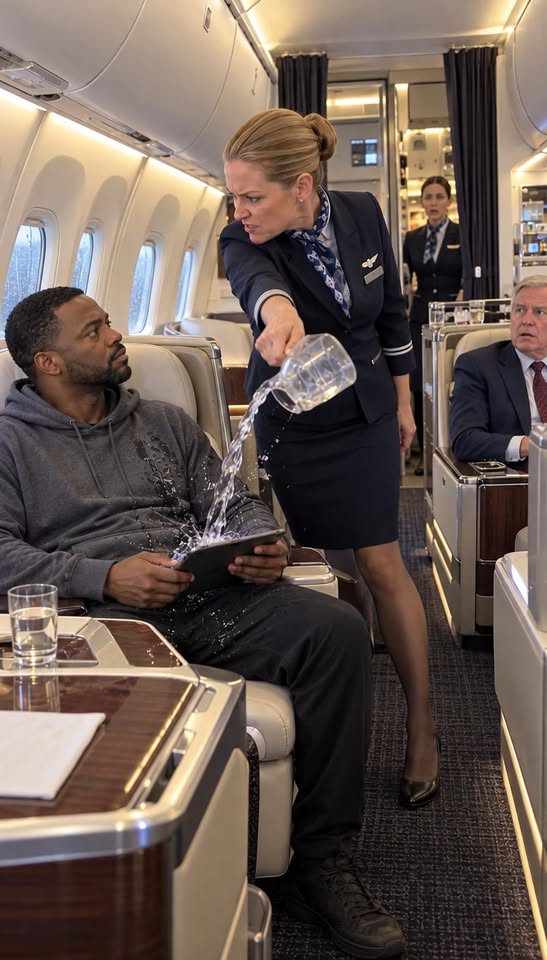
Rebecca’s hand flew to her throat, the color draining completely from her cheeks until the rouge on her cheekbones looked like clown paint. Her mind raced backward through every word she had spoken at the boarding door, the pitcher of tap water, the slap that still glowed red across his cheekbone. Her knees buckled slightly, and she had to catch the edge of the stainless-steel counter to stay upright.
“Mr. Donovan, sir—I—I didn’t know—” she choked out, tears of pure self-preservation springing instantly to her eyes. “There was a terrible confusion with the manifest, I swear to you—”
“Save your breath,” Marcus said coldly. He didn’t even look at her; his slate-gray eyes locked onto Captain Reynolds’s sweating face. “Because the assault in this aisle isn’t what is going to put both of you in a federal prison for the next fifteen years.”
Reynolds flinched as if struck between the eyes.
Marcus reached out and tapped his knuckles twice against the brushed-aluminum door of the floor-to-ceiling bulkhead compartment directly beside Seat 1A. BONDED CUSTOMS LOCKER — POSITIONS DF3 / DF4.
“For the past eighteen months,” Marcus said, his voice steady and inexorable as a prosecutor’s closing argument, “Flight SA-104 has logged a fourteen-point-six-kilogram customs weight discrepancy on its bonded duty-free carts. Six months ago, a twenty-six-year-old inventory clerk at Heathrow noticed that Cart DF4 was heavier coming onto the plane than the liquor and perfume manifest accounted for. Eleven days later, your friends in Flight Operations fired him to keep him quiet. And when I sat down in 1A today with a forensic audit folder bearing the header Customs & Bonded Freight Anomalies, Ms. Miller panicked so badly at the thought of an investigator sitting three feet from her locker that she tried to drown my paperwork and provoke a diversion to get me off this plane.”
Marcus looked past the two paralyzed senior crew members toward the rear curtain of the First Class cabin, where Grace Parker had crept back up the aisle at the sound of breaking porcelain.
“Grace,” Marcus called out gently. “Come forward, please.”
Grace stepped into the forward galley, her eyes wide as she looked from the trembling captain to Marcus.
“Six months ago, someone in this crew bullied you into keeping quiet about what happens in this forward galley during the transatlantic turnarounds,” Marcus said to her. “And earlier today, someone grabbed your wrist hard enough to leave a bruise when you got too close to Locker DF4. Starting right now, you answer directly to me, and you have the full legal and financial protection of Donovan Capital behind you. Step past Ms. Miller and break the customs seal on Locker DF4.”
“Don’t touch that locker!” Reynolds barked suddenly, desperate survival instinct overriding his terror as he lunged half a step toward the aluminum bay. “That is sealed international bonded cargo! Under UK and US customs law, nobody opens that bay in flight!”
“First Officer Clarke is flying the aircraft, Mr. Reynolds, and you are suspended from duty effective immediately,” Marcus said without raising his voice. Across the aisle in 1K, William Harrington stood up to block the starboard gap, while in 2A, Eleanor Vance kept her iPhone lens locked steadily on the galley. “If you lay a single finger on Ms. Parker or that locker door, every witness in this cabin will watch you add obstruction of a federal customs inspection to your indictment. Step back.”
Reynolds froze, looking at Harrington’s broad shoulders, the glowing red camera light in 2A, and Marcus’s unforgiving eyes. Slowly, defeated, the captain sagged back against the cockpit bulkhead.
Grace Parker looked at Rebecca Miller—who was now weeping silently against the galley sink, her manicured hands covering her face—and then drew a long, steadying breath. For the first time all morning, the tremor in Grace’s hands disappeared.
She stepped up to the brushed-aluminum door of Locker DF4, gripped the blue plastic customs padlock that Rebecca had forced her to sign off on at Heathrow, and twisted it until the plastic snapped. She pulled the heavy latch and swung the locker door open, rolling out the stainless-steel duty-free cart inside.
“Take out the top two trays of fragrance and Cognac,” Marcus instructed.
Grace lifted the two shallow aluminum trays and set them on the walnut console of 1A. At the bottom of the cart sat a seemingly solid floor of riveted brushed steel.
“Look at the depth of the exterior shell versus the interior floor,” Marcus said, crouching beside the cart and running his fingers along the inner lip. “There’s four inches of dead space beneath this plate, and the rivets on the left bracket aren’t factory Airbus rivets—they’re magnetic spring latches.”
Marcus pressed his thumb and forefinger into the two recessed corners of the bottom plate. With a soft metallic click, the false steel floor popped upward half an inch.
Marcus lifted the steel plate away.
Across the cabin, William Harrington let out a low whistle, and Eleanor Vance stepped closer to zero her camera lens in on the open cart.
Packed tightly into custom-cut blocks of high-density charcoal foam were two distinct layers of contraband. On the left side lay thirty-six matte-black watch winders housing undeclared Patek Philippe Grand Complications and Audemars Piguet Royal Oaks—nearly four million dollars in untaxed Swiss horology meant for gray-market brokers in Manhattan’s Diamond District. And on the right side, sealed in vacuum-packed antistatic silver bags stamped with restricted European defense export serial numbers, were dozens of military-grade dual-use photonic microchips.
“That isn’t just customs evasion,” Eleanor Vance said quietly from behind her camera, her experienced legal mind instantly calculating the federal statutes. “Those are export-controlled semiconductors. Under the Arms Export Control Act and federal smuggling statutes, moving those past CBP in a commercial crew cart carries twenty years in a maximum-security federal facility.”





