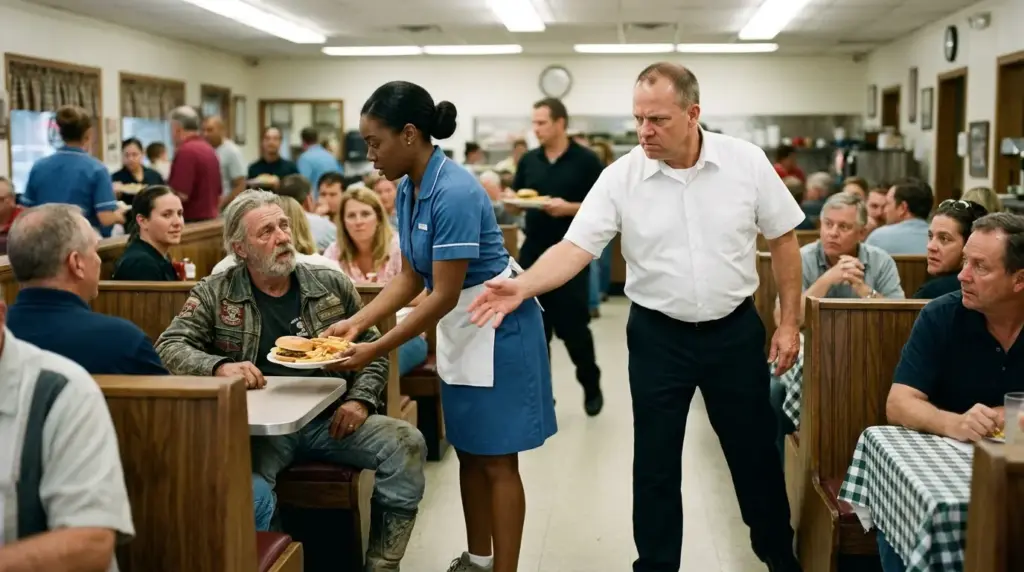
The kitchen bell never stopped ringing. Plates slid across the pass beneath heat lamps. Silverware clattered into plastic tubs. Children bounced against vinyl booths while their parents checked watches and waved for refills. Outside, a late-summer storm had left the highway slick and shining, and every few minutes another pair of headlights swept across the front windows before turning into the crowded gravel lot.
Maya Johnson moved through the chaos with three plates balanced along her left forearm and a coffee pot in her right hand. At twenty-six, she had learned to move through Maple Grove the way musicians move through songs they have played too many times to count. She knew which floorboard near the kitchen entrance caught the heel of her shoe, which customers tipped in coins, and which believed a waitress became invisible the moment she turned away. Four years earlier, she had taken the job because she needed it for one semester, but after both parents died within eight months of each other, she stayed to help her younger brother Jordan finish college.
She told Jordan she liked the hours. That was easier than telling him she was afraid that if she stopped moving, she would notice how tired she was. The only thing her mother had left that Maya carried every day was a small brass key on a red thread around her neck. It did not open anything she owned. Her mother had worn it for years and once told her, “Some keys open doors. Some remind you not to close one.”
Steve Collins hated almost everything that could not be measured by table turnover, average ticket size, or online reviews. He was forty-three, always clean-shaven, always wearing shirts one size too tight at the shoulders, and always standing where customers could see that someone important was in charge. He had purchased Maple Grove three years earlier and stripped away most of what made it feel local. He called it modernization. The regulars called it stripping the soul out of the place.
That Friday, Steve had been especially tense because a major charitable foundation was considering Maple Grove for a three-year meal-service contract worth more than two million dollars. The partnership would provide catered dinners, boxed lunches, and community meal vouchers for veterans, displaced workers, and families in temporary housing. “Tonight matters,” Steve had told the staff before opening. “We don’t know who might come through. Keep the place looking respectable.” Maya had almost asked what respectable meant, but she did not need to.
Just before sunset, the front door opened. The man who entered did not look like anybody Steve wanted photographed near his front window. He was older, maybe sixty-five or seventy, with a full gray beard and deeply weathered skin. Rain had darkened the shoulders of his worn leather motorcycle jacket. His jeans were faded at the knees, his boots were dusty beneath the water stains, and his right hand trembled slightly as he removed one black glove.
He carried no luggage, only a battered helmet tucked under one arm. The hostess, Ellie, looked toward Steve before speaking. Steve had already seen him. The older man did not notice the hesitation and gave Ellie a tired smile. “Evening. Table for one, if you’ve got it.”
“We’re pretty full tonight,” Steve said, stepping over. The man looked past him at three empty booths. “I can wait.” Steve’s jaw tightened. “Could be a while.” Maya saw the exchange while setting down a milkshake, and she saw something else: the biker’s left hand was pressed against his ribs, not dramatically, just the way someone hides pain from strangers.
“Booth nine just opened,” Maya called. Steve turned sharply. Maya took the menus from Ellie’s station and walked toward the biker. “This way, sir.”
Booth nine faced the rain-streaked front window. The man lowered himself slowly onto the vinyl seat and placed his helmet beside him. Up close, Maya saw fine cuts along his knuckles and a yellowing bruise beneath one eye. “Coffee?” she asked. “Water first. Coffee after I convince my hands they belong to me again.”
“Long ride?” she asked. “Longer than planned.” She set down a menu. “What’s good?” “Depends. Do you want what sells or what’s actually good?” One corner of his mouth lifted. “What’s actually good.” “Meatloaf. Mashed potatoes. Apple pie if Earl hasn’t burned the last one.”
“I’ll trust you.” “I wouldn’t. I work here.” He laughed quietly.
Maya filled his water glass and walked toward the kitchen, but Steve intercepted her halfway. “What are you doing?” “Taking an order.” “I told Ellie we were full.” “We’re not.” Steve leaned closer. “People like that never spend. He’ll take up a booth for an hour, order coffee, and leave three quarters on the table. We’ve got families waiting.”
“Nobody’s waiting.” Steve’s eyes hardened. “The point is I run this restaurant. Tell him the kitchen is closing early and get him out.” Maya felt the small brass key under her shirt. Some keys remind you not to close one. “My section,” she said quietly. “My table.”
“That wasn’t a request.” Maya held his gaze for a second, then walked away. She rang in meatloaf, mashed potatoes, green beans, and coffee.
At booth nine, the biker lifted the water glass again. “Manager doesn’t like motorcycles?” he asked. “He likes motorcycles fine if the rider owns a dealership.” The man studied her. “You always say things like that?” “Only when I’m trying to stay employed.” He smiled, but his eyes stayed tired.
“My name’s James.” “Maya.” He looked at her name tag. “I cheated.” “I figured.”





