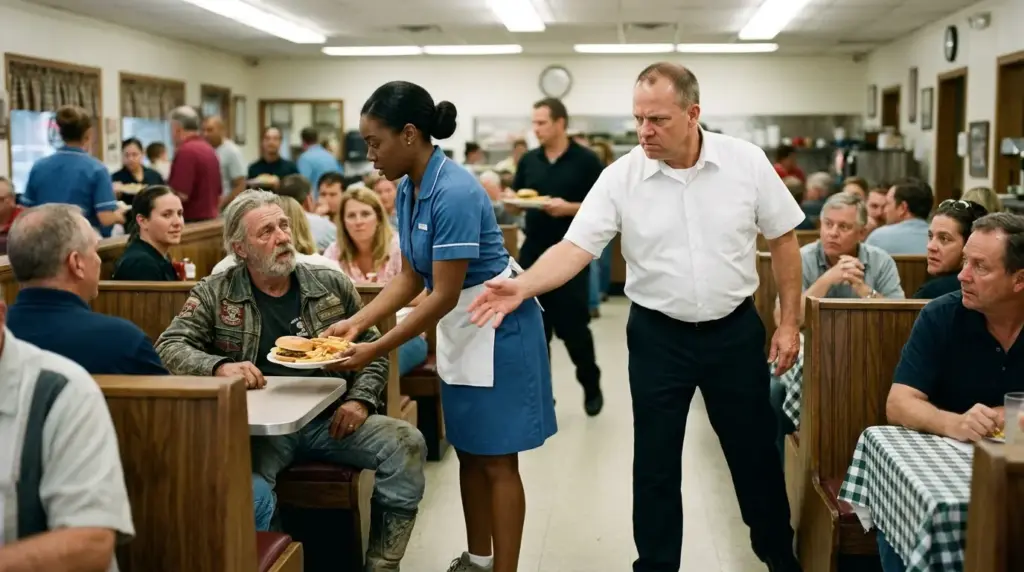
Jordan called while she was making coffee. “You got fired?” Maya closed her eyes. News traveled quickly in small towns. “Who told you?” “Mrs. Patel’s daughter posted the whole thing online.” “What whole thing?” “A video.”
Apparently three customers had recorded the confrontation. One clip already had more than eighty thousand views. Maya did not care. Views did not pay rent. “I’m coming home,” Jordan said. “No.” “Maya—” “You have exams Monday.”
“You lost your job because you’re paying for me to stay in school.” “I lost my job because Steve is an idiot.” “That’s not better.” “It is to me.” Jordan was quiet. “You always do this.” “Do what?” “Act like helping everybody doesn’t cost you.”
Before she could answer, someone knocked at the apartment door. A woman in a navy suit stood outside holding a folder. Behind her, parked along the curb, were two black SUVs.
“Ms. Johnson?” “Yes.” “My name is Rebecca Hall. I’m general counsel for the Walker Foundation. Mr. Walker would like to speak with you.”
An hour later, Maya sat in a conference room inside the Walker Foundation’s regional office. James Walker stood at the window wearing jeans and a blue button-down shirt, no leather jacket in sight. A fresh bandage crossed his left hand. He turned when she entered. “You came.” “You sent a lawyer.”
James gestured to a chair. Maya sat. On the table between them lay a folder. She immediately disliked it. Folders changed lives. Medical folders. Tuition folders. Final paycheck folders.
James sat across from her. “I owe you an apology.” “For what?” “You lost your job because of me.” “No. I lost my job because of Steve.” James studied her. “You defend people quickly.” “When they deserve it.” “What about yourself?” Maya looked away.
He slid the folder toward her. The first page described the Walker Foundation’s Community Table Initiative, a new program combining free meal access, job placement, cooking apprenticeships, and emergency food vouchers across six counties. The second page described a position: Community Operations Coordinator. The salary was nearly twice what Maya earned at Maple Grove.
She closed the folder. “No.” James blinked. “No?” “I can’t take this.” “Why?” “Because I gave you meatloaf.” “You think I’m paying you for dinner?” “I think you met me yesterday.”
James smiled. “Good.” Maya frowned. “Good?” “If you had accepted immediately, I would have worried.” He reached for another folder.
“I had my team look at you.” “That sounds illegal.” “It was all public.” “That sounds only slightly better.” James opened the file. “You organized free breakfast vouchers through your church after the Birch Street apartment fire. You coordinated meal deliveries when the school kitchen closed during the flood. You trained six new servers at Maple Grove. You paid your brother’s tuition while keeping your own bills current.”
“That is none of your business.” “No,” James said. “But it tells me you understand responsibility.” Maya’s face tightened. James saw it and closed the folder.
“My wife’s name was Ruth.” The change in subject caught Maya off guard. “She started the first Walker meal program out of a church basement. I gave her money. She gave people dignity. There is a difference.”
James looked down at his bandaged hand. “When she died, I expanded the foundation because expansion felt like grief with paperwork. Bigger budgets. More buildings. More partnerships. Yesterday, before I walked into that diner, I had spent three hours arguing with my board about cost per meal. Then I wrecked my motorcycle in the rain because I was angry.”
“That part seems less inspirational.” “It was stupid.” “Very.” James smiled faintly. “I left the hospital before the driver arrived. I rode until I saw Maple Grove.”
His expression darkened. “The truth is, Steve didn’t surprise me.” Maya frowned. “What do you mean?” James opened his wallet and removed an old photograph.
It showed a woman behind a diner counter, maybe thirty years earlier. She had dark hair pinned back, tired eyes, and a smile Maya recognized instantly even though she had never seen the woman before. James turned the photograph around. On the back, handwritten in blue ink, were the words: Maple Grove, 1989.
“My wife worked there.” Maya stared. “Ruth?” “For eight months.” James looked toward the window. “She was broke. Newly divorced. Raising her son. Maple Grove’s original owner, Mr. Finley, let her eat one meal a shift and take home leftovers. He never wrote it down because he said writing kindness down made some people feel like debtors.”
Maya felt the brass key against her chest. James continued. “Years later, when Ruth and I had money, we funded our first shelter kitchen because she remembered what it felt like when someone fed her without making her feel small.”
“So Maple Grove was personal.” “Yes.” “And Steve ruined it.” “No,” James said. “Steve showed me it had already changed.”
That sentence stayed with her.
James pushed the job folder back toward her. “I don’t want to hire you because you served me. I want to hire you because when your livelihood was threatened, you still understood what that place was supposed to be.”
Maya looked at the salary again, then at the responsibilities, then one line near the bottom. Program launch location: pending acquisition.
“What does that mean?” James’s face changed slightly. “That depends.” “On what?” “On whether Maple Grove survives.”
James explained that Steve did not own the building. He owned the business. The property belonged to an older woman named Evelyn Finley, daughter of the diner’s original owner. Steve had a lease with an option to buy, but the option depended on maintaining certain community-service commitments written into the original agreement. James’s foundation lawyers had discovered that Steve had quietly eliminated the veterans’ discount, canceled a monthly free-breakfast program, and violated employment clauses tied to the lease.
The diner was not merely at risk of losing a charity contract. Steve could lose the diner itself.





