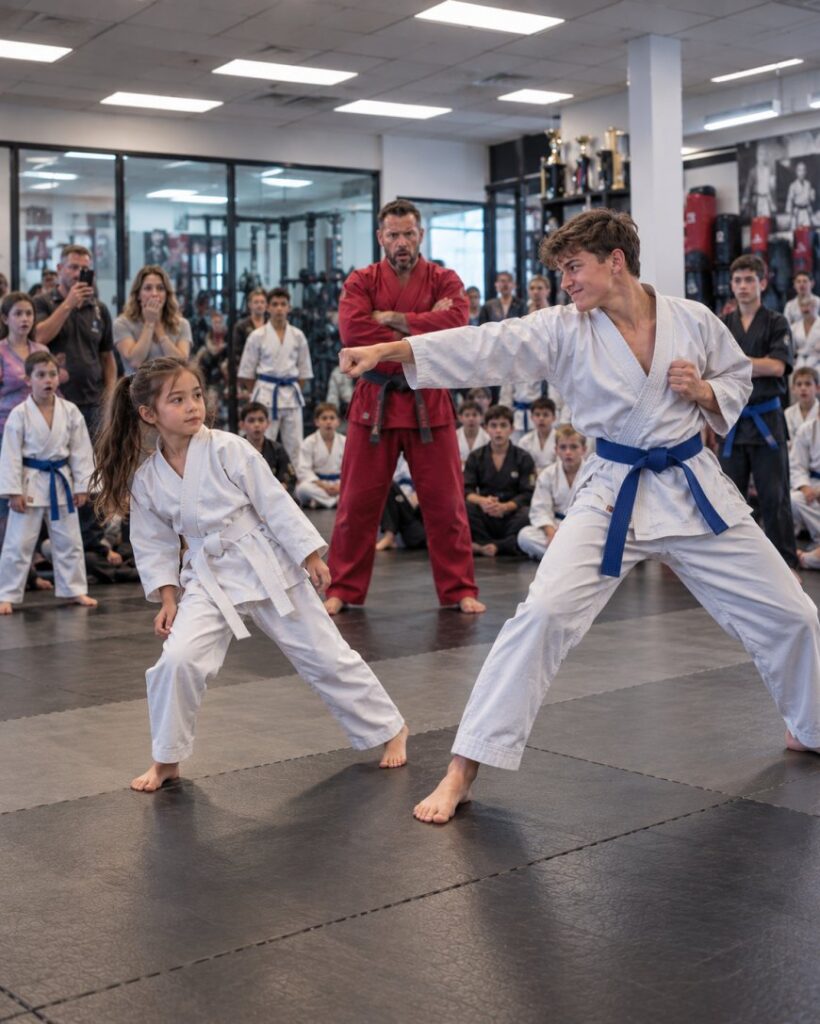
Ellie stood beside me at the edge of the mat, her gi crisp and white, her father’s black belt tied securely around her waist. She looked small—smaller than she had seemed in the dojo, where she had claimed her corner with quiet authority. Here, surrounded by older, taller, louder competitors, she looked like what she was: a ten-year-old girl about to face opponents twice her size.
But I saw the way she stood. Feet slightly apart, weight balanced, hands relaxed at her sides. She wasn’t shrinking. She was waiting.
Riker appeared beside us, his expression unreadable.
“How are you feeling?” he asked Ellie.
She looked up at him. “Ready.”
He nodded. “Good. Remember what we talked about.”
She nodded back. I didn’t ask what they had discussed. Some things were between student and teacher.
The first match was called. Ellie’s name echoed over the loudspeaker, and she walked onto the mat without hesitation.
Her opponent was a girl about her age—eleven, maybe twelve—with a brown belt and a confident smile. She was taller than Ellie by several inches, with the lean, athletic build of someone who had been training since she could walk.
The referee called the match to order. The girls bowed to each other. The bell rang.
The girl came fast—faster than Ellie’s previous opponents, with a flurry of strikes designed to overwhelm and intimidate. Ellie didn’t block. She didn’t strike back. She simply moved, flowing around the girl’s attacks like water around a stone.
The crowd murmured. I heard someone nearby whisper, “What is she doing? She’s not even fighting back.”
But I knew what she was doing. She was listening. Finding the rhythm.
The girl grew frustrated, her attacks growing wilder, less controlled. And then—in a moment that seemed to happen in slow motion—she overextended herself, lunging forward with a punch that left her entire right side exposed.
Ellie didn’t take advantage. She didn’t strike. She simply stepped to the side, planted her foot, and waited.
The girl stumbled, caught herself, and turned to face Ellie with a mixture of confusion and anger.
“What are you doing?” she demanded. “Fight me!”
Ellie looked at her calmly. “I am.”
The girl lunged again. This time, Ellie moved even more efficiently, slipping past the attack and ending up behind her opponent. She could have taken her down. She could have ended the match right there.
But she didn’t.
She stepped back, gave the girl space, and waited.
The crowd was silent now. Even the coaches were watching with rapt attention.
The girl turned slowly, her face flushed with embarrassment and frustration. She looked at Ellie—really looked at her—and something in her expression shifted.
She saw what everyone else was beginning to see. Not a weak little girl. Not an easy opponent. Something else entirely.
The match continued for another three minutes. The girl attacked, and Ellie evaded. The girl grew tired, and Ellie remained calm. The girl made mistakes, and Ellie didn’t punish her for them.
When the final bell rang, there was no clear winner. No points had been scored. No contact had been made.
But as the girls bowed to each other, I saw the change in the other girl’s eyes. Respect. Genuine, earned respect.
“Good match,” Ellie said softly.
The girl nodded. “Yeah. Good match.”
She walked off the mat with her head high—not because she had won, but because she had learned something. Something she would carry with her for the rest of her life.
Riker appeared beside me again.
“She’s not trying to win,” he said quietly, echoing the words he had spoken weeks ago. “She’s teaching.”
I nodded. “That’s what he taught her.”
“To teach?”
“To show people what they’re capable of. To help them see their own potential.”
Riker was quiet for a long moment.
“I’ve been training students for fourteen years,” he said finally. “I’ve taught them how to punch and kick and block. But I never taught them that.”
“Maybe that’s because you didn’t know it yourself,” I said gently.
He looked at me, and I saw something in his eyes that I hadn’t seen before. Not just respect. Not just admiration.
Understanding.
“You’re right,” he said. “I didn’t.”
Ellie competed in three more matches that day. She didn’t win any of them—at least, not in the traditional sense. No points. No pins. No submissions.
But by the end of the tournament, she had become something of a legend. Whispers followed her through the gymnasium. Parents pointed her out to their children. Coaches approached Riker to ask about the girl with the strange style and the old black belt.
“She’s not fighting to win,” one coach said, shaking his head. “She’s fighting to… I don’t even know what she’s doing.”
“She’s fighting to understand,” Riker replied. “And to help her opponents understand themselves.”
The coach looked at him like he had grown a second head. “That’s not how tournaments work.”
Riker smiled slightly. “Maybe it should be.”
After the tournament, we went to a small diner on the edge of town. Ellie sat across from me in a booth, her father’s black belt folded neatly beside her, a chocolate milkshake in front of her that she was drinking with the same careful precision she applied to everything else.
Riker sat beside her, nursing a cup of coffee. He had been quiet since we left the gymnasium, lost in thought.
“You didn’t win,” he said finally.
Ellie looked up at him. “I know.”
“But you learned something.”
She nodded. “I learned that winning isn’t the point.”
Riker raised an eyebrow. “What is the point?”
She was quiet for a moment, thinking.
“The point is… to be present. To be aware. To see what’s really happening instead of what you think is happening.”
She paused, stirring her milkshake with her straw.





