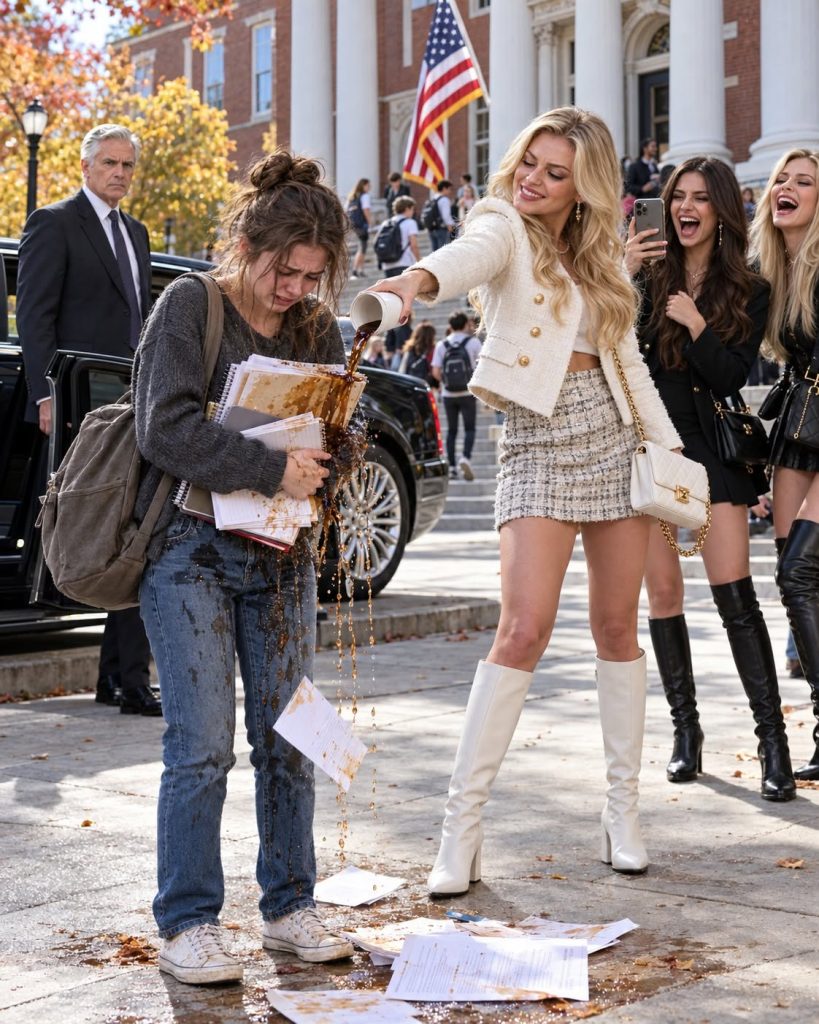
The wet black dirt of the courtyard lawn ground deep into the fibers of the paper, tearing the title leaf diagonally across the seal.
“Whoops,” Madison murmured, her phone never wavering. “Look at that. Littering on the historic quad. That’s probably a code violation, Sophia. You should ask your financial aid counselor if they cover street-cleaning fines.”
A few yards away, Ethan stepped out from the crowd near the library steps. His worn canvas barn jacket was damp from the mist, his dark hair tucked behind his ears. He had spent the last two weeks helping Sophia decipher the nineteenth-century shipping manifests in the microfiche room, working in the cold basement until their fingers were gray with dust.
“Cole!” Ethan’s voice cut through the courtyard with the crack of a snapped spar. “Take your foot off that paper.”
Madison didn’t move. She tilted her head, her smile widening into something predatory. “Or what, Ethan? Your dad going to write a stern letter to the alumni magazine? Tell him to finish painting our pool house first.”
Sophia sank to her knees. She didn’t look at Madison’s shoe. She didn’t look at the students who had pulled out their own phones, their faces illuminated by the pale blue glare of screens as they recorded the spectacle. With trembling, icy fingers, she reached out to gather the torn leaves. The soil had already turned the bottom edge into brown pulp; the ink was feathering into unreadable blue-black stains.
“Don’t touch them,” Sophia whispered, her voice so thin it barely cleared the grass.
“What was that?” Madison leaned down, thrusting the phone lens four inches from Sophia’s nose. “Speak up, Vane. Tell the followers how it feels to know you don’t belong here. Tell them—”
A sound interrupted her.
It was not a human voice. It was the low, resonant thrum of a heavy, twelve-cylinder engine, idling with such immense, vibration-free mass that the water in the fountain basin began to form concentric, shivering rings.
The courtyard seemed to tilt.
Down the restricted north carriage drive—a cobblestone lane protected by hydraulic bollards that had been lowered exclusively for heads of state and the governor’s motorcade—a vehicle was approaching.
It did not move at the speed of campus security vans or delivery trucks. It glided. A custom long-wheelbase Mercedes-Maybach S680 Pullman, armor-plated to VR10 ballistic specification, its exterior finished not in standard metallic gloss, but in an obsidian black so dense it seemed to swallow the morning light. The glass was three inches thick, dead-black, reflecting neither the brick of the libraries nor the pale faces of the undergraduates who stood petrified on the sidewalks.
A junior from the rowing team stepped backward off the curb, his foot landing in an ornamental flowerbed, his mouth hanging open.
The Maybach did not park at the visitor meter. It pulled squarely across the circular drive in front of Founders Hall, mounting the decorative limestone pavers with the heavy, hydraulic indifference of an armored personnel carrier.
The engine did not shut off. It remained in a muffled, subterranean purr.
The front passenger door opened with a heavy, pressurized thunk. A security operative in a charcoal tactical suit, wearing a clear acoustic earpiece and gloves of thin, untextured deerskin, stepped onto the gravel. His eyes swept the courtyard in three distinct, calculated sweeps—left, high-ground library portico, right perimeter—before he moved to the rear door.
He didn’t use the handle immediately. He waited four seconds, his eyes fixed on a small display embedded in the exterior pillar.
Then, with a smooth, mechanical arc, he drew the heavy rear door open.
Richard Bennett emerged.
He was sixty-two years old, standing six feet two inches of unyielding, granite-hewn posture that made the four-thousand-dollar bespoke Anderson & Sheppard suit hang from his frame like plate armor. His hair was the color of unpolished silver, cropped short, accentuating the razor-straight line of his jaw and a nose that looked as though it had been broken in a boarding-school boxing ring forty years ago and never fully set. His tie was dark silk, pinned with an unadorned platinum bar.
He did not look at the buildings. He did not look at the historic copper domes.
He stepped onto the wet asphalt, paused, and adjusted the cuff of his left sleeve. The gold-rimmed face of a Patek Philippe Grandmaster Chime caught the gray November light—a timepiece that was not merely an extravagance, but an asset class unto itself.
Across the lawn, Madison Cole’s laughter did not simply stop; it was severed.
The phone in her hand drooped three inches. Her shoulders stiffened until the seam of her cream blazer pulled tight across her shoulder blades. Her face, which had been flushed with the pink heat of triumph, drained so rapidly of color that her cosmetic bronzer looked like two strokes of dry mud across her cheekbones.
She knew him.
Her father, Marcus Cole, had spent eighteen months begging for an audience at the Bennett Tower in New York, hoping to refinance a five-hundred-million-dollar maritime terminal lease in Long Beach. She had heard his name spoken in her dining room in Greenwich with the hushed, terrified reverence usually reserved for terminal diagnoses and the federal reserve board.
Richard Bennett.
The man who had broken three sovereign shipping cartels before he was forty. The man whose signature on an equity purchase agreement could trigger a trading halt on three continents.
Behind him, two more men stepped from a chase SUV that had silently glided into position fifty yards behind the Maybach: analysts carrying leather briefcases, their faces cold, professional, and vacant of youth.
“Olivia,” Ethan murmured, his eyes shifting from the silver-haired titan to Sophia, who was still kneeling in the mud with the torn paper in her lap. His voice had lost all its casual weight, replaced by a strange, dangerous awe. “Look at the crest on the license plate.”





