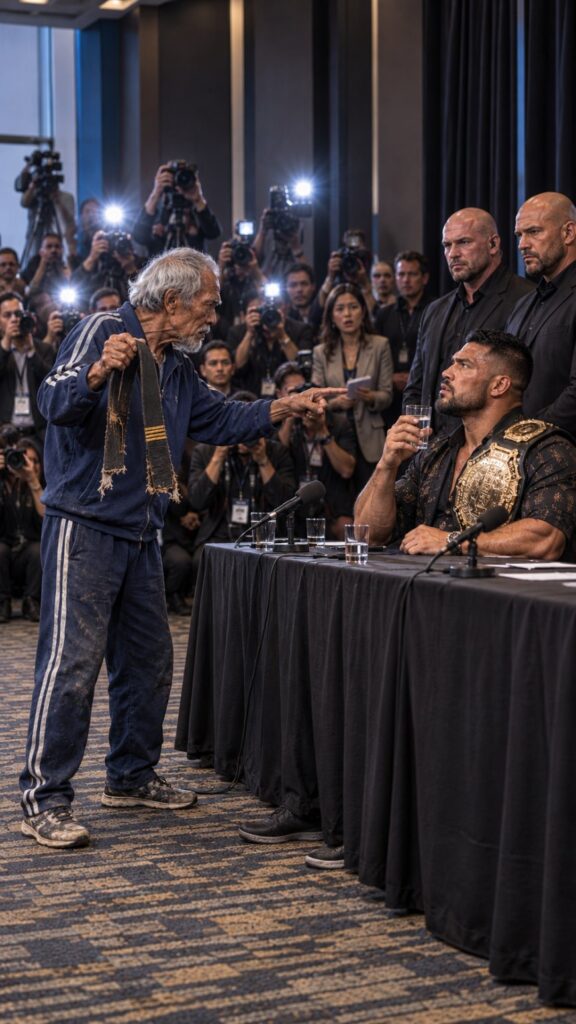
A modest gathering was already assembling. There were a handful of local sports journalists from regional newspapers, two independent camera crews setting up their tripods in the back, and about thirty elderly members of the local martial arts community—men and women who had known me and Julian for decades, who knew the whispered rumors of what had really happened ten years ago.
I wheeled Julian up the small wooden ramp and positioned him directly in the center of the low stage. I stood beside him in my only clean, ironed suit—a grey wool two-piece I usually reserved for funerals. I rested my calloused hand protectively on the rubber handle of his wheelchair.
On a simple wooden podium at the front of the stage, directly under the microphone, I placed the proof.
There sat the two thick, leather-bound notebooks. Their edges were worn, yellowed, and fraying from years of use. The covers were cracked. They were the undeniable, tangible proof of my son’s genius. Julian was here to publicly donate them to the regional sports archives, legally transferring the historical copyright of the combat system to the public domain, ensuring his name would be forever attached to the foundational mathematics of the style before he passed away.
The journalists murmured quietly among themselves, sipping coffee from styrofoam cups. None of them expected a major headline. They thought they were covering a sweet, mildly tragic local interest story about a dying martial arts instructor donating some old journals.
The wall clock ticked loudly. 7:55 AM.
I looked down at Julian. His eyes were focused on the heavy double doors at the back of the auditorium.
“Do you think he’ll come?” Julian rasped, his voice barely above a whisper.
“I don’t know,” I answered honestly, my jaw tight. “I gave him the choice. The rest is up to whatever is left of his conscience.”
At precisely 8:00 AM, the heavy double doors at the back of the auditorium clicked loudly. The metal latch echoed like a gunshot in the quiet room.
The doors swung open, letting in a draft of cold morning air.
A quiet, collective gasp rippled through the journalists. The cameramen froze, their coffee cups hovering halfway to their mouths.
Marcus Vance walked into the room.
He looked nothing like the polished, arrogant superstar who had sat in front of the world’s media the night before. He wasn’t wearing his custom-tailored suit. He wasn’t wearing his fifty-thousand-dollar watch, his diamond earrings, or his athletic sponsor gear. He looked completely stripped down.
He was dressed in a plain, faded black hooded sweatshirt and a pair of worn grey sweatpants. His massive shoulders were slumped forward. His face was drawn, his eyes heavily bloodshot and shadowed from a completely sleepless night.
The media members instantly snapped out of their shock. Two dozen camera lenses rapidly pivoted toward him, the mechanical focus rings whirring frantically as they scrambled to capture the undisputed heavyweight champion of the world walking into a municipal hospital auditorium unannounced.
The journalists began muttering to one another in panicked, excited whispers, pointing their digital audio recorders toward the aisle. They instantly sensed that an unscripted, highly dangerous confrontation was about to unfold. They fully expected Marcus’s high-priced legal team to storm in right behind him with cease-and-desist orders. They expected an aggressive, corporate attempt to silence a dying man to protect a multi-million-dollar athletic brand.
But no lawyers followed Marcus through the doors. He was completely alone.
Marcus walked slowly down the center aisle. His heavy, deliberate footsteps echoed loudly off the shiny linoleum floor, cutting through the frantic clicking of camera shutters. He didn’t look left or right. He didn’t acknowledge the media. His deeply conflicted eyes were locked entirely on the frail figure sitting in the wheelchair on the stage.
He stopped directly at the base of the wooden platform, staring up at Julian.
For ten long, agonizing seconds, neither man uttered a single word. The tension in the room was so thick it felt like it was pulling the oxygen from my lungs. The room was so still that the subtle, rhythmic hum of the overhead fluorescent lighting sounded deafening. I tightened my grip on the handle of the wheelchair, ready to step between them if Marcus showed even a hint of aggression.
But there was no anger in Marcus’s eyes. There was only a profound, devastating sorrow.
“You actually came,” Julian said. His voice was faint, raspy from the oxygen tubes, but it carried a deep, unwavering clarity that seemed to pierce right through Marcus’s chest.
Marcus swallowed hard, his throat bobbing. “I had to,” he replied quietly.
Marcus took a step up onto the wooden platform. The journalists leaned forward so far they were almost falling out of their metal chairs. The camera operators pushed closer, desperate to catch every syllable.
Marcus walked straight past the cluster of microphones set up for the press conference. He didn’t look out at the audience. He walked directly to the simple wooden podium. He reached out his thick, heavily scarred right hand—the same hand that had knocked out the champion of the world thirty-six hours ago—and gently touched the cracked leather cover of the top notebook.
His fingers traced the frayed edges with a startling reverence. Slowly, he opened the heavy cover and turned to the very first page.
There, drawn in precise, faded blue ink, was a detailed mechanical diagram of the exact defensive pivot and counter-hook Marcus had executed to win his title. It was a masterpiece of kinetic engineering, charting the exact weight transfer required to slip a strike and deliver a knockout blow using the opponent’s own momentum. Beneath the hand-drawn illustration was Julian’s neat, meticulous handwriting, dated twelve years ago to the very month.
At the bottom of the page was the philosophical note Julian had written: The counter is never a strike born of anger. It is simply a precise answer to an unfinished physical question.





