PART 5: The Life I Chose
“Yes,” I said.
Andrew stared at me.
Julia drew the folder toward her and explained the immediate arrangements in a quiet voice.
I listened carefully because I wanted to understand the life I was choosing, including the difficult parts.
There would be conversations about housing, expenses, and the baby.
There would be documents to read and decisions that could not be settled in a single afternoon.
Leaving did not make those things disappear.
It made them possible to discuss without pretending our marriage was still intact.
Andrew rubbed both hands over his face.
“I thought we’d have more time.”
I looked at the man across from me and felt the strange, painful tenderness of knowing someone even after trust had gone.
“We did have time.”
He nodded once.
This time, he did not argue.
When we left the office, he walked beside me as far as the elevator.
For years, I had followed his pace through hotel lobbies and crowded rooms.
That afternoon, he slowed to mine.
The small courtesy hurt.
It was such an easy thing to have done sooner.
At the elevator, he asked whether there was anything I needed from the penthouse.
“My clothes and the things in the bathroom.”
“I can bring them.”
“Let’s arrange it through Julia for now.”
His jaw tightened, but he agreed.
Then he looked at my stomach.
“Will you tell me about appointments?”
“We’ll make a plan.”
He swallowed.
I wanted him to understand that ending our marriage did not erase the child we were expecting.
I also needed him to understand that the baby could not become a passage back into decisions I had already made.
Both truths would require patience.
Neither could be solved beside an elevator.
When the doors opened, I stepped inside.
Andrew stayed in the hallway.
This time, he watched me leave without telling me to come back.
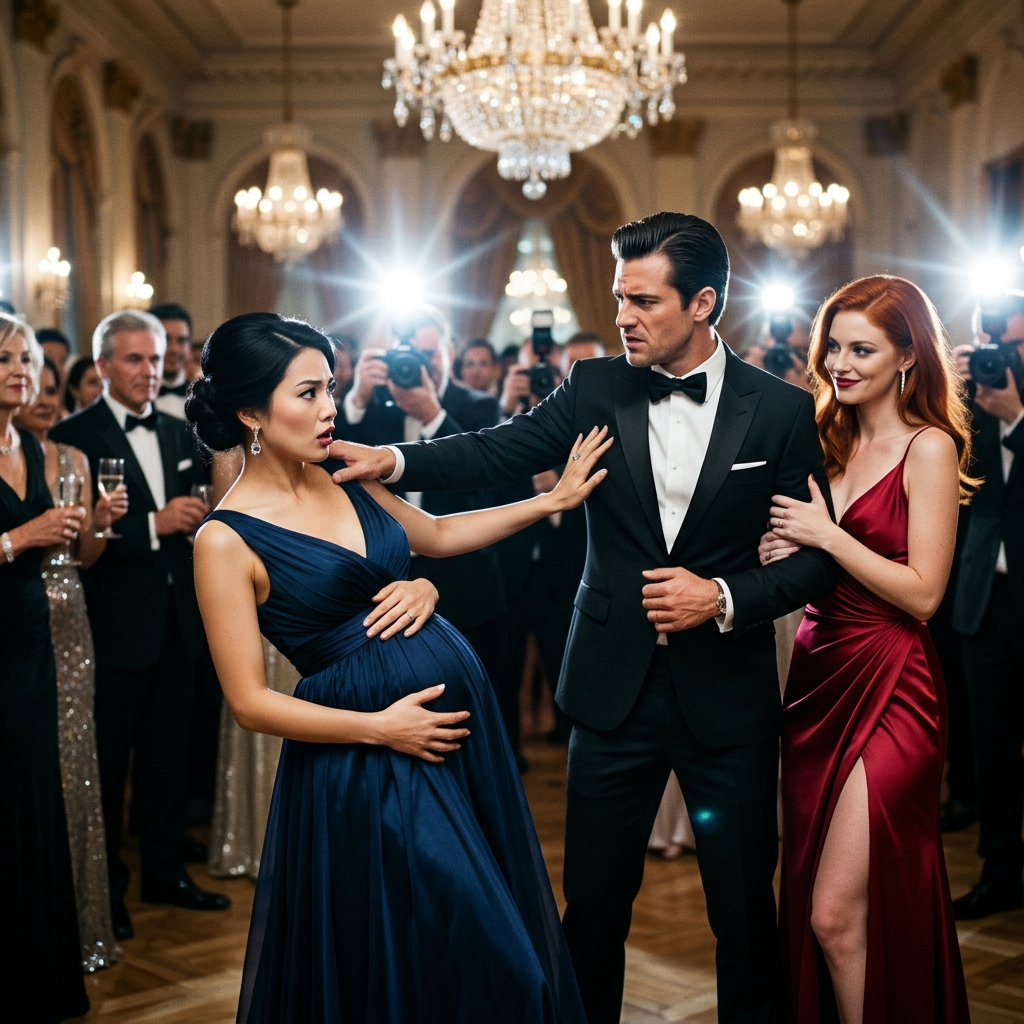
The weeks that followed were quieter than the ballroom and harder in ways no photograph could capture.
I cried while unpacking socks.
I cried when a grocery order contained the tea Andrew liked because I had added it without thinking.
Some mornings, I reached for my phone to tell him something ordinary and remembered that ordinary things had to find a new place to go.
I did not become fearless.
I became more willing to make a decision while afraid.
I found an apartment I could manage.
I chose a chair comfortable enough for late nights and a crib that arrived before anyone had approved a design.
The nursery took shape slowly.
There were no dramatic purchases, only small things accumulating until the room looked as though someone was expected.
Andrew attended appointments when we agreed he would.
At first, every meeting carried the ache of what we had failed to become.
Over time, we learned to discuss the baby without reopening the marriage.
He apologized again, once in writing.
The letter contained no request for an answer.
I kept it because accountability mattered, even when it arrived too late to restore what had been lost.
I did not confuse keeping it with returning.
People eventually stopped asking about the gala.
Another scandal occupied the rooms where ours had briefly become entertainment.
I was relieved to discover how little the opinions of those three hundred people mattered once I no longer organized my life around surviving them.
Lila did not contact me.
I did not contact her.
Whatever she had believed she was winning beneath those chandeliers had never been mine to hand over.
Andrew’s choices belonged to him.
My next choices belonged to me.
The divorce took longer than the night that began it.
There were revisions, uncomfortable conversations, and days when I resented every page.
But the documents eventually became ordinary, too.
They stopped looking like evidence that I had failed.
They became the record of a decision I had followed through.
Our child arrived on a clear summer morning.
I will always remember the astonishing weight of that small body against my chest.
For months, I had apologized to the baby beneath my hands.
Holding my child at last, I understood that I had been promising something as much as regretting something.
I could not promise a life without disappointment.
I could promise a home where love would not require someone to become smaller to keep it.
Andrew came when we had agreed he could.
He stood beside the bed and cried quietly before asking whether he could hold the baby.
I said yes.
There was grief in that room, but there was room for tenderness, too.
I no longer needed one feeling to cancel the other.
Months later, while clearing old messages, I found the text that had frightened me in the car.
Mrs.
Weston, your jet is ready.
I remembered reading it three times beneath the shifting streetlights.
The explanation had turned out to be simple.
A lawyer had followed up on a practical request.
A coordinator had written a careless message.
An available plane had become, for a few minutes, a mystery large enough to distract me from the terrifying fact that I had nowhere I wanted to go.
No stranger had known my future.
No unseen hand had decided where I belonged.
There had been an option waiting, and I had been allowed to refuse it.
That was the part I understood differently now.
I deleted the message and set the phone beside the chair.
From the crib came a soft, impatient sound.
I crossed the room, lifted my baby, and felt a small hand close around my finger.
Outside the window, evening settled over a city that no longer seemed to belong entirely to my husband.
I had once thought the strangest part of leaving was the plane waiting for me.
It was discovering, after so many years of being told where to stand, that I could choose where to go.





