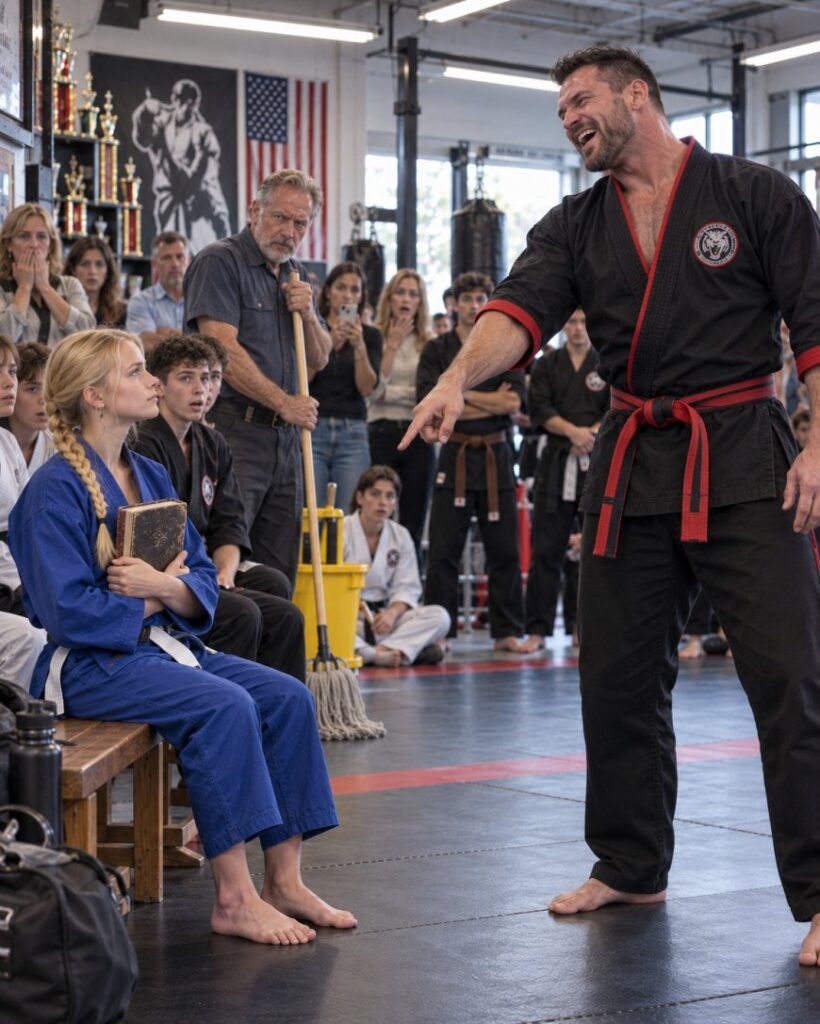
Elise stood at the front of the room, small but commanding in her blue GI.
“Today,” she said, her voice calm and clear, “we’re going to learn something different. Not how to fight. Not how to win. How to be strong.”
The children stared at her. They were used to Marcus’s loud commands, his sharp corrections, his public humiliations. This was something else entirely.
“Strength isn’t about overpowering someone,” Elise continued. “It’s about knowing yourself. Knowing your limits. Knowing when to act and when to be still. Today, we’re going to practice being still.”
She led them through simple breathing exercises. Then simple movements. Then simple partner drills where the goal wasn’t to win, but to move together.
David, who had been tense and withdrawn, began to relax. Mia, who had been trembling, began to smile. Jordan and Taylor, who had been skeptical, began to lean in.
By the end of the session, something had shifted. Not just in the children, but in the room itself.
“What did you learn today?” Elise asked.
David raised his hand hesitantly. “That… that it’s okay to be slow. As long as you’re trying.”
Mia nodded. “That mistakes are part of learning.”
Taylor, the older sibling, spoke up. “That you don’t have to be the best to be good.”
Elise smiled. It was a small smile, but it lit up her whole face.
“That’s right,” she said. “That’s exactly right.”
The program grew.
Word spread. Parents talked to other parents. Children talked to other children. Within a month, we had twenty students. Within two months, we had forty. Mr. Keller gave us more space, more time, more resources.
Marcus, still suspended, started showing up to the Saturday sessions. Not to teach — he knew better than that — but to watch. To learn. To help set up mats and clean up afterward.
At first, the children were wary of him. David flinched when Marcus walked past. Mia hid behind her father. But Marcus didn’t push. He didn’t try to explain or apologize. He just worked. Quietly. Humbly. Consistently.
After one session, I found him sitting alone on the bench, his head in his hands.
“Are you okay?” I asked.
He looked up. His eyes were red. “I don’t know how to do this,” he said. “I don’t know how to teach without… without being that person.”
I sat down beside him. “Maybe you don’t teach. Maybe you learn.”
He was quiet for a long moment. Then he nodded slowly. “Maybe.”
The community festival came six months later.
Elise’s program was invited to perform. Not as a demonstration of skill, but as a demonstration of philosophy. The children — now numbering over sixty — filed onto the stage in neat blue GIs, their faces calm, their movements precise.
Elise stood at the front, her braid hanging over one shoulder, her blue eyes scanning the crowd. I watched from the side, my heart swelling with pride.
“We’re not going to show you how to fight,” she announced. “We’re going to show you how to stand.”
The children moved through a series of forms. Slow. Deliberate. Controlled. Each movement carried the weight of years of training, but also the lightness of joy.
When they finished, the crowd erupted into applause.
Liam — Marcus’s former star student — stepped forward. He had changed over the months. The arrogance was gone, replaced by something quieter. Something more genuine.
“I used to think strength was about being better than everyone else,” he said into the microphone. “I used to think it was about winning. But I was wrong. Strength is about lifting others up. It’s about being part of something bigger than yourself. And I learned that from a twelve-year-old girl.”
He turned to Elise and bowed.
The crowd applauded louder.
I saw Marcus in the back of the audience, wiping his eyes. I saw Richard Carter standing apart from everyone else, his expression unreadable. I saw Mr. Price, the janitor, nodding slowly with a satisfied smile.
And I saw Elise, small and calm and radiant, accepting the applause not for herself, but for the children she had taught.
One year later, the gym had become something entirely different.
The youth program was now the heart of Iron Fist Academy. We had hired new instructors — all trained under Elise’s philosophy. We had scholarship programs for children who couldn’t afford classes. We had outreach programs in local schools.
Marcus had been reinstated, but not as the head instructor. He taught beginner classes now, under Elise’s supervision. He was patient. He was humble. He was still learning.
And Elise?
Elise was still twelve years old. She still read books in the corner. She still trained every day. She still carried her father’s legacy in every movement, every breath, every quiet act of discipline.
But she was no longer invisible.
Master Hannisado’s visit had changed things. The renowned instructor had spent a week observing the program, asking questions, taking notes. At the end of her visit, she had made an announcement that shocked everyone.
“I have trained students on four continents,” she said. “I have seen the best and the brightest. But I have never seen anything like this. The philosophy, the discipline, the compassion — it is a model for the world. And it was built by a child.”
She turned to Elise. “I would be honored to have you train with me. Not as a student, but as a partner. Together, we can spread this philosophy across the globe.”
Elise had bowed deeply. “Thank you, master. But I’m not ready to leave. These children — this community — they need me.”
Hannisado had smiled. “Then I will come to you. I will bring students from around the world to learn from you. And your influence will spread, not through ambition, but through example.”
I found Elise in the gym late one evening, long after everyone else had gone home.





