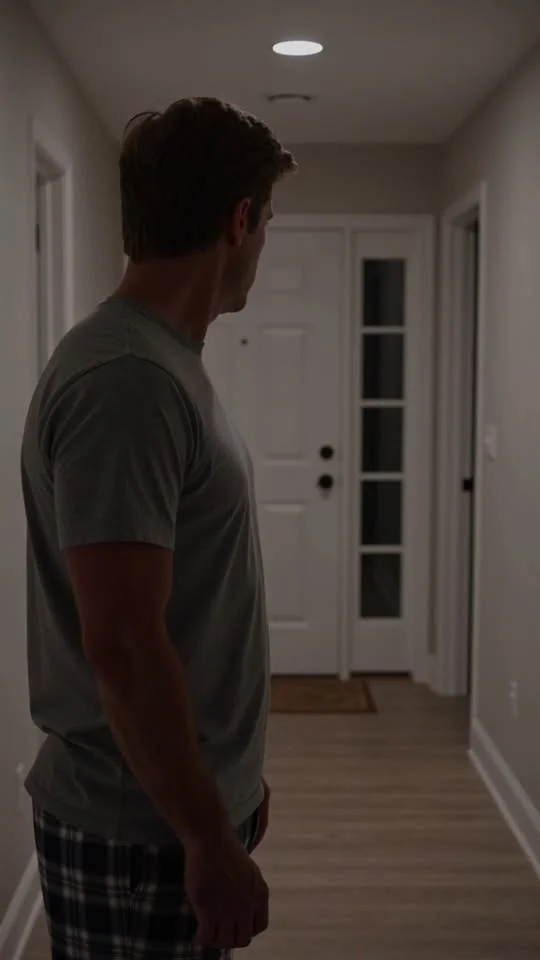
“A guy in a white utility van pulled onto the ramp right after the SUV left,” Lauren said. “He saw me shaking beside my car in a ripped dress with blood running down my leg. He didn’t ask questions—he just reached behind his seat, pulled a clean spare work shirt out of a canvas duffel, and handed it to me through the window so I could cover up. I told him I lived ten minutes away and just wanted to go home. He drove off, I drove straight here, and I was so terrified of bringing that phone inside that I left it under the seat.”
I sat completely still, letting every jagged piece of her story settle into place—until one tiny, sharp discrepancy snagged my attention like a splinter.
“Wait a second,” I murmured, my eyes dropping from Lauren’s face to the matte-black burner phone on the table. “Think carefully, Lauren. If the man in the gray coat gave you this phone to call him, why did it just ring with my name on the screen? And why did whoever is sitting outside our house text He is in the garage directly to a phone the gray-coated man gave you?”
Lauren blinked, her brow furrowing in sudden, sick realization. “I… I don’t know. When I shoved the key behind the seat, I didn’t look at the phone again.”
“Wait,” I said, standing up slowly and leaning closer to the white shirt draped over her shoulders. Under the dim amber glow of the stove hood, I noticed something I had missed in the mudroom—a faint, dark rectangular stitch mark above the left breast pocket where a rectangular company uniform patch had been hastily ripped away with a knife.
And protruding a quarter of an inch above the white pocket hem was the crisp, folded corner of a pale yellow paper slip.
“Lauren,” I said softly. “Check the pocket of that shirt.”
Chapter Three
Lauren’s fingers shook as she reached into the breast pocket of the oversized white Oxford and drew out a tightly folded yellow carbon-copy fuel receipt.
She smoothed it flat against the oak table beside the silver key fob. Scrawled across the back in thick, hurried blue ballpoint ink—the handwriting slightly jagged, as if written against a steering wheel in the dark—were four short lines:
HBR Annex. 418 West Mound St. Side dock door. Locker 14.Don’t touch the burner—Kessler’s guy cloned the SIM at the ramp.Your dad didn’t die of bad lungs, Ethan.Before 4:00 AM. —W.F.
A cold, electric jolt ran straight down my arms.
“The driver in the white utility van,” I whispered, staring at the jagged blue ink. “He wasn’t a random Good Samaritan, Lauren. He was working with the man in the gray coat—W.F. When Kessler’s guy blocked the ramp and grabbed your door handle, he didn’t get the key, so he slipped a SIM-cloner or swappedChapter One
Rain fell over Clintonville in a slow, relentless curtain, turning the brick curb along our street into dark, glistening glass.
I stood at the front living room window with a cold mug of tea in one hand and my phone in the other, watching the yellow cone of the streetlight across the road catch the silver slant of the drizzle. Our porch light burned steadily behind the frosted glass beside the front door—a quiet habit Lauren and I had kept since the week we bought this cramped 1940s Cape Cod six years ago. Whoever came home last clicked the switch off. It was a small, unspoken promise that someone inside was still awake.
The microwave clock in the kitchen behind me read 1:56 a.m.
My thumb hovered over our text thread. My last message had gone out at 10:14 p.m.: Still out with Megan and Tessa? Need a ride? No read receipt. No little dancing gray dots. Before that, at 8:30, she had sent a single cheerful line from the Italian place on High Street: Second round of wine. Tessa’s trying to talk us into going dancing after.
Lauren didn’t go dancing on a Thursday night. Lauren worked forty-five hours a week untangling insurance denials as a billing coordinator for Hawthorne Patient Services, and by nine o’clock on a weeknight she usually wanted nothing more than flannel pants and the heating pad on her lower back. Still, I had forced myself not to call. We trusted each other. That was the whole architecture of our marriage—no tracking apps, no jealous interrogations, no keeping score.
At 2:02 a.m., a pair of headlights swept across the wet hedges at the end of the driveway, swinging wide and fast.
I stepped back from the window, relief loosening the tight knot behind my sternum—until I heard the tires bite too hard into the gravel apron. The garage door groaned upward on its rusted tracks, and Lauren’s silver Honda pulled in crookedly, its right fender stopping barely two inches from the stack of firewood I kept along the drywall. The engine died, but the headlights stayed on for ten long seconds before clicking off.
I walked to the mudroom door and pulled it open just as she stepped up from the concrete floor of the garage.
The relief vanished instantly, replaced by a cold, hollow drop in my stomach.
Lauren was barefoot. Her black tights were shredded across the left knee, where a dark, glistening smear of blood and grit had dried against her pale skin. She wasn’t wearing the navy wrap dress she had left the house in—or rather, she was, except the torn hem of it barely peeked out beneath a massive, rumpled men’s white Oxford shirt buttoned hastily up to her collarbone, the cuffs hanging past her fingertips. Her mascara had bled into faint gray crescents beneath her eyes, and her chest rose and fell in shallow, jagged breaths.
“Lauren?” My voice came out barely above a whisper. “Jesus—what happened to you? Were you in an accident?”





