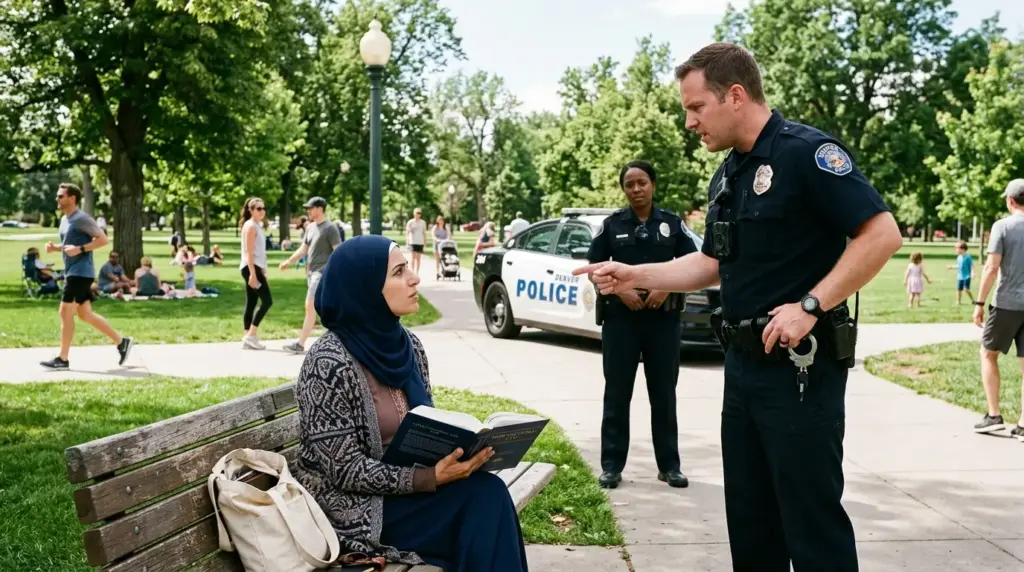
Aisha reached slowly into her bag.
Brandon’s hand moved to his weapon. “Slow,” he barked. “Real slow.”
“I’m reaching for my wallet,” Aisha said calmly. “Nothing else.”
She pulled out a leather wallet. Inside was her driver’s license, three credit cards, and a DOJ credential card that identified her as a federal investigator. She removed only the driver’s license and handed it to Brandon.
Brandon looked at it: Michigan license, name Aisha Rahman. The address was in Dearborn, Michigan, which Brandon probably knew had one of the largest Muslim populations in America. He studied it for a long moment, then handed it back.
“You’re a long way from Michigan,” he said. “What brings you to Denver?”
“I don’t have to answer that,” Aisha said. “You’ve seen my ID. I’ve provided what you asked for, though I shouldn’t have had to. Am I free to go?”
“Not until I’m satisfied,” Brandon said.
“Satisfied about what?” Aisha pressed. “What crime do you think I’ve committed?”
Brandon was breathing hard now. He knew he was on shaky ground. He knew he should walk away, but his pride wouldn’t let him. He’d committed to this stop, and backing down would feel like losing.
“You’re in a public park in an area that’s had security concerns,” Brandon said. “You’ve been here alone for a suspicious amount of time. Your behavior fits a pattern we’ve been told to watch for.”
“What pattern?” Aisha asked. “And told by whom?”
Brandon didn’t answer that. Because there was no pattern. There were no security concerns. There was nothing except a woman in a hijab sitting on a bench, and that was apparently enough for Brandon to see a threat.
“I’m going to need to search your bag,” Brandon said suddenly.
“Absolutely not,” Aisha replied immediately. “You have no probable cause for a search. You have no reasonable suspicion. You have nothing except a phone call from someone who apparently thinks my existence in a park is suspicious. You’re not searching anything.”
“If you refuse a search, that gives me reasonable suspicion,” Brandon said.
“That’s not how the law works,” Aisha said. “Asserting my Fourth Amendment rights doesn’t create suspicion. That’s established case law: Florida v. Bostick and several others I can cite if you’d like.”
Brandon’s face was red now. “Who are you, some kind of lawyer?”
“Would it matter?” Aisha said. “Do lawyers get constitutional rights that other people don’t? Or should everyone be able to sit in a park without being harassed?”
Jessica Torres finally stepped forward. “Brandon, I really think we should—”
“Jessica, go wait in the car,” Brandon snapped.
Jessica hesitated. Then she made a decision that would later save her career: she pulled out her phone and started recording. Not obviously, but she held it low, pointed at Brandon and Aisha, capturing audio at minimum.
Brandon turned back to Aisha. “Stand up. Hands behind your back.”
“For what charge?” Aisha asked, still seated.
“Obstruction. Failure to comply with lawful orders. Disturbing the peace.”
“I’m sitting quietly on a bench. I’ve complied with your ID request, though it was unlawful. I haven’t disturbed anything except your assumptions.” Aisha’s voice was still calm, but there was an edge now. “If you arrest me right now, you will regret it. I’m giving you that warning clearly and on the record.”
“Are you threatening an officer?” Brandon said, his hand now actually on his cuffs.
“I’m advising you that your actions are being documented and will have serious consequences,” Aisha said. “I’m giving you an opportunity to walk away from a decision that will end your career.”
Brandon pulled out his cuffs. “Stand up now.”
Aisha stood. She placed her hands behind her back. She didn’t resist. She kept her voice level as Brandon cuffed her.
“I am not resisting. I am complying under protest. This arrest is unlawful. I am Dr. Aisha Rahman, a federal investigator with the Department of Justice Civil Rights Division, and you are being recorded on equipment that has been transmitting everything to federal servers for the past twelve minutes.”
Brandon froze. The cuffs were already on one of Aisha’s wrists. His hand stopped moving.
“My credentials are in my wallet, which you already handled,” Aisha continued. “My bag contains professional recording equipment that has captured every word, every action, every unlawful moment of this encounter. The DOJ has been investigating complaints about this exact type of conduct in your department for six months. You have just provided us with perfect evidence.”
Brandon’s face went from red to white. He looked at Jessica, who was still recording on her phone, her expression a mixture of shock and vindication. He looked at the bag on the bench. He looked at the small, professional-looking camera lens that was, now that he noticed it, clearly visible in the open zipper.
“I… I didn’t know,” Brandon started.
“You didn’t ask,” Aisha said. “You saw a Muslim woman in a hijab, and you decided I was suspicious. You violated my constitutional rights based on nothing but my appearance and your bias. And now it’s documented in a way that will be used in federal court.”
Brandon’s hands were shaking as he unlocked the cuff he’d already secured. “I was just responding to a call.”
“A call that gave you no legal basis for a stop,” Aisha said, rubbing her wrist where the cuff had been. “No description of criminal activity, no specific threat, just ‘suspicious’—which in this neighborhood apparently means a Muslim woman enjoying a public park.”
Jessica Torres stepped forward. “Dr. Rahman, I recorded this encounter on my phone as well. I… I’ve been concerned about Officer Cole’s behavior for a while now. I want to provide my recording and a statement to your investigation.”
Brandon’s head snapped toward Jessica. “What? Jessica, what are you—”
“I’m doing the right thing,” Jessica said quietly. “Something I should have done months ago.”





