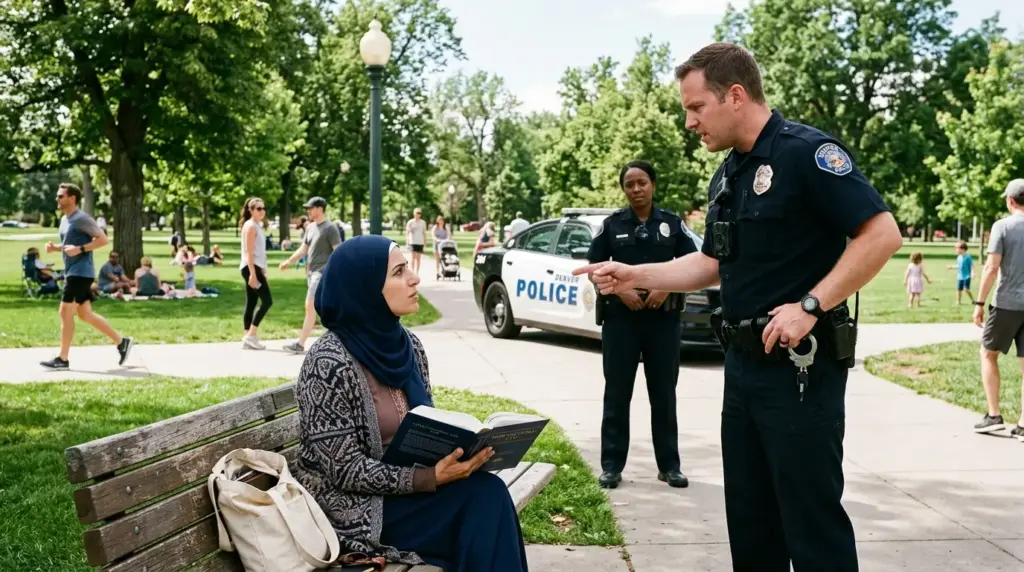
“Afternoon,” Brandon said. His tone wasn’t friendly. It was the tone cops use when they’ve already decided you’re a problem.
Aisha looked up. “Good afternoon, Officer.”
“Mind if I ask what you’re doing here?” Brandon said.
Aisha gave him a small smile. “I’m sitting on a bench in a public park, reading a book, having a nice Saturday afternoon.”
Brandon’s jaw tightened. “How long have you been here?”
“About twenty minutes. Why do you ask?”
“We got a call about someone suspicious in the area,” Brandon said. “So, I need to know what you’re doing here and how long you’re planning to stay.”
This was already illegal. You can’t stop someone and demand information just because someone called them suspicious while they’re engaged in perfectly legal activity. Brandon needed reasonable suspicion of a specific crime. Sitting on a bench isn’t a crime. Reading a book isn’t a crime. But Brandon was operating on a different set of rules, the ones that applied in his mind to people who looked like Aisha.
“Officer, I’m not sure what’s suspicious about reading in a park,” Aisha said calmly. “Could you tell me what specific behavior prompted the call?”
“I don’t need to explain my reasons to you,” Brandon snapped. “When an officer asks you a question, you answer it. That’s how this works.”
Officer Torres stepped closer. “Brandon,” she said quietly, “maybe we should—”
“I got this, Jessica,” Brandon cut her off. He turned back to Aisha. “Ma’am, I’ve asked you twice already. What are you doing here?”
“I’m sitting on a bench,” Aisha said, her voice remaining level. “In a public park. Is that suddenly illegal?”
“Don’t get smart with me,” Brandon said, his voice getting louder now. A few people in the park were starting to look over. “Multiple people called about someone suspicious in the area.”
“Suspicious?” Aisha gestured to her book. “I’m literally reading a book.”
Brandon’s face was flushed now. “Look, this is a nice neighborhood. Residents here pay good money for their homes. They have a right to feel safe. So, I’m going to need to see some ID and know why you’re really here.”
There it was: the tell. Why you’re really here. The implication that Aisha didn’t belong, that her presence in this nice neighborhood needed additional justification beyond being a human being in a public space.
“Officer,” Aisha said, her tone still calm, but with steel underneath, “I don’t have to provide ID unless you can articulate reasonable suspicion that I’ve committed, am committing, or am about to commit a crime. Can you articulate that suspicion?”
Brandon’s hand moved to his belt—not to his gun, but to his cuffs. An intimidation tactic. “You’re refusing to cooperate with a lawful order. That’s obstruction.”
“That’s actually not what obstruction means,” Aisha said. “Obstruction requires me to physically interfere with your duties. Asking you to justify your actions isn’t interference. It’s my constitutional right.”
Jessica Torres was now visibly uncomfortable. “Brandon, seriously, maybe we should call a supervisor.”
“I don’t need a supervisor to handle someone who won’t follow simple instructions,” Brandon said. He looked back at Aisha. “Last chance: ID now, or you’re going in cuffs for obstruction.”
Aisha reached slowly into her bag.
Brandon’s hand moved to his weapon. “Slow,” he barked. “Real slow.”
“I’m reaching for my wallet,” Aisha said calmly. “Nothing else.”
She pulled out a leather wallet. Inside was her driver’s license, three credit cards, and a DOJ credential card that identified her as a federal investigator. She removed only the driver’s license and handed it to Brandon.
Brandon looked at it: Michigan license, name Aisha Rahman. The address was in Dearborn, Michigan, which Brandon probably knew had one of the largest Muslim populations in America. He studied it for a long moment, then handed it back.
“You’re a long way from Michigan,” he said. “What brings you to Denver?”
“I don’t have to answer that,” Aisha said. “You’ve seen my ID. I’ve provided what you asked for, though I shouldn’t have had to. Am I free to go?”
“Not until I’m satisfied,” Brandon said.
“Satisfied about what?” Aisha pressed. “What crime do you think I’ve committed?”
Brandon was breathing hard now. He knew he was on shaky ground. He knew he should walk away, but his pride wouldn’t let him. He’d committed to this stop, and backing down would feel like losing.
“You’re in a public park in an area that’s had security concerns,” Brandon said. “You’ve been here alone for a suspicious amount of time. Your behavior fits a pattern we’ve been told to watch for.”
“What pattern?” Aisha asked. “And told by whom?”
Brandon didn’t answer that. Because there was no pattern. There were no security concerns. There was nothing except a woman in a hijab sitting on a bench, and that was apparently enough for Brandon to see a threat.
“I’m going to need to search your bag,” Brandon said suddenly.
“Absolutely not,” Aisha replied immediately. “You have no probable cause for a search. You have no reasonable suspicion. You have nothing except a phone call from someone who apparently thinks my existence in a park is suspicious. You’re not searching anything.”
“If you refuse a search, that gives me reasonable suspicion,” Brandon said.
“That’s not how the law works,” Aisha said. “Asserting my Fourth Amendment rights doesn’t create suspicion. That’s established case law: Florida v. Bostick and several others I can cite if you’d like.”
Brandon’s face was red now. “Who are you, some kind of lawyer?”
“Would it matter?” Aisha said. “Do lawyers get constitutional rights that other people don’t? Or should everyone be able to sit in a park without being harassed?”
Jessica Torres finally stepped forward. “Brandon, I really think we should—”
“Jessica, go wait in the car,” Brandon snapped.





