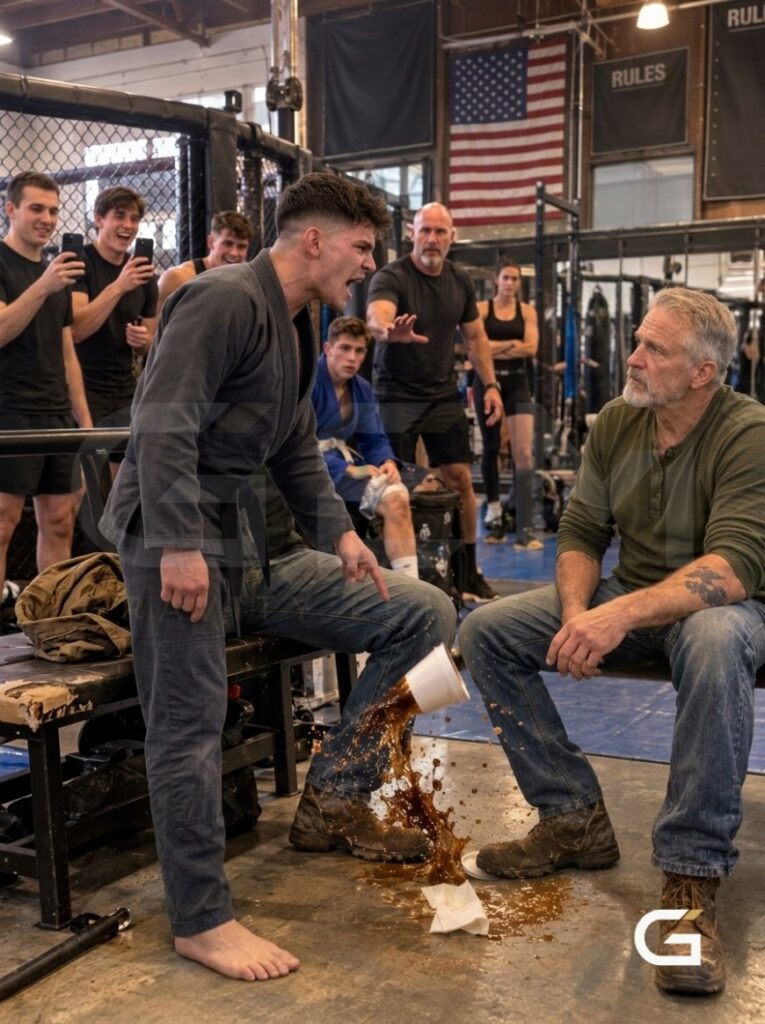
The steel door clicked shut behind me, and the cold hit my face like a slap.
The adrenaline that had carried me through the last three minutes was already draining out of my system, leaving a hollow, buzzing emptiness in its wake. My left knee was screaming — not the dull throb I’d learned to live with, but a sharp, hot wire of pain that ran from my hip all the way down to my ankle.
I walked across the parking lot with my jaw locked, one step at a time, my gait controlled and even. Nobody was watching me now. No audience, no lesson to deliver. But the discipline didn’t turn off just because the lights went out. I’d trained too long for that.
I reached my truck — a twenty-year-old F-150 with rust eating the wheel wells and a cracked windshield that had never been fixed. The door groaned when I pulled it open.
I sat behind the wheel for a moment without turning the key. My hands found the steering wheel and gripped it. I watched my knuckles go white. Then I forced them to relax, one finger at a time.
Breathe in. Four seconds. Hold. Four seconds. Out. Four seconds.
The tremor was starting. That familiar, bio-chemical aftershock. The body hadn’t caught up yet to the fact that it was safe. It was still braced for the ambush, for the muzzle flash, for the burning smell of fuel and rubber.
I closed my eyes and saw Cade’s face, not as he was now — young, broken, humiliated — but as he could have been fourteen years ago in Fallujah. A target. A threat. A checklist of vulnerabilities to exploit.
That was the part I hated. Not the violence itself.
How easy it came back.
I started the engine and pulled out onto the wet gray streets. The drive back to Milbrook took twenty minutes through farmland and strip malls. Rain started about halfway, streaking the windshield and blurring the headlights of oncoming traffic.
My house sat at the end of a quiet dead-end road, a small ranch with peeling trim and a sagging front porch. The backyard was the only thing I was proud of — neat rows of tomato plants, squash vines, and a fig tree I’d coaxed through three winters.
I killed the engine and sat in the driveway for a while.
The rain drummed on the roof of the cab. I didn’t want to go inside. Inside meant quiet. Quiet meant the memory had room to breathe.
But the truck was starting to smell like sweat and blood — Cade’s blood, I realized. I looked at my right hand. There was a faint smear of red across the knuckles from where my forehead had connected.
I got out, walked up the porch steps, and let myself in.
The house was dark. I didn’t turn on the lights. I shuffled into the bathroom, stripped off my thermal shirt and jeans, and stepped into a shower as hot as I could stand.
The water hit my back and I leaned against the tile, palms flat, and let it run over the fused vertebrae in my lower spine. The heat helped. The steam helped. The silence didn’t.
Twenty-five years I’d spent in the shadows. Recon first, then special operations, then a long stint in a unit that didn’t officially exist. I’d done things that were necessary. I’d done things that weren’t. I’d carried both categories back with me in equal measure, and I’d spent the last decade trying to make the ledger balance.
Growing tomatoes. Volunteering at the animal shelter. Reading history books. Learning how to sleep through the night.
I’d thought I’d succeeded.
But that afternoon on the mat, something had clicked loose. Not anger. Worse — nothing at all. Just the cold hum of muscle memory kicking in, evaluating, calculating, executing. I hadn’t hesitated. I hadn’t wanted to hurt the kid. I just hadn’t wanted anything at all.
That was the scariest part.
When I finally got out of the shower, I stood in front of the bathroom mirror for a long time. Gray hair thinning at the crown. Deep lines around the eyes. A long scar running from the base of my throat down beneath my collarbone, faded to silver.
I looked at that old man in the mirror and asked him the same question I’d asked a thousand times.
Was that really necessary?
He didn’t answer.
I pulled on a fresh pair of jeans and a heavy sweater, made myself a cup of tea, and limped out to the front porch. The rain had stopped. The sun was dropping behind the tree line, painting the sky orange and pink.
I sat in the rocking chair and watched the colors change and tried not to think about the expression on that kid’s face when he realized he was beaten.
It didn’t work.
—
Three days passed.
I went through the motions. Watered the tomato plants. Drove into town for groceries. Stopped at the library to return two books about the Pacific theater. Ate soup. Slept poorly.
My knee didn’t stop complaining. I’d aggravated everything — the meniscus, the old fracture in my tibial plateau, the sciatica that came and went like a bad neighbor. I wore a brace around the house and popped ibuprofen like candy.
On the fourth morning, I was sitting on the porch with my tea when a faded blue Ford Ranger turned onto my road.
I recognized the truck before I recognized the driver. I’d seen it parked outside Grit House for years, in the spot with the best shade.
The engine cut and the door opened. Cade Marsh got out.
He looked worse than I’d left him. Both eyes ringed with deep yellow-green bruising, a hard white splint taped across the bridge of his nose. He was wearing gray sweatpants and a black hoodie with the hood pulled up, hands jammed into the pockets.





