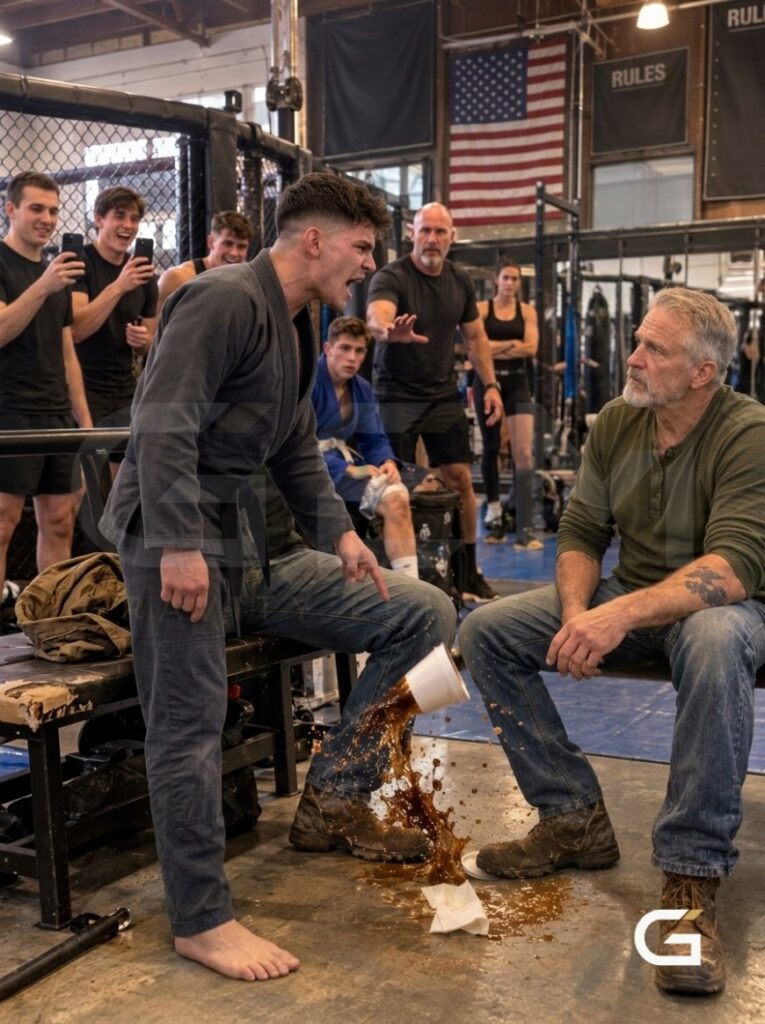
The swagger was gone. So was the pride.
He walked up the gravel driveway slowly, like each step was a decision he was making all over again. When he reached the bottom of the porch steps, he stopped and looked up at me.
I didn’t say anything. I just rocked.
“Dale gave me your address,” he said.
His voice was thick and nasal — the splint did that. I nodded once.
“I assumed.”
Cade shifted his weight from one foot to the other. He looked around at the peeling paint, the sagging gutter, the neat rows of tomato plants behind the fence. Something in his face changed — surprise, maybe. Disappointment.
It didn’t look like the home of a dangerous man.
It looked like the home of somebody’s grandfather.
“I came to apologize,” he blurted.
The words came out fast, like he was afraid he’d lose his nerve if he slowed down.
“I was out of line. I was disrespectful. You were just sitting there and I acted like a punk.”
I stopped rocking. I set my mug on the small side table.
“Yes, you did.”
Cade flinched. He’d been expecting the usual script — the easy absolution, the “no hard feelings,” the “water under the bridge.” That’s how these things went in his world. A slap on the back, a laugh, a story to tell at the bar.
I wasn’t offering any of that.
“My nose is fractured in two places,” he said, gesturing vaguely at his face.
“I know. I felt it.”
He swallowed hard. He took a hesitant half-step toward the porch.
“I don’t understand.”
“Understand what?”
“How you did it.”
His voice cracked on the last word. He tried to cover it with a cough, but the damage was done. The question hung there between us, raw and honest.
“I’m faster than you,” he said quietly. “I’m stronger than you. I train four hours a day. I’ve got a black belt and a boxing background. You didn’t even put your hands up. You just walked through me like I wasn’t there.”
I let out a long breath. It carried more weight than I meant it to.
I leaned forward, elbows on my knees.
“You’re a race car, Cade,” I said. “You’re built for a track. You have rules. You have referees. You have a canvas with perfect traction and opponents who agree to fight you under a very specific set of conditions.”
He watched me, silent.
“I’m a bulldozer. I was built to clear rubble. I don’t care about the rules of the track because I was trained for places where there is no track.”
He stared at me. The bruised flesh around his eyes twitched.
“When you stepped to me, you were calculating distance and timing and combinations. I was calculating the fastest route to shut your body down.”
I paused.
“You weren’t even mad when you had me pinned,” Cade said. “When you could have broken my arm. You looked bored.”
“Anger is a liability,” I said flatly. “Anger floods your brain with chemicals that wreck your fine motor skills. Anger makes you swing wide. It makes you predictable. You fight out of ego. You want to be the baddest man in the room. That requires an audience.”
I pointed one thick, calloused finger at his chest.
“When you fight for survival, you don’t care who’s watching. You don’t even want to be there. The violence isn’t a performance. It’s a terrible, necessary chore. Like taking out the garbage. Nobody gets angry at the garbage. You just remove it.”
Cade absorbed that. I watched it hit him — harder than the headbutt had.
His whole identity had been wrapped up in being untouchable. And I’d just quietly taken it apart on a front porch in a flannel shirt holding a mug of tea.
“Why didn’t you break my arm?”
The question came out barely above a whisper.
“Because you yielded,” I said. “And because I’m trying very hard to be a civilized man. Breaking a kid’s arm over a bruised ego is bad for the soul. I’ve broken enough things in my life.”
Silence settled over the yard. The blue jays that had been fighting over a peanut earlier had flown off. A lawnmower hummed three streets over.
Cade stood at the bottom of those stairs for a long moment.
I could see him working through it — the burning desire for a rematch, the need to prove it was a fluke, the fantasy of coming back in six months and beating me clean. All of it dying, one small piece at a time.
In its place was something humbler. Something I recognized, because I’d had to learn it the hard way myself.
He pulled his hands out of his pockets and stood up straight, correcting his posture. He didn’t bow — that would have been theatrical. He just offered a deep nod.
“Thank you, Mr. Callaway.”
I picked up my tea and leaned back in the rocker.
“Take a month off, Cade,” I said, looking out toward the street instead of at him. “Let the bone heal. Let your ego heal. And stop sparring with kids who work warehouse shifts just to feel good about yourself. Find a heavier bag. Find a harder gym.”
He nodded slowly. He turned and walked back down the path, opened the door of his truck, then paused and looked back.
“Are you ever coming back to Grit House?”
I took a sip of my tea. A faint melancholy smile touched the corners of my mouth.
“Only for the coffee.” I paused. “Even though Dale makes terrible coffee.”
Cade managed a weak, lopsided smile that clearly hurt his face. He climbed in, started the engine, and drove away.
I watched the truck disappear around the corner. I felt the familiar dull ache in my lower spine. I rubbed my left knee without thinking about it.
I was old. I was broken.





