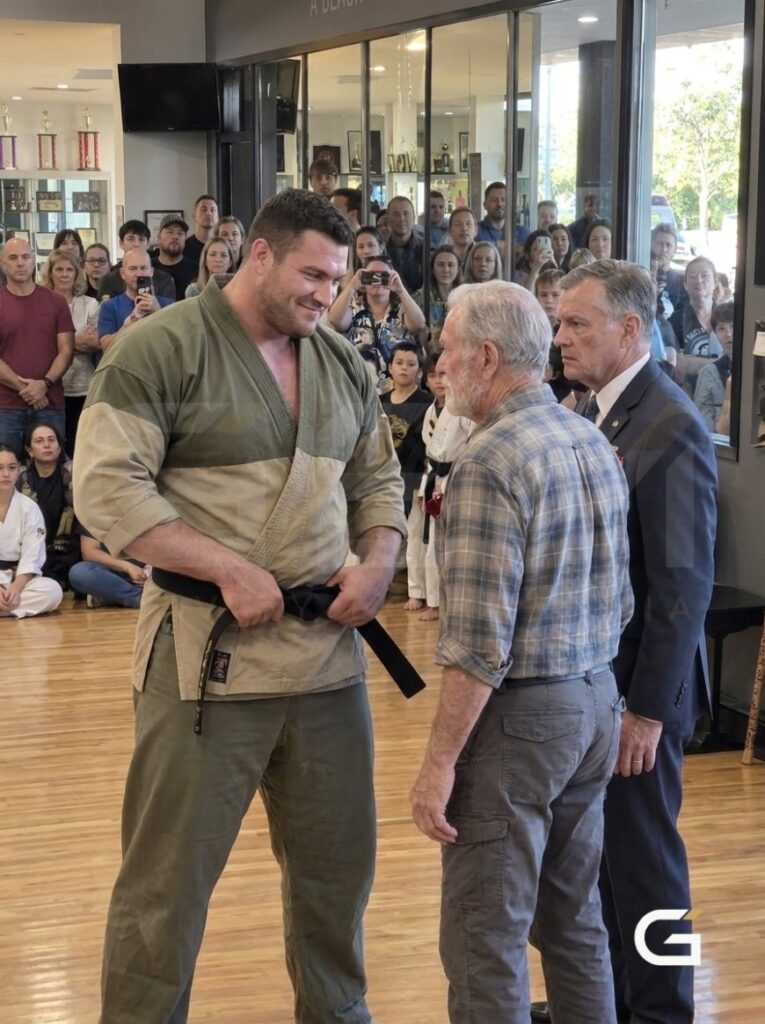
“I kept wondering when you’d finally stop punishing yourself for things that weren’t your fault.”
The words hit like a punch I hadn’t braced for.
I set the photograph down on my knee. Carefully. Gently. The way I’d once handled photographs of a different kind. Ones I’d never shown anyone.
“You don’t know what you’re asking, Marcus.”
“I know exactly what I’m asking.”
His voice softened.
“I’m asking you to stop carrying it alone. Whatever’s left. Whatever weight you’ve been dragging around since you disappeared.”
I looked at him. At all four of them.
At men who had followed me into hell and walked out the other side because I’d asked them to trust me.
And I remembered why I’d stopped answering their letters.
Because looking at them meant looking at everyone who hadn’t come home.
“Grandpa?”
A small voice cut through the moment.
I turned.
My granddaughter stood at the edge of the circle, still in her practice uniform, hair pulled back in a tight ponytail, water bottle clutched in both hands.
Her name was Lily. She was fifteen. Sharp as a blade. The best thing that had ever happened to me in a life that hadn’t always given me reasons to be proud.
She was staring at the four men surrounding me with wide eyes.
“Grandpa,” she said carefully.
“Who are these men?”
The room seemed to hold its breath.
I smiled. Waved her over.
Old friends. From a very long time ago. Before I became the grandfather who watches you train every single week.
She walked toward us slowly. Her eyes moved from Marcus to Thomas to Danny to Samuel. Reading them the way teenagers do—quickly, thoroughly, with an instinct for what adults are trying to hide.
“You were in the military together?” she asked.
We didn’t answer right away.
Marcus said, “You could say that.”
“What does that mean?”
Thomas leaned forward, grinning. “It means your grandfather is the reason I’m still alive, young lady. And he’s never once let me thank him properly.”
Lily’s eyes shifted to me.
I kept my face neutral. I’d practiced that expression for decades.
“Grandpa,” she said slowly.
“Are you some kind of war hero?”
“No,” I said.
“Don’t let these old fools fill your head with nonsense.”
“You’re the reason I’m alive too,” Danny added.
“I trained under him for six years. Learned more about honor and duty from Robert Hail than I ever learned in any classroom.”
Lily’s head was spinning.
I could see it in her face. The sweet, sharp, confusing collision of the grandfather she knew and the man these four strangers were describing.
“Okay,” she said.
“Now I have questions.”
“You always do,” I said.
She sat down on the floor in front of us, cross-legged, her water bottle forgotten in her lap.
“Start talking.”
I looked at Marcus. He looked at me.
The four men surrounding me grinned like they’d been waiting years for this exact moment.
And maybe they had.
I let out a long breath.
“Fine,” I said.
“But just the parts I’m allowed to tell.”
The stories began slowly.
Marcus started. It was easier for him. He’d always been better at words than the rest of us.
He told Lily about the first time I’d saved his life—the night training exercise that went sideways, the moment he’d frozen under pressure, the way I’d grabbed him by the collar and dragged him through the mud while bullets split the air above us.
He told her how I’d refused to leave him behind even when the smart play was to move on.
“How old were you?” Lily asked.
“Twenty-three,” Marcus said.
“And your grandfather? Twenty-six. He was always younger than he seemed.”
Thomas took the next story.
The time we’d been trapped behind enemy lines for three days. The way I’d kept everyone alive on ration bars and stubbornness.
“I watched that man stare down death and call it a bluff,” Thomas said.
“Every single day. For three days. And he never once considered giving up.”
Lily’s eyes were wide.
Danny came next. Samuel last.
Each story added a layer she hadn’t known existed.
A layer I had spent decades trying to forget.
By the time they finished, the observation window was dark. The academy had emptied out. Even the instructors had gone. Only the five of us and my granddaughter remained.
Lily sat perfectly still.
“Why didn’t you ever tell me?” she asked quietly.
“Because it wasn’t a story worth telling,” I said.
“Not the way you’re thinking. Not the way it sounds when these old men say it.”
“Why not?”
I leaned back in my chair. Looked up at the ceiling. Searched for the words.
“Because the stories have two sides, Lily. The side where you survive. And the side where others don’t. These men like to remember the first side. I remember the second.”
The room was silent.
The other four didn’t argue. They knew.
“Then tell me that side,” Lily said.
“Tell me what you don’t like to remember.”
I looked at her.
My granddaughter. Fifteen years old. Asking the question I’d spent half a lifetime avoiding.
I considered saying no. I considered changing the subject. I considered all the defenses I’d built over the years.
But then I saw her face.
She wasn’t asking because she wanted a hero story. She was asking because she loved me and she wanted to understand.
I nodded slowly.
“Okay,” I said.
“But this one isn’t easy.”
“That’s fine,” she said.
“Neither are you.”
The others laughed. Quietly. Gently.
And I began.
I told her about the mission I’d never told anyone except her grandmother—and even then, only in pieces. The mission that had ended my career in a way no one else understood.
I told her about the men I hadn’t been able to save.
The ones whose faces still lived behind my eyes every time I closed them at night.





