paused the video. “Dad, are you okay?” I realized my hands were shaking. Just slightly. Just enough to rattle the desk. “I’m fine. Keep playing it.” The video continued. “I know people are going to say this is just me trying to save face. Damage control. But here’s the thing—my channel’s already gone. I deleted everything an hour after that happened. Because I realized I’d built my whole brand on making other people look weak. And I couldn’t stand to look at it anymore.” Hunter reached off-screen and pulled something into view—a piece of paper, crumpled and folded. “I enrolled in a trade program this week. Welding. I’m going to learn how to make something that lasts. Something real.” He looked directly into the camera, and there was something in his eyes I recognized. Something broken but trying to heal. “To the man in the gym, and to his son—I don’t know if you’ll ever see this. But I’m sorry. And I’m going to be better. I don’t know how yet, but I’m going to try.” The video ended, and the silence that followed was so complete I could hear the wind rattling the gutters outside. Noah closed the laptop and turned to face me. His eyes were wet, though he wasn’t crying exactly—just blinking a lot, the way he did when he was trying to process something too big for words. “He said he was going to be better,” Noah said, softly. “Do you think he will?” I thought about Hunter Brooks, pinned beneath me on that canvas, real human terror in his eyes for the first time in his adult life. I thought about the way he’d scrambled to pick up my towel without hesitation. I thought about the kids I’d trained over the years, the ones who’d come in with something to prove and left with something to protect. “I think he might,” I said. “If he has someone who believes in him.” Noah was quiet for a long moment. Then he nodded, slowly, and stood up. “Dad?” “Yeah.” “I want to learn more. The stuff you know. Not just footwork. I want to learn what you did in the cage.” The request hit me like a punch to the gut. For years, I’d been careful—so careful—to keep the full extent of my training away from Noah. He knew I’d been in the army. He knew I’d taught soldiers. But he’d never asked for more than the basics, and I’d never offered. “You’re eleven,” I said, and the words came out more weakly than I intended. “I know.” He stood in front of me, still in his gym clothes, still smelling like the dust of the heavy bag. “But I’m not asking to learn how to hurt people. I’m asking to learn how you didn’t.” The words landed with the weight of something far older than his years. I looked at my son, standing there with his mother’s eyes and my uncomfortable persistence, and I felt the last of the day’s tension drain out of me. “Okay,” I said. “But we do this right. Form first, technique second, philosophy third. If you can’t explain why you’re doing something, you don’t get to do it until you can.” Noah’s grin split his face wide open—the first real smile I’d seen from him since before his mother died. “Deal.” We spent the next hour in the living room, pushing back the coffee table, working through footwork patterns on the hardwood floor while the rain drummed against the windows. I showed him how to move without telegraphing, how to read an opponent’s weight distribution, how to stay rooted and ready at the same time. And when he got frustrated—when his feet tangled and his balance wavered—I saw him take a breath, close his eyes for just a second, and reset. The same thing I’d done a thousand times in a thousand worse places. At eleven-fifteen, I sent him to bed with sore legs and a brain full of new information, and I stood alone in the living room for a long time afterward, listening to the rain. My phone buzzed on the kitchen counter, and I nearly ignored it. But something made me check. The notification was from a number I didn’t recognize, and the message was brief: “Saw the video. My kid watched it too. We’ll be at Iron Works next Tuesday if you want to teach two boys instead of one. :)”—Sarah Chen. I stared at the screen for what felt like a very long time. Then I typed back, “Seven o’clock. Bring water.” And for the first time in four years, the house didn’t feel quite so empty. — The next Tuesday, Sarah Chen showed up at Iron Works with her son—a skinny, nervous kid named Eli who looked at me like I might bite him—and we started something new. It wasn’t a class, exactly, not at first. Just Noah and Eli, working through footwork drills while Sarah watched from the bench and Derek pretended not to hover nervously near the front desk. But other people noticed. A middle-aged electrician named Marcus, who’d been coming to the gym for years without ever quite finding a rhythm, started lingering nearby. A college kid named Destiny, who had a black belt in Tae Kwon Do but had quit competing after a bad experience with a coach who screamed, asked if she could join in. A week later, it was six kids and four adults, and I had to ask Derek if we could reserve the back mats on Tuesday nights. “Are you kidding?” He was practically vibrating with excitement. “This is the most people we’ve had in here since—I don’t know when. Keep it coming.” So I kept it coming. I laid out rules on the first night, and I made everyone repeat them back to me before we started. One: We don’t hurt each other. Not ever, not for any reason. If you can’t control your emotions, you
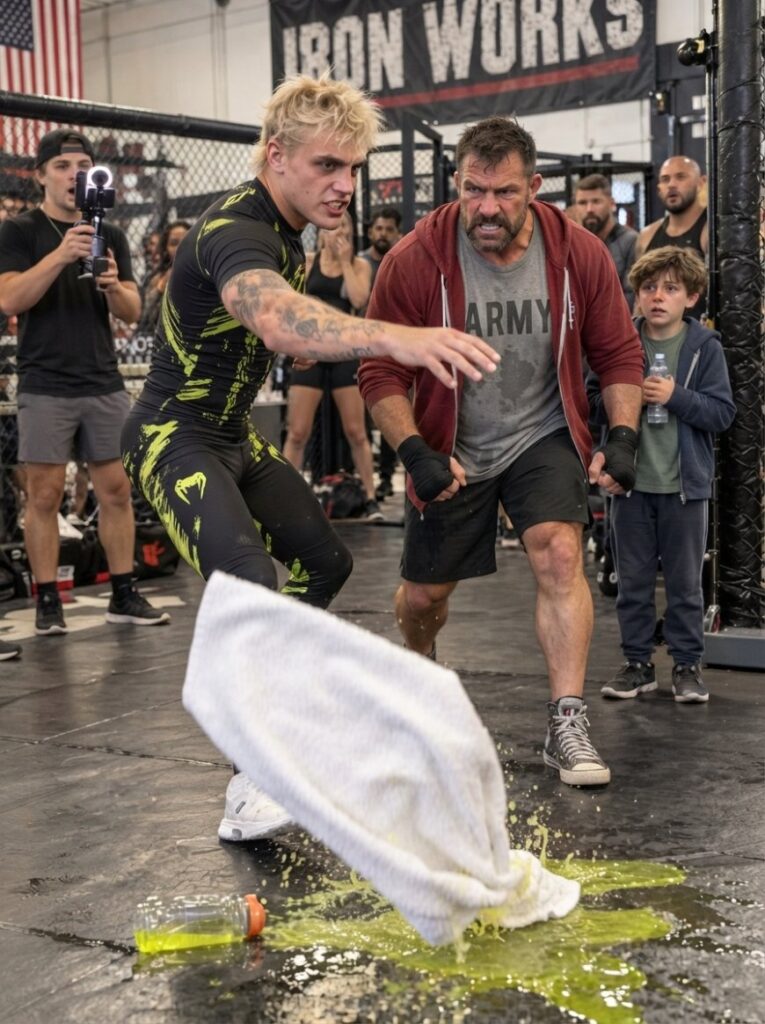
PART 2: He WIPED HIS SWEAT on my gym towel, threw it in a puddle, and called me “Gramps” in front of my 11-year-old son