leave the mat until you can. Two: We don’t humiliate each other. The person who taps out is the person who learned something. Respect that. Three: What we learn here stays here unless it needs to leave. And that’s not about secrecy—it’s about not needing to prove anything to anyone. Eli, Sarah’s son, was the first one to really struggle. He was small and quick and eager, but every time he made a mistake, his shoulders would hunch up and his face would go red, and I could see the anger building behind his eyes. The third week, he snapped at Noah over a missed footwork drill, and I pulled him aside. “Eli. What just happened?” He wouldn’t look at me. “I got mad.” “Why?” “Because I messed up. Because Noah’s better than me. Because I always get like this and I hate it.” I crouched down to his level—he was small enough that I didn’t have to crouch far—and waited until he looked at me. “Getting mad is fine,” I said. “It’s what you do with it. Right now, you’re letting it control you. You’re shouting at your friend because you feel weak. But here’s the secret, Eli—everyone feels weak. Everyone. The trick isn’t to stop feeling it. The trick is to decide what to do anyway.” He sniffled. “How?” “By remembering why you’re here. Not to be the best. Not to beat Noah. You’re here because your mom wanted you to learn something that would make your life better. That’s the only reason you need.” Eli was quiet for a long moment. Then he nodded, wiped his nose on his sleeve, and walked back to the mats. He and Noah did the drill again, and this time Eli didn’t get it right either. But he didn’t snap. He just took a breath and tried again. That’s when I knew we’d done something real. — Weeks turned into months, and Tuesdays became something I looked forward to in a way I hadn’t anticipated. The group grew—not huge, never huge, but enough that Derek had to order more mats and Sarah started bringing coffee from her café to pass around afterward. We’d sit in a loose circle on the floor, drinking coffee and water and talking about everything except fighting. Marcus and his ex-wife and the custody battle he was trying to handle without losing his temper. Destiny and her dream of opening a youth center in her old neighborhood. Sarah and the fear that haunted her every day since her husband had walked out—that she wasn’t enough for Eli, that he’d grow up angry and lost the way she saw so many boys become. And Noah, quiet and watchful, taking it all in. One night, after everyone else had left, my son stayed behind to help me stack chairs. “Dad?” “Mm-hmm.” “You know the video Hunter posted? The one where he said he was going to be better?” “I remember.” Noah set down the chair he was holding and turned to face me. “I looked him up again. His new channel. He’s got like two thousand subscribers now. It’s not about fighting. It’s about welding.” I felt something warm spread through my chest. “Is it good?” “It’s boring.” A smile crept across his face. “But he’s helping people learn how to make things. And he says thank you at the end of every video. He says “thank you to the man in the gym.”” I didn’t know what to say to that, so I just nodded. Noah picked up another chair, then paused. “Do you think he’ll ever come back? To the gym?” “Maybe. Maybe not.” I stacked the chair he handed me and looked around the quiet, dark room—the heavy bags hanging motionless, the cage in the corner where the whole thing had started. “But he doesn’t need to. He got what he needed.” “And what was that?” I thought about it for a moment, trying to find the right words. “A reason to change. Which is the only thing that ever makes anyone change.” Noah absorbed that the way he absorbed everything, then nodded and picked up the last chair. “Dad?” “Yeah.” “I’m proud of you.” The words hit me harder than any punch I’d ever taken. “I’m proud of you too, bud.” We walked out together into the cool night air, and I locked the gym doors behind us, and we drove home through the quiet streets of a town that felt a little bit smaller and a little bit warmer than it had six months before. And somewhere in the cab of that old pickup truck, my son fell asleep with his head against the window, and I realized that all the training in the world couldn’t have prepared me for the hardest fight of my life—the fight to raise a good man—and that somehow, against every odd, I might just be winning. — Three months after that, I got a letter. Handwritten, on cheap notebook paper, folded into a slightly too-small envelope and mailed to the gym’s address. Derek brought it back to me with an expression of mild confusion. “No return address. But the postmark’s from a couple counties over.” I knew who it was before I opened it. “Dear Mr. Mercer,” it said. “I don’t know if you’ll remember me. I’m the guy from the gym. The one who threw your towel in the puddle.” I sat down on the bench where Noah had watched me fight, and I kept reading. “I’ve been in the welding program for six months now. I’m not going to say I’m the best, because I’m not. I’m probably not even in the top ten. But I show up every day, and I don’t quit, and last week my instructor told me I had good hands. He said it like it was a compliment, and I almost cried in the shop because nobody’s ever said that to me before.” I stopped reading for a moment and looked
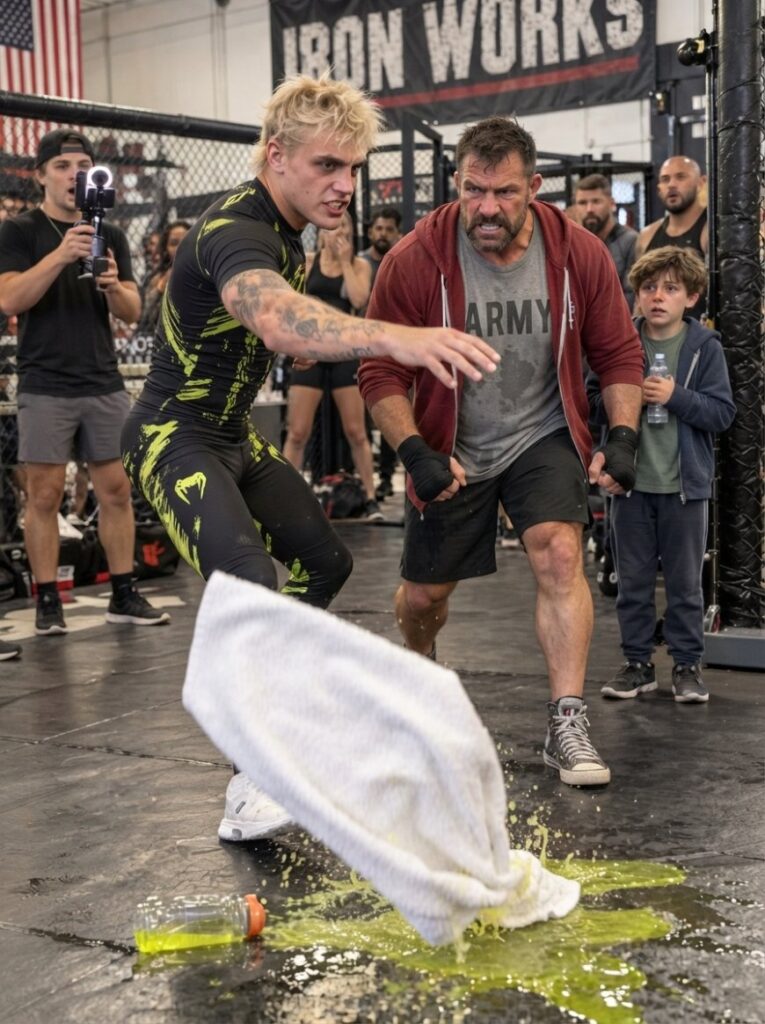
PART 2: He WIPED HIS SWEAT on my gym towel, threw it in a puddle, and called me “Gramps” in front of my 11-year-old son