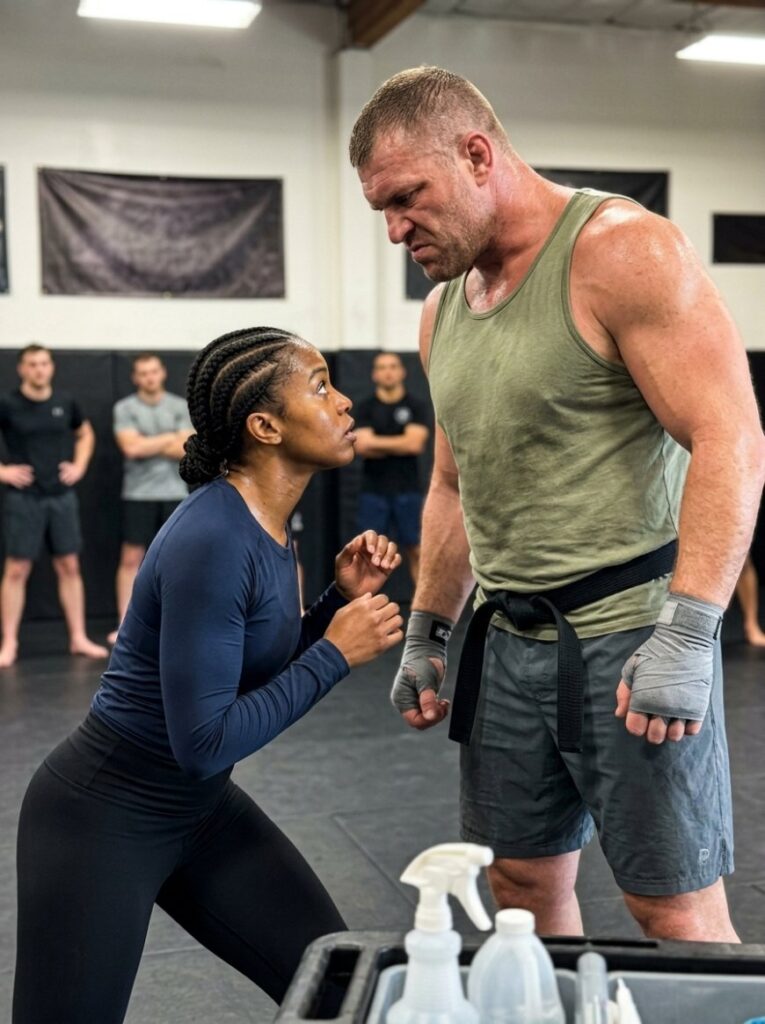
She didn’t say what the word was. She didn’t have to.
“I cleaned it off before anyone came in.”
Nobody moved.
“I’ve been cleaning this gym for eleven months,” she said. “This is the third time someone in the Tuesday class has asked me to fight for their entertainment.”
The fighter took a small step back. His hands lowered a few inches.
“I never said anything,” she continued. “I just kept cleaning.”
“Then why tonight?” I asked.
She looked at me. Really looked at me. For a long moment.
“Because he kicked at my head,” she said simply. “And you all filmed it.”
That landed like a punch nobody saw coming. Several people around the mat shifted their weight. A woman near the water fountain covered her mouth.
The fighter opened his mouth, then closed it. His coach—a broad-shouldered man who had been standing near the back entrance the whole time—finally stepped forward.
“Alright. That’s enough,” the coach said. He had a thick accent I couldn’t place. Eastern European, maybe. “We’re done here. Everyone clear the mat.”
The woman didn’t move.
“Ma’am,” the coach said, more softly. “I’m asking you to step off the mat.”
She looked at him. Then she lowered her hands. Slowly. Not defeated. Just done.
She bent down and picked up the gloves. Slid them back on. The yellow rubber swallowed her hands up to the wrist.
“Your floors need mopping,” she said. “I’ll finish up.”
She turned and walked toward the cart.
Nobody stopped her. Nobody said a word.
The fighter stood in the center of the mat with his hands at his sides, breathing hard, staring at the space where she had been.
I watched her push the cart through the double doors that led to the back hallway. The doors swung shut behind her with a soft hiss.
The room stayed frozen for another ten seconds.
Then everyone started talking at once.
—
I didn’t go home right away.
I stood in the parking lot for twenty minutes with my key fob in my hand, staring at the back door of the gym. The concrete was cold under my shoes. A few cars pulled out behind me and their headlights swept across the building before they turned onto the main road.
My phone was full of notifications. Everyone from the gym was tagging me, asking questions, posting clips. Somebody had already uploaded the footage to a local MMA forum. The comments were a mess.
A few people had driven off without saying anything to anyone. The coach had closed the gym early. The fighter—whose name I still didn’t know—had left through the back with a hoodie pulled over his head.
I almost left. I had my keys in my hand, my car unlocked, one foot on the pavement.
Then the back door opened.
She stepped out in a brown winter coat that was too thin for the weather. Her hair was down now. Loose and gray at the temples. She carried a black backpack over one shoulder and clutched a thermos in her hand.
She saw me. I saw her.
Neither of us moved.
“I’m not waiting for an autograph,” I said. “I just—” I didn’t know how to finish the sentence.
She walked past me toward a small gray sedan parked three rows over. Her breath fogged in the cold air.
“I know what you’re going to ask,” she said without turning around.
“Do you?”
She stopped. Turned her head halfway.
“You’re going to ask me why I never told anyone.”
I didn’t answer.
She turned fully. In the parking lot light, her face looked older. Tired. Not the kind of tired that comes from a long shift. Something deeper.
“Because I was twenty-nine when I fought in Atlanta,” she said. “Thirty-one when my knee blew out in the finals of a tournament in Warsaw. I had a chance to go pro. Two weeks after my last fight, my mother got sick. Then my father. Then the money ran out.”
She tucked the thermos under her arm.
“I’m not telling you this because I want you to feel sorry for me. I’m telling you because I want you to understand that I didn’t quit. I just stopped fighting in rings.”
I swallowed.
“You could still teach,” I said. “Coach. Train. There are gyms all over the city that would—”
“I know,” she said. “But that’s not my life anymore.”
She looked back at the gym. The lights inside had gone dark. The yellow cart was parked somewhere behind those walls. Waiting for her tomorrow.
“I clean it because it’s a gym,” she said. “I still love the smell of it. The sound of hands hitting pads. The squeak of shoes on mats. That never went away.”
Her voice changed for just a second. Softer.
“It’s enough.”
We stood in the cold a moment longer.
“What was your name?” I finally asked. “The one you fought under?”
She looked at me for a long time. Long enough that I started to feel uncomfortable.
“Delia,” she said. “Delia Monroe.”
The name hit me like a punch to the chest.
I knew that name. Everyone who had ever followed amateur kickboxing knew that name.
Delia Monroe had won three national titles in two years. She’d been on the cover of a regional combat sports magazine. She’d been the next big thing.
Then she’d disappeared. No announcement. No farewell fight. Just gone.
“People said you retired,” I whispered.
“I did.”
“Why didn’t you come back?”
She smiled. The smallest smile. The same one from the mat.
“Because I was tired of fighting for people who didn’t see me,” she said. “And I was tired of fighting people who only saw my color.”
She turned and walked to her car. Unlocked it. Tossed her bag in the passenger seat. When she slid into the driver’s seat, she paused one last time.
“Goodnight,” she said through the open door.
“Goodnight, Delia.”





