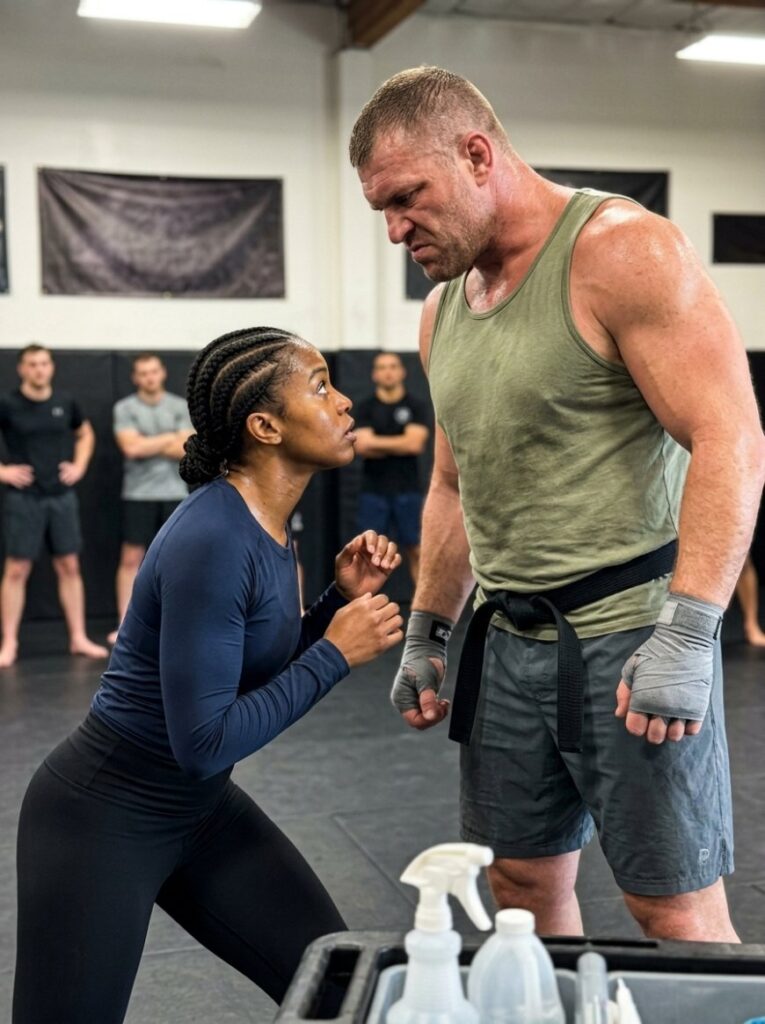
She closed the door. The engine turned over on the second try. The headlights flickered on, and I watched her pull out of the parking lot, turn right onto the empty road, and disappear around the curve.
I stood there for another five minutes in the cold.
Then I got in my car and drove home.
—
I didn’t sleep that night.
I sat at my kitchen table with my laptop open. I typed her name into the search bar. There were photos. Old ones. Grainy. From before anyone had phones with good cameras.
Delia Monroe, age twenty-seven, in a red gi. Arms crossed. Chin up. Looking straight through the lens like she could see the person behind it.
Delia Monroe, age twenty-nine, with her hand raised at a tournament in Texas. A gold belt over her shoulder.
Delia Monroe, age thirty, at a weigh-in. Standing next to a woman who would go on to win two world titles in two different promotions. Side by side. Equal height. Equal stance.
Then nothing. The photos stopped. The articles stopped. Her name disappeared from every ranking and every roster.
I found one forum post from eight years ago. The title said *Whatever Happened to Delia Monroe?* Twenty-two replies. Most of them speculation. One of them said she had gotten hurt. Another said she had quit to take care of family. A third said she had been blacklisted after turning down a contract with a promoter who had a reputation for treating fighters badly.
That third reply had been downvoted ninety-four times.
I closed my laptop at three in the morning. Lied down. Didn’t sleep.
—
The next morning, I drove back.
I told myself I was just going to ask her a few questions. Just for context. Just to understand. I brought a notebook. I didn’t bring my phone.
I parked in the same spot. The gym opened at five. It was six-fifteen when I walked in.
The front desk was empty. The lights over the mats were on. Three early-morning regulars were doing light drills in the corner. None of them looked up.
I found her in the back hallway.
She was on her knees, scrubbing the baseboards near the locker room door with a small brush. Her gloves were on. Her hair was tied back. She saw my shoes first, then looked up.
“You came back,” she said. Not surprised. Not annoyed.
“I have questions.”
She sat back on her heels. Wiped her forehead with the back of her glove.
“Most people do. After something like last night.”
She reached for a rag and stood up.
“Ask.”
I opened my notebook. I didn’t need to. But I wanted to look like I knew what I was doing.
“I want to write about you,” I said. “Not a tabloid thing. Not a viral post. Something real. Something that tells people—”
“Tells them what?”
“That you exist.”
She looked at me for a long moment. Then she laughed. A real laugh. The first one I’d heard from her.
“I exist every day,” she said. “I’ve been existing right in front of them for eleven months.”
“Then let me tell them why.”
She set the rag down on the edge of the cart. Pulled one glove off. Then the other.
“I’ll give you thirty minutes,” she said. “I need to wax the floors by nine.”
—
She told me the whole story over coffee from a machine that had a broken milk frother.
Delia Monroe was born in a small town outside of Savannah. Her father had been a boxer. Not a great one. But a proud one. He taught her to stand before she could walk. He taught her to keep her hands up before she could read.
Her mother had been a nurse. The kind of woman who worked double shifts and still came home with a smile. She had died when Delia was twenty-two. West Nile virus. Of all things. A mosquito bite in her own backyard.
Her father had passed four years later. A stroke. Two weeks after Delia’s last professional fight.
“I fought in Warsaw with his voice in my head,” she said. “He’d always told me that if I was going to fight, I had to be the last one standing.”
She had been the last one standing. But when she walked off the mat that night, she was the only one left.
“It didn’t feel like winning,” she said. “It felt like coming home to an empty house.”
She had kept fighting for a little while after that. Then her knee had gone. Then the money. Then the offers had slowed down. Then they’d stopped altogether.
“The fight game eats people,” she said. “It doesn’t matter how good you are. It matters who’s willing to sell you.”
She had met one of those people. A promoter. She didn’t say his name. She just said he had made her an offer. An offer that would have made her money but cost her everything else.
“I turned him down,” she said. “He made sure nobody else would work with me.”
She had taken a job at a sporting goods store. Then at a hospital. Then at a nursing home. Then, eleven months ago, she had applied to clean a gym.
“I saw the listing online,” she said. “I saw the address. I knew the owner. He was a decent guy. Been around the fight scene for years. I figured he wouldn’t care about my past as long as I did the job.”
The owner, apparently, had no idea who she was. He had hired her based on a phone interview.
“He never asked,” she said. “I never told.”
We sat in the small break room for a while after that. The fluorescent light buzzed above us. Somewhere down the hall, someone dropped a weight and it echoed against the concrete walls.
“The man from last night,” I said. “The one who filmed you. That was me.”





