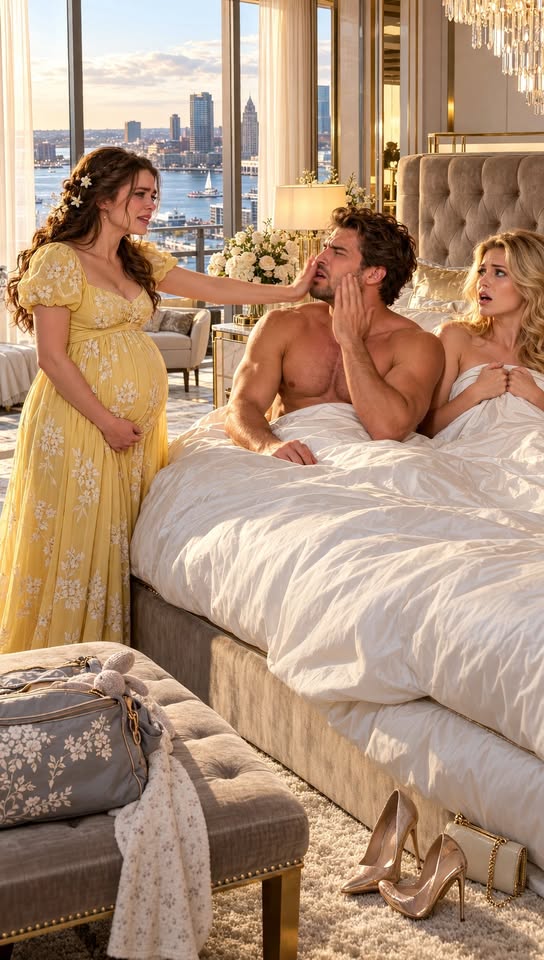
For the first month, he slept in the guest room.
Sarah’s choice.
Then one evening she stood in the doorway.
“You can sleep upstairs.”
He looked at her.
“Sure?”
“Yes.”
He followed her.
No grand romantic scene.
No need.
Trust had returned through dozens of smaller choices already.
That night, Maya woke at two in the morning crying.
Greg got up first.
Sarah listened from bed while he murmured through the baby monitor:
“Okay, tiny dictator. Daddy’s coming.”
Sarah smiled into the darkness.
Ordinary.
That was what she wanted.
Not perfection.
Ordinary truth.
Years passed.
Greg never became CFO again.
Eventually he stopped wanting to.
He became director of financial controls at his firm—a role Sarah found deeply ironic.
“So your job is stopping people from doing what you did?”
“Basically.”
“Efficient career development.”
He laughed.
He became good at it.
Not because wrongdoing made him wise automatically.
Because he chose to learn.
He developed a policy requiring independent verification whenever spouses or family members appeared on guarantees involving privately held businesses.
His company adopted it.
He never publicly used Sarah’s story.
Good.
It belonged to her too.
Sarah eventually returned to full-time work.
Then moved into a senior project role.
When offered a management position requiring occasional travel, she almost turned it down because of Maya.
Greg asked:
“Do you want it?”
“Yes.”
“Then let’s figure out logistics.”
No guilt.
No automatic assumption his work outranked hers.
They figured it out.
Maya grew into a cheerful child who liked drawing elephants because of the gray baby bag Sarah kept in her closet.
At six, she found it.
“Was this mine?”
“Before you were born.”
Maya examined the embroidery.
“Cute.”
Sarah smiled.
That bag had once fallen beside her feet while her marriage collapsed.
Now it held old baby clothes.
No tragedy attached.
Just history.
On their fifteenth wedding anniversary, Sarah and Greg did not renew vows.
They considered it.
Then Sarah said:
“We already made enough promises.”
Greg agreed.
Instead, they went to dinner.
Emily babysat Maya.
At dessert, Greg handed Sarah an envelope.
She narrowed her eyes.
“No financial papers.”
He smiled.
“No.”
Inside was a blank sheet.
Sarah frowned.
“What is this?”
“Nothing hidden.”
She stared.
“That is extremely corny.”
“I worked hard on it.”
“You bought paper.”
“Yes.”
She laughed.
Then Greg became serious.
“I spent years thinking love meant preventing you from being afraid.”
Sarah looked at him.
“I know.”
“I understand now I was really preventing you from deciding whether the fear was worth it.”
Her throat tightened.
“Better.”
“I don’t want to protect you from truth anymore.”
“Good.”
“I want to face it with you.”
Sarah touched the blank page.
No forged signature.
No secret guarantee.
Nothing written for her.
That symbolism was almost too obvious.
She loved it anyway.
“So what do we put on this?”
Greg asked.
Sarah thought.
Then wrote:
Ask first.
She slid the paper to him.
Greg added:
Tell early.
Sarah wrote:
Decide together where together is required.
Greg added:
Leave room for no.
Sarah looked at him.
That was the one.
Leave room for no.
The sentence their old marriage had lacked.
Greg had hidden the investment because Sarah might say no.
Hidden the guarantee because Sarah might say no.
Delayed the truth because she might say no to the baby timing.
Turned to Allison because Sarah might say no to the version of him that wanted admiration without accountability.
Their rebuilt marriage worked because no had become survivable.
So yes could mean something again.
Sarah folded the page.
“Keep it?”
Greg asked.
“Yes.”
“Where?”
“Not in a secret LLC.”
He laughed loudly enough that the table beside them looked over.
Sarah laughed too.
Years earlier, she might have thought laughter meant the pain had not mattered.
Now she knew better.
Healing did not require solemnity forever.
Later that night, they went home.
Maya was asleep.
Emily had left.
Greg walked through the kitchen turning off lights.
Sarah found the old gray baby bag in the hall closet.
She took it out.
Greg saw.
“That survived.”
“Yes.”
She ran her finger over one embroidered elephant.
“I bought this the day I found you.”
His face changed.
“I know.”
“I almost threw it away.”
“Why didn’t you?”
Sarah thought.
“Because it belonged to Maya before it belonged to that memory.”
Greg nodded.
Good answer.
She handed him the bag.
“Put it back.”
He did.
Then paused.
“Sarah?”
“Yes?”
“I’m sorry.”
Not every day anymore.
Not compulsively.
Only when memory surfaced naturally.
She looked at him.
“I know.”
“And I love you.”
“I know that too.”
That had once been insufficient.
Now it existed beside other evidence.
Greg asked:
“Tea?”
“Yes.”
He made two cups.
Sarah sat at the kitchen table while rain tapped softly against the windows.
Years ago, she had thought the worst betrayal was opening a bedroom door.
Later, she believed it was the false signature.
Then the missing money.
Then discovering Greg had allowed her to make family decisions without understanding the financial risks.
Eventually, she understood they were all versions of the same mistake.
Greg had feared losing control of outcomes more than he respected Sarah’s right to participate in them.
And the marriage only became possible again after he learned a difficult truth:
Loving someone does not give you permission to arrange reality so they choose what you want.
Sarah learned something too.
Forgiveness did not require pretending the past had become acceptable.
It meant the past no longer controlled every interpretation of the present.
Greg was late from work one Tuesday.
Three years after moving home.
Sarah noticed the old tension in her shoulders.
Then her phone buzzed.
Train delay. Home in 35. Want me to pick up dinner?
No proof attached.
No photograph.
No elaborate explanation.
Just information.
Sarah smiled.
Thai. Maya wants noodles.
Greg replied:
Of course she does.
Thirty-seven minutes later, the front door opened.
“Dad!” Maya shouted.
Greg walked in carrying paper bags.
Sarah watched them.





