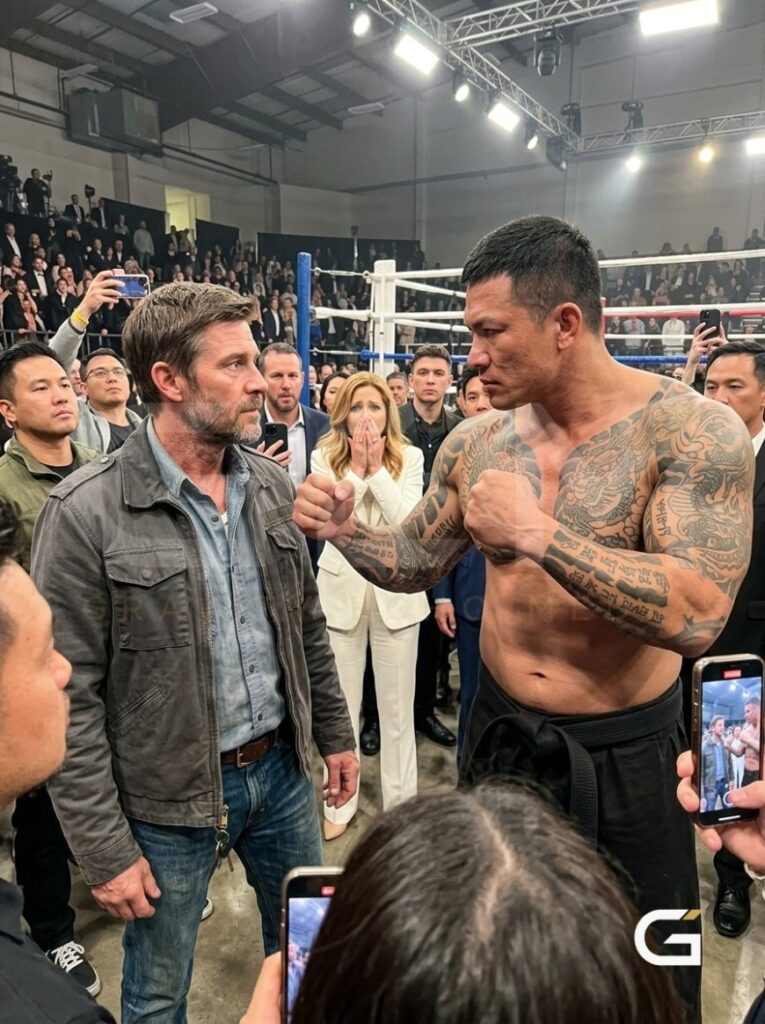
The silence didn’t break all at once. It cracked, the way ice cracks under weight—slowly at first, then all at once.
Someone near the back of the hall started clapping. Then another. Then a dozen hands, then fifty, until the entire room was thundering with applause that had nothing to do with the fight and everything to do with what they had just witnessed.
I didn’t turn around to acknowledge any of it.
My eyes stayed fixed on the exit doors at the far end of the training hall. Old habit. Two exits on the north wall, one on the east, a service corridor behind the technical booth that fed directly into the parking structure. I had mapped every one of them the day I first walked into this building.
Grant Holloway was still on his knees behind me. I could hear his breathing—ragged, uneven, the breathing of a man whose entire understanding of himself had just collapsed in front of three hundred witnesses.
“You set me up,” he said. His voice carried just enough for the front rows to hear.
“You knew exactly what I was going to do, and you let me walk into it.”
I stopped walking.
I didn’t turn around. I didn’t need to. I had heard that tone before—in interrogation rooms, in hospital corridors, in the quiet moments after an operation went sideways. It was the sound of a man searching for someone else to blame because looking inward was too painful.
“I didn’t set you up, Mr. Holloway,” I said quietly.
“You told that crowd what you were going to do to me before you ever stepped onto the mat. I just didn’t stop you.”
I heard him rise to his feet. The crowd’s applause faltered, uncertain now, sensing that something else was unfolding.
“You’re a fraud,” Grant said, louder now.
“You’ve been playing janitor for months while you trained in secret. You came here for a reason. What is it? Who sent you?”
I finally turned.
Grant stood in the center of the mat, his chest still heaving, his face flushed with humiliation and something worse—fear. Not fear of me. Fear of what my existence meant about his own.
And behind him, near the edge of the crowd, I saw Brett Langford.
He wasn’t watching Grant. He was watching me, his expression carefully neutral, the way a man looks when he’s calculating odds. Our eyes met for half a second. He smiled—a small, polite smile that didn’t reach his eyes—and then he turned and disappeared into the crowd.
That smile told me everything I needed to know.
“I came here to work,” I said, answering Grant’s question and Brett’s smile at the same time.
“Nothing more.”
I turned and walked through the east exit doors without another word.
The night air hit my face like cold water.
The parking lot behind the training center was mostly empty—just a few staff vehicles and the catering trucks still being loaded. I walked to the far end, past the dumpsters, to the spot where I had parked my old truck that morning.
Fourteen years old, rust along the wheel wells, a dent in the rear quarter panel from a shopping cart I never bothered to fix. It started on the second try, the way it always did.
I sat behind the wheel for a long moment without turning on the lights.
My hands were steady. They were always steady. That was the problem.
I reached into my jacket pocket and pulled out the watch—wrapped in its worn cloth, the engraving on the back rubbed smooth by time and intention. I didn’t unwrap it. I didn’t need to see it. I knew every scratch on its casing the way I knew the lines on my own palms.
“Tommy,” I said quietly, to no one.
The name didn’t echo. It never did. It just sat in the cab of the truck with me, the way it had sat beside me for eleven years.
I started the engine and drove home.
My apartment was on the third floor of a building that had seen better decades. Two bedrooms, one of which I used for nothing at all. The other held a bed, a dresser, and a single framed photograph I had never hung on the wall.
In the photograph, seven men stood in a line in full desert gear. Six of them were smiling. One of them—the youngest, the one on the far right with the crooked grin—had his arm slung around my shoulder like we had all the time in the world.
I set the watch on the dresser next to the photograph.
Then I sat on the edge of the bed and stared at the wall until the sun came up.
—
The three-second man.
That was what they called me by Monday morning.
I heard it in the elevator when I arrived at 4:58 a.m. Two marketing associates, both of them in their twenties, both of them whispering behind their coffee cups like I couldn’t hear them from three feet away.
“I heard Grant Holloway hasn’t left his house since Friday.”
“I heard the company’s cutting ties with him.”
“My cousin works at the training center. He said the janitor just—like—folded him. Twice.”
They didn’t notice me. Nobody ever did. I was the man in the faded work shirt, the one who fixed the elevator when it got stuck, the one who knew which conference room had the outlet that kept blowing fuses.
I stepped off on the fourth floor and went to work.
The server room needed a new filter. The west stairwell door was sticking again. The third-floor break room refrigerator had been making a noise for a week that nobody else had reported, so I replaced the compressor before lunch.
By 2:00 p.m., I had done the work of three people and spoken to no one.
That was the plan. That had always been the plan.
Then Tessa Whitmore found me.





