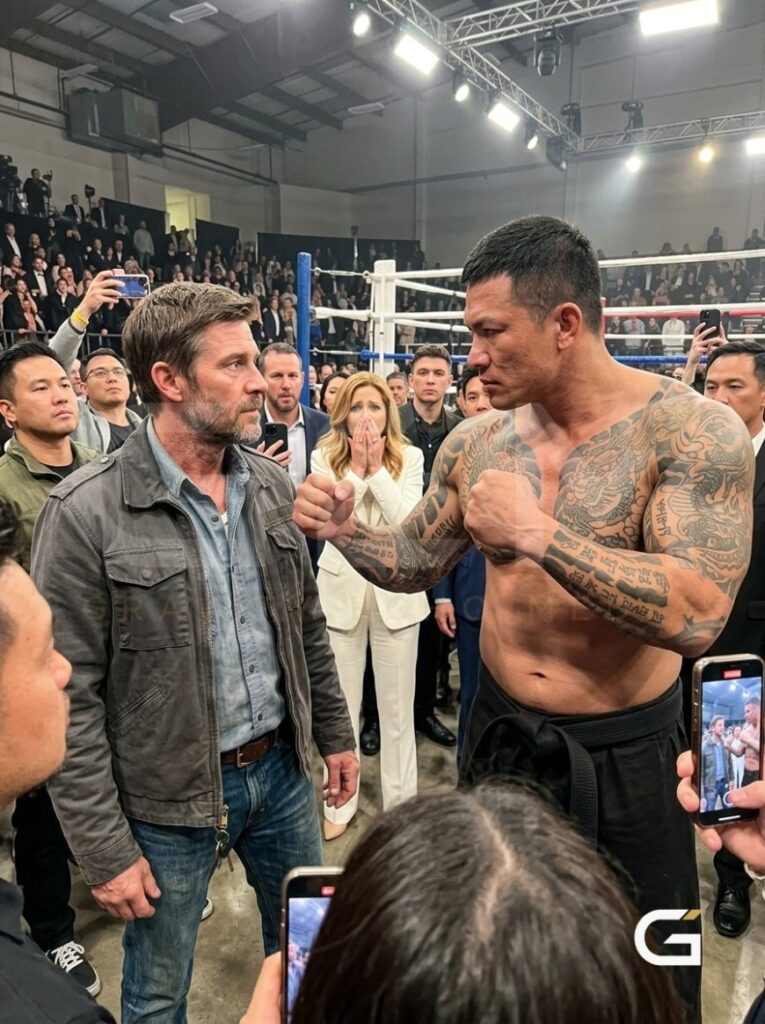
I was on my knees in the basement mechanical room, replacing a valve on the main water line, when I heard footsteps on the stairs. Measured. Deliberate. Not the casual shuffle of someone who had wandered down by mistake.
I didn’t look up.
“Mr. Mercer,” Tessa said.
“Ms. Whitmore.”
I finished tightening the valve and wiped my hands on the rag at my belt. Only then did I stand and turn to face her.
Tessa was in her fifties, with the kind of posture that came from years of holding herself ready for something. Former federal investigator—that’s what her file said. She had been at Caldwell Dynamics for four years, brought in to overhaul the company’s security protocols after a data breach that had never quite been explained.
She was looking at me the way I used to look at people I didn’t trust.
“I pulled your personnel file this morning,” she said. “There’s nothing in it. Background check came back clean in eleven hours. That’s not normal.”
“Eleven hours is efficient.”
“Eleven hours is impossible.” She took a step closer. “For a facilities manager with no military record, no prior employment history before Caldwell, no references, no social media presence, and no listed next of kin.”
I said nothing.
“So I ran your prints,” she continued. “Through a routine contractor verification database. And I got back a message telling me that my query had been logged, flagged, and forwarded to the Department of Defense for review.”
She let that land.
“I’ve been a federal investigator for eighteen years, Mr. Mercer. I have never once had a routine background check flagged by the DoD. Not for anyone. Not ever.”
I picked up my toolbox and started toward the stairs.
“Who are you?” Tessa asked.
I stopped at the base of the stairs. Not because she had asked—I had been asked that question before, by people far more determined than Tessa Whitmore—but because of something in her voice. It wasn’t suspicion. It was something closer to concern.
“I’m the man who fixes your building,” I said.
“That’s not an answer.”
“It’s the only one I have.”
I climbed the stairs and left her standing in the mechanical room.
She didn’t call after me. She didn’t need to.
I knew she wouldn’t let it go.
—
Marissa Caldwell summoned me to her office the next afternoon.
Her assistant, a young woman named Dana who always greeted me with genuine warmth, looked at me a little differently now. Everyone did. That was the problem.
“You can go in,” Dana said. “She’s expecting you.”
I expected the office to be formal—the way it always was when I was called up to fix something. But when I walked in, Marissa was standing by the window with her back to me, and there were two cups of coffee on the conference table.
She didn’t turn around right away.
“Close the door, please,” she said.
I closed it.
“I’ve been trying to figure out how to have this conversation for three days,” she said. “I’ve rehearsed it in my head about forty times. None of the versions make me sound like a good person.”
She finally turned.
Marissa Caldwell was forty-one years old, and she had inherited a company from a father who had built it into a regional powerhouse through a combination of brilliance and ruthlessness. In the six years she had been CEO, she had tripled revenue and doubled headcount, and somewhere along the way she had learned to stop apologizing for the parts of herself that made those numbers possible.
But she wasn’t looking at me like a CEO right now. She was looking at me like someone who had just realized she had been asleep for a very long time.
“Sit down,” she said. “Please.”
I sat.
She sat across from me, took a sip of her coffee, and set the cup down with unusual care.
“Grant Holloway has been calling my office every day,” she said. “He wants to know who you are. So does Brett. So does the board. So does every investor who was in that room on Friday night.”
“And what did you tell them?”
“That I would find out.”
She looked at me steadily.
“So I’m asking you directly, Nolan. Who are you?”
I considered the question the way I considered most things—slowly, from multiple angles, with an awareness that every word I spoke would close certain doors and open others.
“I’m someone who spent eleven years in a line of work that I can’t talk about,” I said. “I left that work for reasons that are my own. I took this job because it was quiet, because it let me be useful without being seen, and because I thought I was finished with the person I used to be.”
“And are you?”
I didn’t answer.
Marissa leaned back in her chair.
“My father used to say that the most dangerous people in the world are the ones who have already proven what they’re capable of and no longer need to prove it to anyone else.” She paused. “He meant it as a warning. I always thought it was a compliment.”
“It can be both.”
“Yes,” she said quietly. “I’m starting to understand that.”
She reached for a folder on the table and slid it toward me.
“Brett’s been pushing the board to approve a new security contract that would put Grant’s organization in charge of our entire protective infrastructure. He’s been working on it for months. I was inclined to approve it until Friday night.”
I didn’t open the folder. I didn’t need to. I had already read it—twice—from the copy Tessa had left on the security desk.
“Don’t sign it,” I said.
Her eyebrows rose. “Why not?”
“Because the proposal has problems.”
“What kind of problems?”





