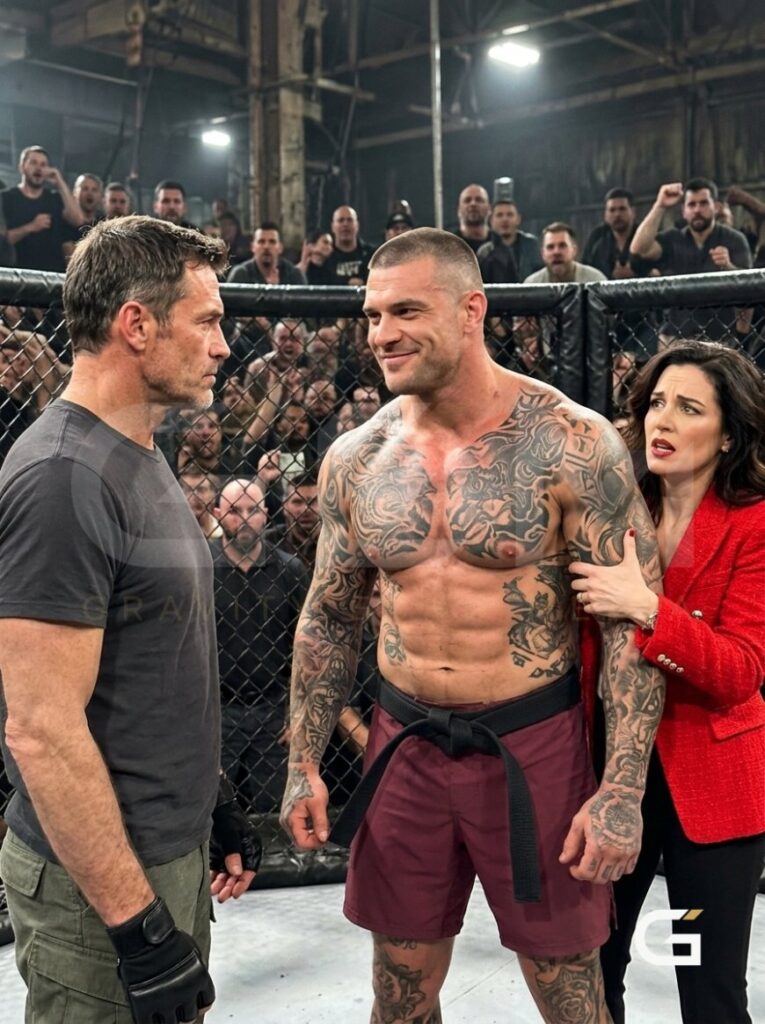
The bell’s echo hadn’t even died against the corrugated walls before Wade Harlland exploded forward like a man who’d been insulted by the very concept of patience.
His right hand came first—a thunderous overhand that had put fourteen men to sleep permanently.
I watched it the way I used to watch weather roll across the plains when I was a kid. Inevitable. Predictable. Slow.
My weight shifted left.
His fist carved through empty air where my head had been half a heartbeat earlier.
The crowd’s roar stuttered.
Wade’s eyes went wide for just a fraction of a second before he recovered and fired a brutal left hook aimed at my liver. That one was faster. Sharp.
I pivoted, letting it graze my ribs instead of burying itself in my side.
“One,” I murmured under my breath.
“One what?” Wade snarled, already resetting his stance.
I didn’t answer. He wouldn’t understand anyway.
One punch that could have ended me. The first of many he’d throw in these next few minutes. But numbers had always been my language—the quiet arithmetic of survival that had carried me through twenty-seven professional fights and the kind of championship bouts that made grown men weep in their corners.
The second combination came immediately.
Jab. Cross. Hook.
Textbook violence, beautifully executed.
I slipped the jab by a whisper, let the cross pass over my shoulder, and ducked under the hook with enough room to feel the wind of it brush my hair.
The crowd was no longer cheering.
They were watching.
That particular silence—the one that falls over a fight crowd when they realize something isn’t going the way it should—that silence had always been my favorite sound in the world.
From the corner of my eye, I caught Everett Sloan pressing himself against the chain-link fence. His knuckles were white where he gripped the metal.
“Impossible,” I saw his lips form.
Colton stood frozen in my corner, his hands wrapped around the bucket he was supposed to hold ready. He looked like a man watching a ghost he’d buried years ago climb out of its grave.
Wade’s frustration was becoming visible. His breathing had changed.
Short, sharp inhales through his nose.
The kind of breathing that meant his brain was finally catching up to what his body already suspected—that this wasn’t going to be the quick, humiliating spectacle he had promised the room.
“What’s wrong?” I asked quietly. “Twenty seconds left.”
His jaw tightened.
He came again.
This time he threw everything—a wild series of hooks and crosses designed not to be accurate but to be overwhelming. The kind of barrage that had made his reputation. Volume and violence. Break the opponent’s will through sheer chaos.
I let him swing.
Three hooks. Four crosses. An uppercut that would have lifted me off my feet if it had connected.
None of them did.
I moved just enough. Never more. That was the secret I’d learned in a small gym in Ohio when I was seventeen years old and didn’t know my life would become this—the art of not being where violence expected to find you.
When Wade finally paused, his chest heaving, his eyes wild, I was standing exactly where I’d started.
“Time,” I said.
He glanced up at the clock.
One minute and forty-three seconds had passed since the bell.
His promised thirty seconds had come and gone without a single clean strike landing.
The murmur started at the front of the crowd and rippled backward like water finding its level. I heard fragments of it—
“Did you see that?”
“He didn’t even…”
“What the hell is happening?”
Wade heard it too. I watched it land on him like rain on hot pavement, each whispered word evaporating into steam that clouded his judgment.
From Wade’s corner, a stocky man named Von Laam—I’d learned his name from the pre-fight chatter—was gesturing urgently. He’d seen what the crowd hadn’t yet processed.
My feet.
I never allowed myself to be cornered. Never crossed my legs. Never committed to a direction without an exit already planned.
The habits of a man who had spent his entire adult life learning how not to get hit.
“Wade!” Von’s voice cut through the noise. “Slow down! He’s baiting you!”
But Wade Harlland had never been baited before. He had never been in a fight where he wasn’t the predator. The concept of someone engineering his aggression like a mechanic might tune an engine simply didn’t exist in his worldview.
He came forward again.
Slower this time. More measured. I watched him try to think, try to calculate.
The effort was written all over his face like a child doing long division.
He threw a jab—not a real one, a probe. Testing my reaction.
I didn’t give him one.
He threw another. Same result.
Frustration flickered across his features.
Then he committed to a cross, and I saw it before he did—the way his weight shifted onto his front foot, the angle of his shoulder, the slight turn of his hip.
The punch was already in the air by the time my body responded.
I didn’t even think about it anymore. That was the thing people never understood about fighters like us. You don’t think at this level. Thinking is too slow. By the time your brain processed the incoming threat and formulated a response, you’d already be on the canvas staring at ceiling lights.
Your body remembers. Your muscles remember.
Twelve years of oil changes and quiet mornings hadn’t erased that. Nothing ever would.
My jab was short. Economical. Barely visible to anyone more than three rows back.
It landed flush on Wade’s chin.
His head snapped back.
The entire depot went silent.
Not the silence of anticipation. The silence of disbelief.





