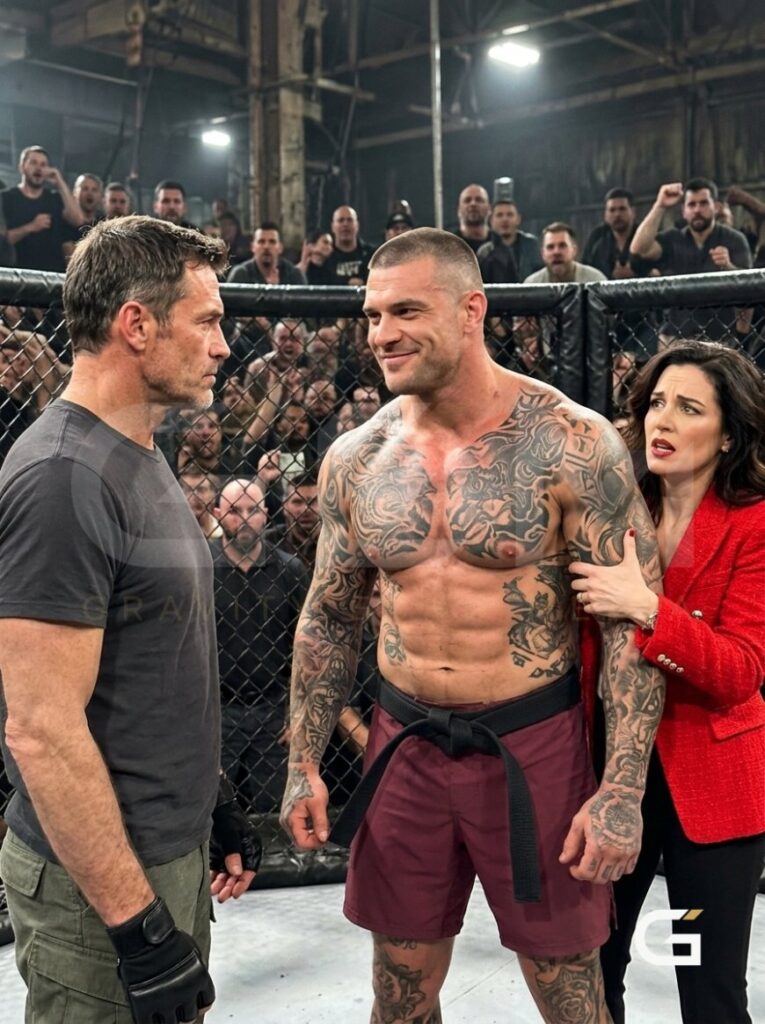
Wade didn’t fall. He was too tough for that. But he stumbled—just one step backward—and that single stumble told everyone watching that the impossible had just become real.
The unbeatable Wade Harlland had been hit.
Cleanly.
By a mechanic.
I saw the rage flood his eyes and knew what was coming next. The composure was gone. The measured approach was done. He was going to come at me with everything he had left, all at once, because that was the only thing his ego could accept.
“Thirty seconds,” I reminded him quietly. “You’re running out of time.”
He screamed something I couldn’t understand and charged.
I sidestepped.
Just a few inches. Just enough.
His momentum carried him past me, and I let him go.
Not yet.
The round wasn’t over.
—
The bell saved him.
Two minutes left in the first round, and Wade had already learned a lesson that a decade of knocking people unconscious had never taught him—that sometimes the most terrifying opponent is the one who doesn’t seem afraid.
He walked back to his corner on unsteady legs, and the silence followed him like a shadow.
I returned to my own corner where Colton was waiting with wide eyes and shaking hands.
“Holy…” He couldn’t even finish the sentence. “Grant, what… how…”
“Water,” I said.
He blinked.
“Water,” I repeated. “I need water.”
He handed me the bottle and I drank slowly, watching the room over the rim.
Everett Sloan had moved. He wasn’t at his station anymore. He was standing directly behind my corner, close enough that I could smell the liniment on his hands—the same liniment he’d used decades ago when he’d worked my corner during those championship nights in Las Vegas and Atlantic City.
“Grant Mercer,” he said quietly.
I set the bottle down.
“Everett.”
“How long has it been?”
“You know the answer to that.”
He shook his head slowly. “I thought you were dead. Everyone thought you were dead. You just… vanished. No goodbye. No explanation. Nothing.”
“I had reasons.”
“I’m sure you did.” He glanced toward the cage where Wade was getting instructions from a frantic Von Laam. “Does he know who you are?”
“He’s about to find out.”
Everett let out a shaky breath. “Christ, Grant. I was there when you beat Delacroix for the belt. I was there when you defended it against Morrison and that Russian kid and… and what happened in Houston.”
I didn’t flinch at the mention of Houston. I’d trained myself not to.
“The last time I saw you,” Everett continued, “you were walking out of an arena with your daughter on your shoulders. She couldn’t have been more than four years old. You were smiling like you’d just won the lottery even though you’d just given up everything any fighter worth a damn would kill for.”
“She was five,” I said quietly. “And I hadn’t given up anything that mattered.”
Everett stared at me for a long moment.
Then he nodded.
“The quiet storm,” he said. “That’s what they used to call you. I never understood why until right now. You always were the most patient fighter I ever wrapped hands for. You never rushed anything. You waited until the other guy made the mistake, and then you…”
He didn’t finish the sentence.
He didn’t need to.
From across the cage, I saw Brinn Calder approach Wade’s corner. Her face was pale with barely contained fury. She spoke rapidly to Von Laam, gesturing toward me, and I watched understanding dawn slowly on Wade’s features as he turned to look at me.
Colton noticed it too.
“She’s telling him,” he said.
“Probably.”
“What do you want to do?”
I thought about it for a moment. I thought about my daughter—now seventeen years old, probably at home studying for finals, completely unaware that her father was standing in an abandoned railway depot about to fight a man half his age.
I thought about the life I’d built. The garage. The neighbors who only knew me as the mechanic who could fix anything and never chased anyone’s rabbit. The mornings that were mine alone.
I thought about what I’d told myself after the last time I ever wrapped my hands professionally—that I would never do this again. That there was nothing left in that world worth pulling me back.
But then I looked at Colton, at his tired eyes and his failing gym and the sweat on his brow from months of wondering whether he’d lose everything he’d built.
And I thought about the way Wade had treated Dustin. The way he’d shoved him into a support beam and smiled about it.
“Standard rules,” I reminded the referee when he came over to check on me. “We’re still using standard rules, right?”
The ref—a grizzled old man named Pete who’d been doing this longer than anyone could remember—nodded slowly.
“That’s what the agreement said.”
“Good.”
I stood up from my corner and rolled my shoulders.
The second round was about to begin.
—
Wade didn’t come out aggressive this time.
He came out cautious. Calculating.
Brinn had told him something, clearly, and whatever it was, it had changed his approach. He circled me carefully, keeping his guard high, watching my feet.
He was trying to learn.
That was smart.
I gave him credit for that.
“Did she tell you?” I asked, keeping my voice low enough that only he could hear.
“About what?”
“About who I am.”
He didn’t answer.
“She told you something,” I continued. “Maybe not everything. Maybe just enough to make you careful. That’s why you’re being smarter now. That’s good. You should be smarter.”
“You don’t know anything about me,” he snapped.
“I know enough.”
He lunged.
I slipped.





