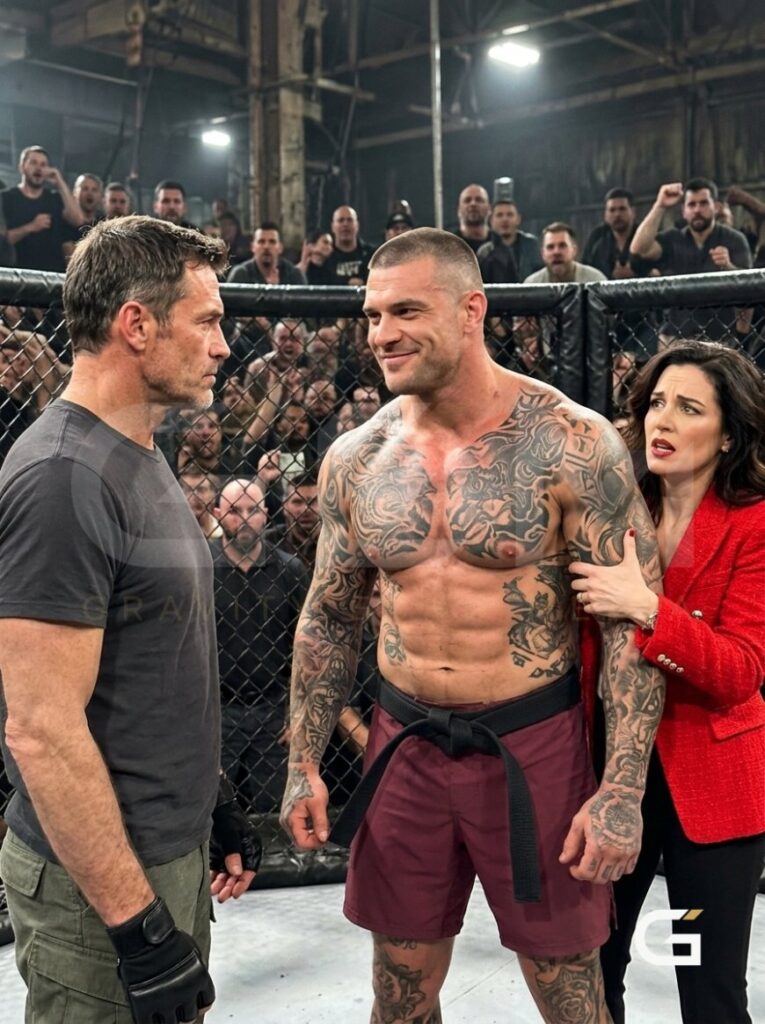
“Fighting isn’t about hurting the other guy,” I said. “It’s about not getting hurt yourself. All the rest is just window dressing.”
“What the hell does that even mean?”
“It means you’ve spent your whole career learning how to hurt people. But you’ve never learned how not to get hurt. And that’s the difference right now. That’s the only difference.”
He attacked again.
Better this time. More controlled. A combination designed to create an opening rather than simply overwhelm me.
I saw it coming, of course. The feint, the pivot, the cross that was supposed to land while I was distracted by the feint.
I let him think it would work.
Then I stepped inside the cross and caught his ribs with a body shot that made his breath stutter.
“Oh,” he managed.
“You’re learning,” I said. “But not fast enough.”
—
Ralph Von Laam was terrified.
I could see it in his eyes, the way he watched his fighter stumble back to the corner at the end of the second round. Wade had taken three clean strikes in those five minutes—not enough to hurt him seriously, but enough to prove a point.
“He’s toying with you,” Von said, wiping sweat from Wade’s face. “He’s not even trying to finish it.”
“Then what is he doing?”
“He’s teaching you something. I don’t know what, but that’s what he’s doing. He could have ended this twice already. He didn’t.”
Wade sat on the stool and stared across the cage at me.
I was standing in my corner, drinking water, having a quiet conversation with Colton about something that had nothing to do with fighting. I was relaxed. Comfortable.
It made him furious.
I understood why. When you’ve spent your entire career being the most dangerous person in every room, encountering someone even more dangerous—someone who isn’t even trying—is a blow to the ego that no punch can equal.
Everett leaned in toward me.
“I have to ask,” he said. “Why didn’t you finish it?”
“Because he needs to learn something first.”
“Grant, this is a fight. Not a classroom.”
“Everything’s a classroom,” I said. “You taught me that.”
Von’s words carried across the canvas. “He’s got nothing left to prove,” he told Wade. “That’s why he doesn’t care if he wins. He already won something you’ll never understand.”
“What’s that?”
“He walked away. On his own terms. No one ever forced him out. He just decided he was done, and that was it. That’s a kind of power nobody can take from you.”
Wade stared at me.
I met his eyes and nodded once.
Not a taunt. Not a challenge.
Just acknowledgement.
The bell rang for the third round.
—
This is where it gets complicated.
This is where I have to be honest about what happens when a man who’s been away from the sport for twelve years faces a man who’s been fighting every weekend for five.
Wade had learned something by that point. He wasn’t the same cocky kid who’d promised to finish me in thirty seconds. He was still prideful. Still angry. But he’d been forced to think, and thinking fighters are infinitely more dangerous than instinctive ones.
He came at me with a precision I hadn’t anticipated.
A sharp jab that split my lip.
A cross that caught my shoulder hard enough to numb my arm.
An uppercut that whistled past my chin close enough to tell me he wasn’t playing anymore.
I tasted blood and smiled.
“Better,” I said.
“Stop coaching me,” he snarled.
“If you don’t want me to coach you, stop making the same mistakes.”
He threw another combination, and this time I had to work. I felt my age in every movement—the slight stiffness in my hips, the way my lungs demanded more air than they used to. Twelve years of not fighting is a long time. You can stay in shape. You can stay sharp. But nothing replicates the specific exhaustion of combat.
He caught me with a hook to the body.
I felt it rattle my ribs.
“See?” he said. “You’re not invincible.”
“Never said I was.”
I slipped his next combination and landed a counter that opened a cut above his eye.
We separated. Both breathing hard. Both bleeding.
The crowd was on its feet now, roaring at something they’d never expected—a real fight. Not a demolition. Not a spectacle of one-sided violence. A contest between two men who had something to prove.
Except they were wrong about that.
I wasn’t trying to prove anything.
That was the secret I’d been keeping my whole career. The reason I’d been so effective. The reason opponents hated fighting me.
I’d never needed to win.
I’d only ever needed to not lose.
Those are different things. Most fighters can’t separate them. They need victory the way they need oxygen. Their entire identity depends on walking out of the cage with their hand raised.
I’d walked away from that need a long time ago.
The bell rang for the final round and we touched gloves.
Wade paused.
“What was your record?” he asked. “Before you quit. What was it?”
“Twenty-seven and two.”
His eyes widened. “You lost twice?”
“I won a championship. I defended it four times. I made enough money to take care of my daughter for the rest of her life. And then I walked away before my body made the decision for me. Those two losses don’t mean anything.”
“What do they mean?”
“They mean I learned something. Every loss teaches you something. Your problem is you’ve never lost, so you’ve never had to learn.”
“Maybe I’ll learn tonight.”
I nodded. “Maybe you will.”
The fourth round began.
—
Wade fought better than he ever had in his life.





