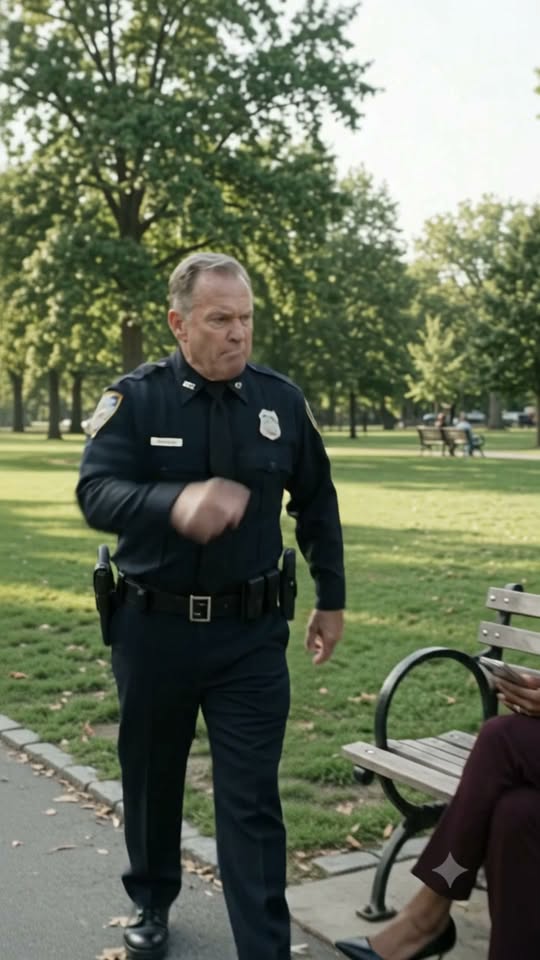
What he did not expect was for the woman to smoothly stand up from the bench, her posture impeccably straight despite the swelling on her face. She calmly picked up her glasses from the pavement, slid them into their protective case, and tucked the Mercer file securely under her arm.
She looked the police chief dead in the eye and said, “My name is Evelyn Carter.”
Hale scoffed, a nervous, dismissive sound. “I don’t care who you are.”
Evelyn nodded slowly. “That is incredibly unfortunate for you.”
She turned and walked away, her footsteps steady on the pavement, leaving the most powerful law enforcement officer in Bellwood standing alone in the grass.
Neither the judge nor the police chief knew that seventy yards away, crouched behind the rusted chain-link fence of the baseball diamond, a man with a 300mm telephoto lens had been watching the entire exchange.
By 5:06 that afternoon, investigative reporter Noah Bennett was sitting in the fluorescent-lit purgatory of the Bellwood Chronicle newsroom, uploading the digital files from his camera to his desktop.
Noah hadn’t gone to the park looking for the police chief. He had been chasing a ghost.
For six grueling months, Noah had been investigating a pattern of missing disciplinary records within the Bellwood Police Department. It was soul-crushing, unglamorous work. There were no cinematic midnight meetings in parking garages. It was a war of attrition fought through ignored Freedom of Information Act requests, heavily redacted internal memos, and bureaucratic stonewalling.
But Noah possessed the one trait necessary for a great investigative journalist: a pathological inability to let things go. He knew that systemic corruption didn’t announce itself with a megaphone. It accumulated in the shadows. A missing use-of-force report here. A suddenly retired detective there. A multi-million dollar city settlement paid out to a grieving family with a strict non-disclosure agreement attached.
That afternoon, Noah had been photographing a delayed, over-budget municipal drainage project near the park when the blue police SUV had jumped the curb. His instincts had taken over. He had raised his camera, tracking Hale’s aggressive march across the grass. He photographed the confrontation. He photographed the body language.
And he had photographed the slap.
Noah clicked the mouse, bringing the sequence of images onto his high-definition monitor. The final photograph was breathtakingly violent. Hale’s massive hand was still suspended in the air, a blur of motion. The woman’s head was violently jerked to the side, her gray hair flying out of its clasp. In the background, three civilian witnesses stood frozen in horror.
Noah stared at the screen, his heart hammering a frantic rhythm against his ribs. He knew instantly that this image was a career-defining piece of photojournalism. But he didn’t yet understand the true magnitude of what he was looking at.
He hit print. The laser printer whirred, spitting out a glossy eight-by-ten.
His editor, a fiercely pragmatic woman named Susan Price, walked past his desk, a mug of black coffee in her hand. She glanced at the photo in the tray. She stopped dead in her tracks.
“Noah,” she breathed, picking up the still-warm paper. “What the hell is this?”
“I took it an hour ago at Bellwood Park.”
Susan stared at the image, her eyes wide. “Is that Chief Marcus Hale?”
“Yes.”
“And he just… backhanded a civilian woman?”
“Yes. Broad daylight.”
“What provoked it?”
“I was too far away to hear the audio,” Noah admitted, rubbing the back of his neck. “I’m tracking down the witnesses now. But Susan… look at the woman. Do you recognize her?”
Susan squinted at the photograph. “No. Just looks like a grandmother.”
“That’s what bothered me. She didn’t fight back. She didn’t scream. She just stood up and walked away. I enlarged the earlier frames.” Noah clicked his mouse, bringing up a zoomed-in shot of the woman sitting on the bench before Hale approached.
In the extreme background, parked legally on the street behind the trees, was a blue sedan. The telephoto lens had captured the first four digits of the license plate.
“I ran a partial plate search through the municipal parking permit database,” Noah explained, his fingers flying across his keyboard. “It belongs to a woman named Evelyn Carter.”
Susan’s brow furrowed. “That name rings a bell.”
“It should.” Noah opened a new tab, pulling up the official directory for the Bellwood Municipal Court. He turned the monitor so Susan could see.
There, staring back at them, was an official portrait of the woman from the park. Her hair was perfectly styled. She was wearing heavy black judicial robes.
Evelyn Carter. Senior Administrative Judge. Chair of the Judicial Ethics Committee.
Susan slowly sank into the empty chair beside Noah’s desk. The color had drained completely from her face. “Oh my god.”
“Yeah,” Noah whispered.
“Marcus Hale just assaulted a sitting senior judge in a public park.”
“Apparently so.”
Susan stared at the screen for a long, agonizing moment. The journalistic implications were staggering. “Does Hale know who she is?”
“Based on the way he hit her? I highly doubt it. If he knew she was the judge overseeing the city’s misconduct dockets, he’d have kissed her ring, not slapped her face.”
“Noah, do not publish this yet,” Susan commanded, her voice dropping to a harsh whisper.
Noah frowned, instinctively defensive of his scoop. “Why? Susan, this is a Pulitzer-level photograph. If we sit on it, someone else might—”
“Because this isn’t just a story about a bad cop losing his temper,” Susan interrupted, tapping the screen with her fingernail. “This is a geopolitical earthquake in this city. If we publish this without context, Hale will spin it. He’ll say she was interfering with an arrest. He’ll say he felt threatened. We need the why.”
“The why?”
“Why was she in that park? Why did Hale approach her? Was she reviewing a case involving his department? We need the whole picture.”





