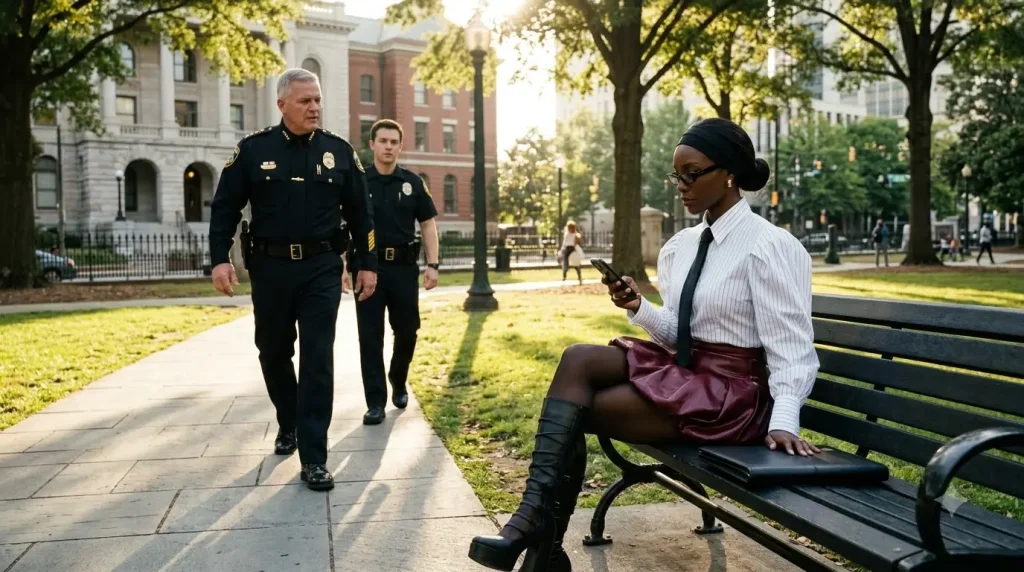
“You chose to come in without him?”
“Yes.”
“Why?”
Price looked at the floor.
“Because I think this is why I was supposed to meet you.”
Amara’s eyes sharpened.
There it was.
The second reason she had been sitting in the park.
She said nothing.
Price continued.
“I sent the letter.”
Three weeks earlier, Amara’s chambers had received an anonymous packet.
Not through the normal electronic filing system.
Paper.
No return address.
Inside were photocopies of internal police emails, body-camera audit logs, and handwritten notes identifying forty-two encounters in which cameras had allegedly been disabled immediately before force was used.
The consent decree already required strict body-camera compliance.
Official department reports claimed compliance exceeded ninety-six percent.
The anonymous material suggested something far worse.
Supervisors had developed a practice they called quiet windows.
Officers would deactivate cameras before certain encounters.
Afterward reports listed technical failure, accidental battery exhaustion, or administrative misclassification.
The allegations were serious enough that Amara referred them through proper legal channels to the independent federal monitor.
Then another note arrived.
I can prove it. I cannot send the files electronically. They audit access. Thursday, 4:30 p.m., south courthouse park. Gray bench near fountain. I will identify myself.
Amara had never intended to conduct a secret investigation personally.
She planned only to receive the whistleblower, then transfer him immediately to the court monitor and federal investigators.
She arrived early.
So did Raymond Mercer.
Amara looked at Price.
“You were the source.”
He nodded.
“How long?”
“Seven months.”
“Why?”
Price breathed out slowly.
“Because my training officer told me the camera was for protecting us.”
“That was day one.”
“Then I got to patrol.”
His hands tightened.
“People started telling me when to turn it off.”
“Who?”
“Sergeants at first.”
“Then lieutenants.”
“Sometimes command.”
“Mercer?”
Price hesitated.
“Yes.”
Amara remained still.
“Directly?”
“Three times.”
“Today makes four.”
Amara glanced toward the empty body-camera mount.
“What exactly is a quiet window?”
Price looked ashamed even though he had not invented it.
“You call out something ordinary.”
“Community contact.”
“Foot patrol.”
“Business check.”
“Then if someone looks like they might become a problem, supervisor says ‘take a quiet window.’”
“Camera goes off.”
“What qualifies as a problem?”
Price looked directly at her.
“Someone who argues.”
“Asks too many questions.”
“Knows policy.”
“Records us.”
“Won’t give ID when they don’t have to.”
Amara’s cheek still burned.
She felt something colder beneath it.
Recognition.
Price continued.
“Mostly Black men.”
“Some homeless people.”
“Protesters.”
“Young people.”
“Anyone officers think will complain.”
Amara asked:
“Have you participated?”
Price’s face reddened.
“Yes.”
The answer mattered.
She respected it.
“How many times?”
“Five.”
“Did force occur?”
“Twice.”
“Were reports inaccurate?”
He closed his eyes.
“Yes.”
Amara sat back.
“Why come forward now?”
Price took a long time.
“Because of a kid.”
She waited.
“Seventeen.”
“Black.”
“Stopped behind a convenience store.”
“He mouthed off.”
“Sergeant told us quiet window.”
“We shut cameras off.”
“One officer shoved him against a wall.”
“Kid pushed back.”
“Everybody said resisting.”
“He got hit.”
“Broke his orbital bone.”
Amara knew the case.
It was one reason the consent decree had tightened.
“Your report?”
Price looked sick.
“I wrote that he initiated physical resistance.”
“Did he?”
“Not the way the report made it sound.”
“Why?”
Price’s eyes filled.
“Because I was scared.”
“Of?”
“Losing the job.”
“Getting frozen out.”
“Being the rookie nobody backed.”
Amara nodded slowly.
Not approval.
Understanding.
Price continued.
“The kid took a plea.”
“Three months.”
“Probation.”
“Then I saw him at a grocery store with his mother.”
“She recognized me.”
“She didn’t yell.”
“She just looked at me.”
“I couldn’t sleep.”
Amara said quietly:
“Guilt is useful only if it changes behavior.”
Price looked up.
“My father says something like that.”
Amara almost smiled.
“Your father sounds exhausting.”
“He is.”
Then Price’s expression became serious again.
“I copied audit logs.”
“Supervisor texts.”
“Dispatch records.”
“Training notes.”
“Where are they?”
“Safe.”
“Not at my house.”
“Good.”
He looked toward her reddened cheek.
“I didn’t know he’d do that.”
“Neither did I.”
“I should’ve stopped him.”
Amara shook her head.
“You kept the camera running.”
“That may matter more.”
Price stared at her.
“Am I going to jail?”
Amara did not lie.
“I don’t know.”
He nodded.
“You may face consequences.”
“You should.”
The rain had stopped by midnight, leaving the pavement around the federal courthouse complex slick and dark, reflecting the amber glow of streetlamps and the flashing red-and-blue strobes of police cruisers that no longer belonged to Raymond Mercer.
Inside the limestone-clad security perimeter of the judicial chambers, the air smelled of stale coffee, expensive parchment paper, and the metallic tang of damp wool coats. Rebecca Lin sat at the long mahogany conference table, her laptop screen illuminating her tired face with a pale, steady blue. Piles of transcribed dispatch logs, officer shift rosters, and internal email chains were stacked three inches high beside her elbows.
Amara Bennett stood by the tall, arched window, looking down at the empty park across the street. The black iron bench was barely visible beneath the drooping branches of the ancient oak trees, quiet now, washed clean of the afternoon’s violence. Her fingers lightly brushed the tender swelling along her cheekbone, where a faint purple bruise was beginning to bloom beneath her skin.
The door swung open, and Lena Morris stepped inside, followed closely by Deputy U.S. Marshal Hayes.
“The network feed has been mirrored across every major wire service from Washington to Los Angeles,” Lena said without preamble, dropping a heavy leather bag onto a chair. She looked exhausted, her professional composure tested by twelve hours of unbroken crisis coverage. “The police union’s public relations director resigned twenty minutes ago after trying to defend Mercer by claiming the judge was ‘loitering suspiciously.’ Even the city council members who used to draft resolutions praising Mercer are scrubbing their social media accounts.”
Amara didn’t turn around immediately. “And the video from Officer Price’s body camera?”





