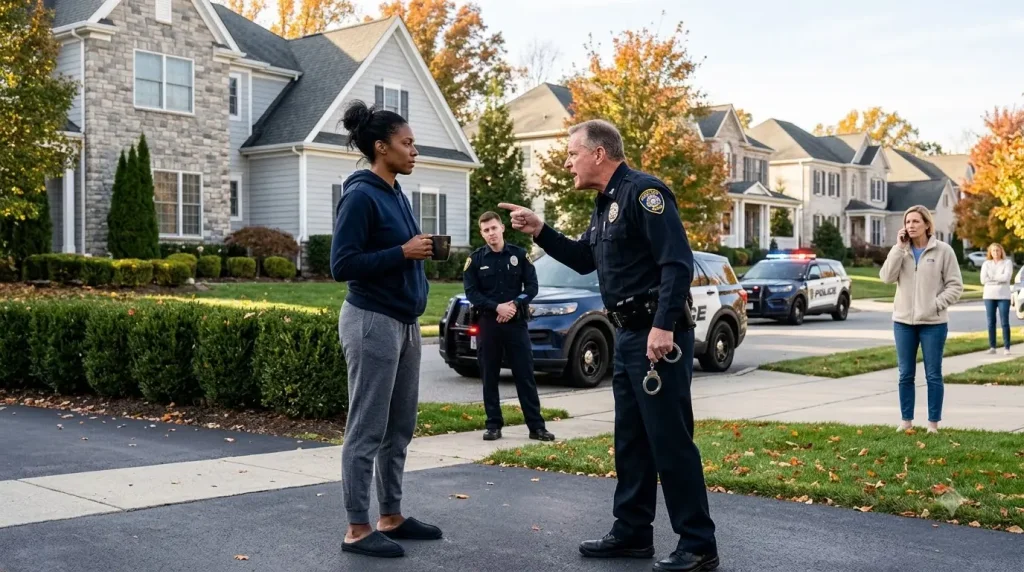
At 7:14 on Saturday morning, Lieutenant Colonel Danielle Carter stood barefoot on the cool white oak planks of her kitchen floor, watching a thin ribbon of steam curl from a heavy stoneware mug.
For eighteen years, home had been an administrative category rather than a place. It was a temporary duty station in Stuttgart, a furnished duplex outside Fort Bragg, a high-rise apartment in Rosslyn chosen solely because it shaved eleven minutes off her morning commute to the Pentagon. Military life trained you early not to fall in love with walls. Orders arrived, boxes were taped shut, and rooms became line items on a relocation voucher.
Yet Hawthorne Ridge felt stubbornly, wonderfully permanent.
Located in a leafy pocket of Arlington County where mature pin oaks arched over stone retaining walls and slate roofs, the street possessed the kind of deep, unhurried quiet Danielle had spent nearly two decades missing. She had closed on the two-story colonial six weeks earlier, using every penny of savings from two overseas deployments and years of disciplined living. Inside, half the rooms still smelled faintly of fresh paint and cardboard. Framed commendations leaned against the wainscoting in her upstairs study waiting for picture wire, and the built-in bookshelves in the dining room held rows of bound federal reporters, constitutional treatises, and emergency-management manuals where other people might have placed porcelain or travel souvenirs.
She wrapped both hands around the warm ceramic mug. No uniform. No encrypted tablet buzzing on the counter. No junior officers knocking with urgent legal reviews before sunrise. For twenty minutes, she intended to be nothing more than a woman drinking dark-roast coffee in her own kitchen.
Then, through the beveled glass beside the front door, she noticed the cardboard box resting near the stone mailbox at the foot of the driveway.
Danielle frowned slightly. The delivery alert on her phone had claimed the parcel was left on the front porch. Evidently, the courier had decided the forty-foot walk up the slight incline wasn’t worth the extra twelve seconds.
Setting her mug down, she pulled on a pair of soft gray sweatpants and an ancient navy sweatshirt whose cuffs were frayed to pale threads. Across the chest, faded white block letters read GEORGETOWN LAW. Her mentor, Colonel Rebecca Sloan, routinely teased her that the garment belonged in a Smithsonian display case, yet Danielle refused to retire it. After surviving three years of evening classes, moot court briefs, and constitutional law seminars in that sweatshirt, she figured it had earned the right to look worn out.
She slid her feet into suede moccasins, reclaimed her mug, and stepped out onto the front porch.
The October air was crisp and bright, carrying the faint, earthy scent of damp leaves and freshly cut grass. Golden maple leaves lay scattered across the flagstone walkway. Across the street, rhythmic pop-up sprinklers hissed softly over an emerald lawn, while three doors down, an older couple in cycling jerseys stood beside an open garage door adjusting helmet straps.
Danielle raised her free hand in a casual wave. “Morning.”
The man looked up and smiled. “Beautiful one out here.”
“Finally,” she called back.
She strolled down the sloped asphalt driveway toward the street. Reaching the stone mailbox, she crouched slightly and lifted the cardboard parcel. It was dense and compact—almost certainly the three-volume reference set on domestic defense support of civil authorities she had ordered for her upcoming lecture series.
Tucking the box securely under her right arm, she straightened up—and caught sight of a woman standing on the manicured front lawn directly across the street.
Blonde hair styled in a neat bob. Soft pink cashmere cardigan buttoned over white slacks. An iPhone pressed to her left ear.
Linda Harper.
They had spoken exactly once, the morning after the moving van pulled away. Linda had materialized on Danielle’s front steps holding a foil-wrapped loaf of lemon bread and what felt like a thirty-point deposition questionnaire. Where did you transfer from? Are you married? Any children? Do you work downtown? Are you renting from the Millers, or did they sell privately?
Danielle had answered with warm, practiced politeness while offering almost nothing substantive. Nearly two decades as an Army Judge Advocate—handling felony courts-martial, sensitive command investigations, and interagency task forces—had taught her that the cleanest way to guard your privacy wasn’t hostility; it was calm, unbothered restraint.
Now, standing beside her boxwood hedge, Linda offered a tight, practiced smile across the asphalt.
Danielle gave a polite nod in return.
Linda did not nod back. Her eyes dropped to Danielle’s frayed sweatpants, lingered on the cardboard box tucked under her arm, and narrowed slightly as she spoke rapidly into her phone.
Danielle turned toward her front porch and took three steps up the driveway.
Behind her, the low, unmistakable rumble of a heavy V8 engine slowed at the crest of the hill. A heartbeat later, a second engine decelerated right behind it.
Danielle glanced over her shoulder.
Two black-and-white Arlington Metro Police cruisers rolled smoothly onto Hawthorne Ridge. The lead vehicle angled sharply to the curb directly in front of her driveway, blocking the apron. The second pulled nose-to-bumper behind it. Twin light bars flared to life, strobing red and blue against the stone mailbox and the trunks of the oaks.
Danielle stopped walking.
Across the street, Linda Harper slowly lowered her phone from her ear, her expression settling into a look of rigid, vindicated expectation.
That answered the first question.
The driver’s door of the lead cruiser swung open. A stocky white man in his mid-fifties stepped out onto the street. He had close-cropped iron-gray hair, a weathered, square jaw, and three chevrons stitched onto the sleeves of his dark navy uniform shirt. He closed the door with a heavy metallic thud and fixed his gaze immediately on Danielle—not on the house, not on the front porch where the brass deadbolt glinted in the morning light, and certainly not on Linda Harper across the road.





