The lamp beside the chair had not been turned on. The evening light coming through the western window was soft and gray and the color of a particular kind of memory. He walked to the writing desk. He opened the bottom drawer. The leather portfolio was where Alena had left it, in the same place she had always kept it, beneath the small bundle of Christmas cards from her sister in Maine, and above the slim folder of letters from her father that she had been unable in the end to throw away.
Harold lifted the portfolio out carefully. He carried it to the small round table beside the window and set it down and untied the ribbon that held it closed. The portfolio contained perhaps 40 letters, arranged in the careful chronological order that Alena had imposed on every paper she had ever filed in her life. Harold did not read the letters. He had no intention of reading them tonight, and he was not certain he would read them at all, because there were certain corners of his wife’s private life that she had not invited him into during her lifetime, and he did not believe his grief gave him a license to enter them now.
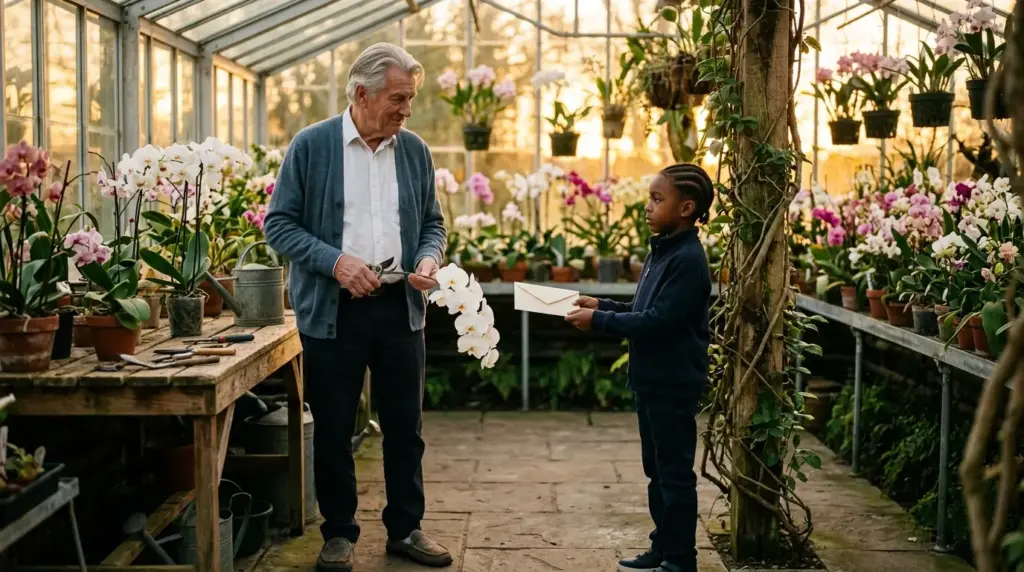
But he leafed through the bundle quickly, looking at the return addresses on each envelope, the way a man searches a file for a single name. He found it on the seventh letter. The envelope was addressed to Alena in the same convent school handwriting he had read in the greenhouse. The return address in the upper left corner read simply P. Donnelly with a street address in Trenton, New Jersey.
The postmark was June of 2014. Harold stood for a moment with the envelope in his hand. He did not open it. He understood with the small particular clarity that came to him only on certain evenings in certain rooms that Alena had known Patricia Donnelly, that Alena had corresponded with her. That Patricia Donnelly was not, as he had assumed in the greenhouse, simply a former secretary writing from a hospice in Trenton to a man she had once brought coffee to for 19 years.
Patricia Donnelly was something more. Patricia Donnelly was someone Eleanor had trusted. He set the envelope back in the portfolio. He retired the ribbon. He returned the portfolio to its drawer.
He stood in the morning room for a moment longer, looking at the small upholstered chair beside the window, and he said, in the quiet voice he sometimes used in this room and in no other room in the house, “I am listening now. I am sorry it took me so long. ” Then he left the room and closed the door behind him. He went back downstairs. He went back to the greenhouse. The boy was still on the stool.
Stephen Colter arrived at the house at 23 minutes past 8:00. He came up the back lane in a dark sedan with the headlights set to their lowest beam, and he parked behind the kennels exactly as Harold had asked him to. Marguerite let him in through the kitchen door. He carried a small leather satchel that Harold had seen perhaps five times in the 34 years of their friendship, and he wore the long gray overcoat he had been wearing to evening meetings since 1989, and he came up the back stairs to the second floor without speaking to anyone he passed in the corridor. Harold met him at the door of the study.
The two men did not embrace. They had never embraced. They shook hands once briefly in the small formal way of men who had stood together at funerals and bedsides and never required the comfort of physical contact to express what they had come to express. Stephen looked at Harold for a long moment. “Tell me,” he said.
Harold told him. He told him in 14 minutes, sitting in the leather wing chair beside the empty fireplace, with the small black telephone on the desk and the envelope from the greenhouse on the table between them. He left nothing out. He showed Stephen the letter. He told him about Wendell.
He told him about Elina’s portfolio and the envelope from Trenton that he had not opened. He told him finally about the boy who was still sitting on a stool in the orchid greenhouse at the bottom of the gravel road waiting to be brought back into the warm light of a room where a man with a notarial seal would write down his account of what he had done that evening and ask him to sign his name at the bottom of the paper. Stephen listened without interrupting. When Harold finished, Stephen sat for a moment in his own chair and looked at the small green folder he had set on the table beside the letter. The green folder had been in the bottom of Steven’s file cabinet for 11 years.
Its contents had been added to it slowly, one document at a time, in the long quiet course of a friendship in which Stephen had occasionally noticed things about certain of Harold’s senior executives that Harold himself had not been ready to notice and which Stephen had filed away rather than raise because Stephen had been raised to believe that a lawyer who raised concerns before they could be substantiated was a lawyer who lost the confidence of the man who paid him. “Bernard Vance,” Stephen said quietly. “Yes. I have been wondering for some time how this conversation would begin. I had not expected it to begin with a child in an orchid greenhouse.
I should have. The truth in these matters almost never comes through the door you have been watching. ” He opened the green folder. He laid three documents on the table between them side by side. He did not explain them. He let Harold look at them.