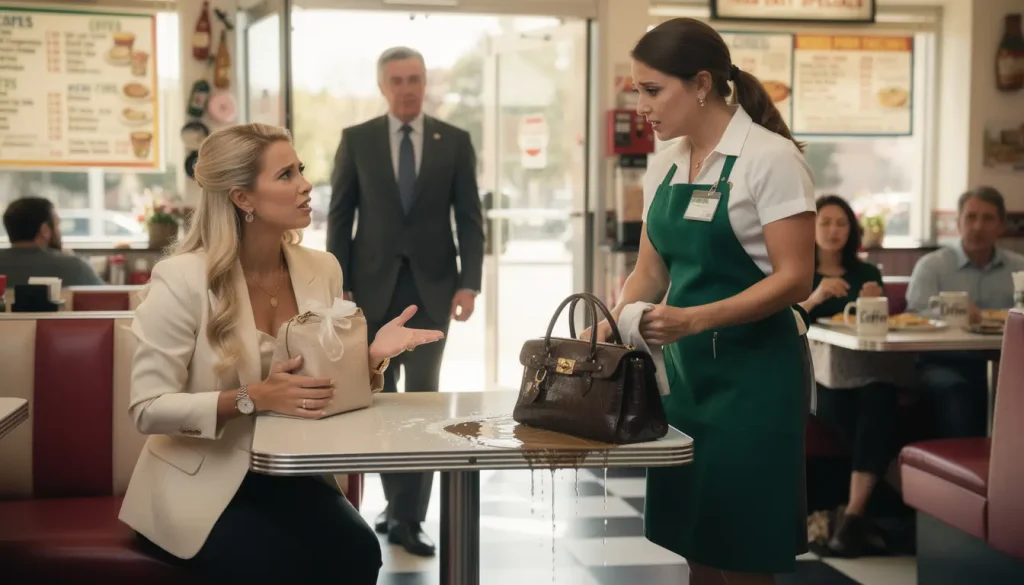
Kennedy held the small glass jar of roasted peanut dust in her coat pocket.
The cold glass burned against the palm of her hand like dry ice.
She stood in the service alley behind the flagship dining room, where the autumn wind smelled of wet brick, charred wood, and caramelized sugar.
Inside, the thirty-year anniversary gala roared through the floorboards like an idling locomotive.
Two hundred guests sat beneath the crystal fixtures of the grand dining room, their laughter muffled by thick velvet draperies and polished brass partitions.
Daisy Okafor sat at the head table beside Marcus Hale, her diamond bracelets catching the candlelight every time she reached for her water goblet.
Down in the prep kitchen, the rhythm of the dinner rush was pure, relentless percussion.
Pots clattered on iron ranges.
Chef Otis barked station checks every thirty seconds, his voice hoarse from four hours of service.
Naomi stood at the pastry station under the harsh glare of the center fluorescent lights.
Her hair was tied tightly beneath a black skull cap, her apron dusted in white flour and gray smudges of ground Madagascar vanilla.
Beside her, forty individual tart pans rested on cooling racks, their fluted crusts golden and speckled with coarse black pepper.
She worked without looking up, her fingers moving across the wooden work table with the practiced, quiet speed she had learned on a milk crate in Kessler twenty years ago.
She brushed melted brown butter into the corners of each pastry shell.
She checked the digital thermometer plunged into a simmering pot of spiced blackberry reduction.
She did not rush, and she did not hesitate.
Kennedy stepped through the swinging stainless-steel doors, her evening dress rustling against the edge of the prep cooler.
She was supposed to be in the front of the house, seated at her grandmother’s table with a forced smile and a glass of ginger ale.
Instead, her fingers stayed curled around the glass jar in her pocket.
Her grandmother’s voice echoed in her ears, sharp and rhythmic as a metronome.
You lose your name, Kennedy, and you are just a girl with opinions.
Do you want to be the second daughter in your own house?
Kennedy moved along the stainless-steel prep counter toward the pastry line.
Naomi’s back was turned as she checked the reach-in refrigerator for the chilled mascarpone cream.
The station was immaculate, arranged in clean rows of glass bowls and stainless-steel measuring spoons.
Beside the cutting board sat a clear plastic container of toasted almond flour, clearly labeled in thick black grease pencil: TREE NUTS ONLY — NO LEGUMES.
It would take three seconds to twist the lid, dump two spoonfuls of the peanut dust across the corner of the board, and step away.
Nobody would even have to eat it.
Her grandmother had promised that the health inspector or the floor captain would find the container during the mandatory pre-dessert allergen sweep.
Naomi would be written up for catastrophic cross-contamination protocol violations.
Chef Otis would throw her out of the kitchen before the main course plates were cleared.
And Marcus would have no choice but to accept that his long-lost daughter was a liability to the brand.
Kennedy reached into her pocket.
Her fingers slid the lid half a turn.
Then she looked down at the cutting board.
Beside the ramekins of sugar sat an index card written in Naomi’s neat, round handwriting.
It was the prep list from the previous Saturday.
Across the bottom margin, in pencil, Naomi had scribbled a note: Kennedy likes the crust colder. Remind her to keep the butter chilled when she cuts it.
Kennedy stopped breathing.
She remembered the grease stains on Naomi’s apron when they stood together at two in the morning over a flat of bruised fruit.
She remembered Naomi standing there, exhausted from a twelve-hour shift, showing her how to feel the dough with the heels of her palms instead of pressing it with a roller.
Naomi hadn’t mocked her for not knowing how to use a pastry cutter.
She hadn’t mentioned the viral video where Kennedy threw twenty-dollar bills onto the diner floor.
She had just told her to cut the butter smaller so the steam could lift the flour.
Kennedy looked at the glass jar in her hand.
Her throat went dry as sandpaper.
The grease pencil on the label seemed to throb beneath the kitchen lights.
She wasn’t protecting her father’s legacy.
She wasn’t protecting her place at the table.
She was doing what Eleanor Hale had done twenty-five years ago in a walk-up apartment with a check and a man in a dark suit.
She was destroying someone who refused to beg.
Naomi turned around, carrying a tray of candied thyme sprigs.
She saw Kennedy standing beside her station, frozen, with one hand jammed deep into her evening jacket.
Naomi’s dark eyes shifted from Kennedy’s pale face down to the bulge in her pocket.
“You’re not supposed to be down here, Kennedy,” Naomi said quietly.
Her voice had no anger in it.
It carried only the flat, exhausted weight of a woman who had worked thirty straight days without a morning off.
Kennedy’s lower lip trembled.
“My grandmother told me to come down here,” Kennedy whispered.
The din of the sauté station seemed to fade into a dull, distant roar behind them.
“I know,” Naomi said, setting the tray of thyme on the marble slab.
“She told you to put something on my board.”
Kennedy pulled the jar out of her pocket.
The yellow label read Roasted Virginia Peanuts — Fine Grind.
She set the jar down on the stainless-steel counter between them.
The glass made a sharp, clean click against the metal.
“She said Daisy wouldn’t get hurt,” Kennedy choked out, tears finally breaking past her mascara.
“She said the captain would find it during the sweep.”
“She said you’d just lose the station and go back to the truck.”
Naomi looked down at the jar.
She didn’t scream.





