Zara stopped at the top of the steps. She took a deep, clean breath of the October air. The weight of the metal on her wrists was gone, but the lesson remained forever etched into her mind: Justice is not an automatic law of nature; it is a structure that must be fought for, brick by brick, against the weight of quiet convenience.
ACT II: THE ANATOMY OF A RUMOR
In a high school of twelve hundred students, news does not travel linearly; it expands like a gas, filling every available space instantly. By seven o’clock that evening, the 4K security footage—or at least, detailed descriptions of it from the student aides who worked in the main office—had circulated through every group chat, social media feed, and lunch circle at Lincoln High.
The narrative that had been carefully constructed over the previous three months collapsed in an instant.
For weeks, the whispering campaign against Zara Mitchell had been subtle, relentless, and calculated. It had begun with small, unprovable assertions dropped into casual conversations by Emily’s inner circle: Have you noticed how arrogant Zara is lately? Do you really think her family earned all that money legally? I heard her father’s firm was under investigation. Then came the sudden, miraculous disappearance of Emily’s high-end belongings—first a designer jacket from the gymnasium locker room, then a pair of expensive wireless earbuds, and finally her new iPhone.
Emily had positioned herself as the victim of an unseen, calculated predator, casting subtle glares at Zara during AP Government classes, lingering near Zara’s locker with a look of dramatic concern, and quietly suggesting to teachers that “certain students” felt entitled to things that didn’t belong to them.
Now, the truth was out, naked and undeniable.
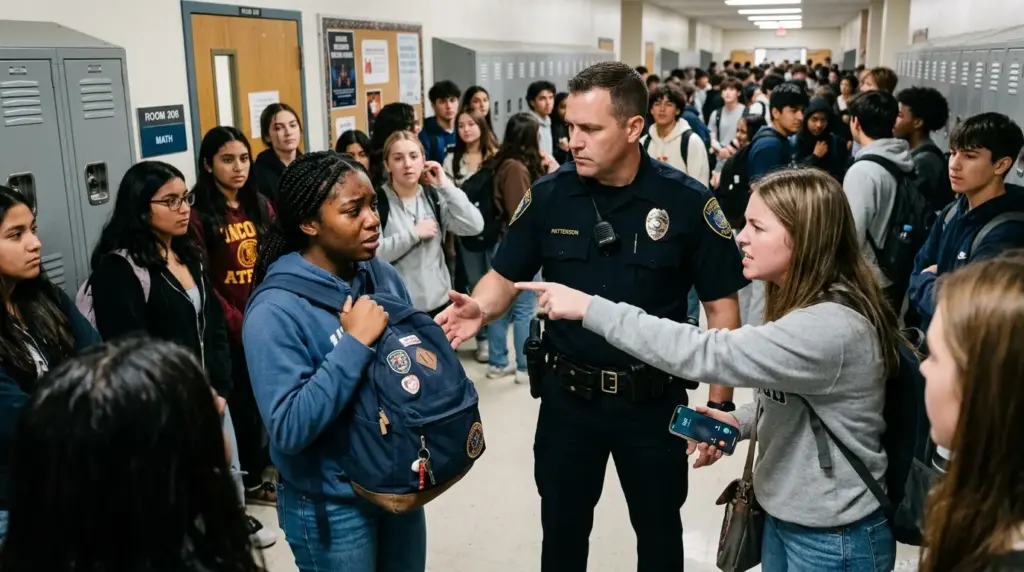
The following morning, the atmosphere in the hallways of Lincoln High was dense with an uncomfortable, collective shame. Students who had previously turned their backs on Zara when she walked past their lockers now stared at her with wide, uncertain eyes. Teachers who had watched passively as Officer Patterson led Zara away in handcuffs the day before suddenly found it difficult to make eye contact with her when she entered their classrooms.
Zara walked through the main doors at 7:45 AM, her head held high, her spine straight. She wore a simple dark blue sweater and dark jeans. She did not wear headphones; she did not hide behind her phone. She let the school look at her.
“Zara!”
A voice called out from near the library entrance. It was Marcus Vance—no relation to the principal—a senior who served as the treasurer for the Debate Club and had previously been one of Emily’s most vocal supporters. He hesitated, holding his binder tightly against his chest, before taking a few awkward steps toward her.
“Hey, Zara,” Marcus said, his voice dropping to a low, nervous murmur. “I… I just wanted to say something.”
Zara stopped and looked at him calmly. “Good morning, Marcus.”
“Look, about yesterday… and about the last few weeks,” Marcus stammered, his face flushing red. “I mean, we all saw what happened. The video. We all know now that Emily… that she planted those things in your bag. I just wanted to say I’m really sorry for believing it. I should have known better. I shouldn’t have said the things I said in the group chat.”
Zara looked at Marcus for a long moment. She observed the genuine discomfort in his face—the desperate desire to be forgiven, to clear his own conscience, to be put back on the “right side” of the story now that the power dynamic had shifted.
“Thank you for saying that, Marcus,” Zara said, her voice smooth and measured. “It takes courage to admit when you were wrong.”
“So… we’re good?” Marcus asked, an eager, hopeful smile beginning to form on his lips.
“We are civil,” Zara corrected gently, without a trace of malice. “We are classmates, Marcus. But trust is not a light switch that you flip when new evidence drops on a screen. You chose to believe a lie because it was easier than asking yourself why you wanted it to be true. I forgive you for being swayed, but I won’t pretend it didn’t show me who you are when things get uncomfortable.”
Marcus blinked, the hopeful smile freezing on his face. He nodded slowly, lower his head. “Yeah. Yeah, that’s fair. I’m sorry, Zara.”
She gave him a polite nod and continued walking toward her homeroom. She understood now that forgiveness did not require her to erase memory. She was not interested in performative reconciliations. She had an election to win, not out of a desire for revenge, but because Lincoln High desperately needed a leadership that understood the difference between authority and integrity.
ACT III: THE TRIAL OF PUBLIC OPINION
The legal aftermath of the incident at Lincoln High unfolded with the systematic, uncompromising precision that characterized Judge Katherine Mitchell’s professional life.
Because Officer Robert Patterson was an employee of the city’s police department, the local district attorney’s office recused itself from the case to avoid any appearance of bias, handing the matter over to a special prosecutor from the State Attorney General’s office.
The findings were swift and severe.
The security footage was conclusive. Emily Patterson was formally charged as a juvenile with filing a false police report, criminal defamation, and evidence tampering. Because of her age and the lack of a prior criminal record, she was not sentenced to a youth detention facility, but the penalties imposed were far from trivial: two hundred hours of mandatory community service at a youth restorative justice center, two years of formal probation, and a mandatory transfer out of the district. Her academic record carried a permanent administrative suspension for severe disciplinary violations involving criminal conduct.





