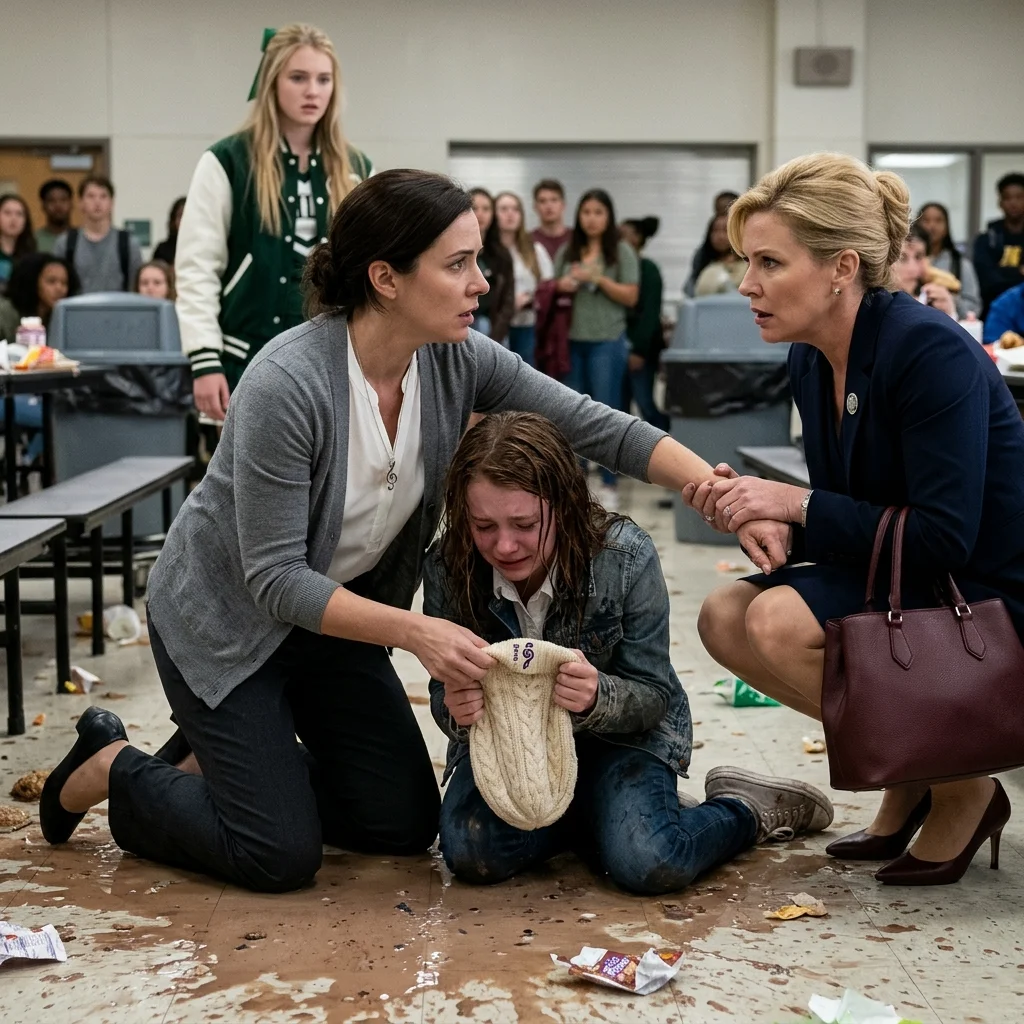
My sixteen-year-old cousin, Brooke Kingsley, stood two feet away in her immaculate white-and-gold varsity cheer jacket. Not a single strand of her honey-blonde ponytail was out of place, and she was dangling my mother’s hand-knitted wool cap by two acrylic-tipped fingers directly over a gray fifty-gallon cafeteria trash barrel—two inches above a glistening mound of ketchup-smeared napkins, crumpled milk cartons, and soggy tater tots.
“Please don’t drop it, Brooke,” I said. My voice came out too loud and slightly flat at the edges, the way it always did when adrenaline flooded my chest and I lost the ability to modulate my own volume over the din of a crowded room. “Please. That’s the last thing she made me.”
My palms went clammy against the straps of my backpack as the ribbed cream cuff swayed perilously close to a greasy foil corner sticking up from the rim of the bin. It was pure, untreated merino wool. If it fell into that rancid mixture of catsup and sour milk, you couldn’t boil it or bleach it without ruining the fibers forever.
Around us, the Tuesday sixth-period lunch rush began to stall. Conversations died in mid-sentence. Up and down the long rows of folding laminate tables, smartphone cameras rose above trays of rectangular pepperoni pizza like periscopes. Leaning against the humming beverage machines ten feet away, Brooke’s four varsity stunt-group teammates pressed their knuckles to their lips to stifle their giggles, while thirty or forty upperclassmen swiveled on their round plastic stools to watch the freshman get put in her place.
Brooke tilted her chin, giving me that sugary, wide-eyed dimpled smile that made every administrator and guidance counselor at Oakridge High refer to her as a natural leader.
“I just think you must be awfully confused, Em,” Brooke said, pitching her crystalline soprano loud enough to carry clear across the front three rows of tables. “Mr. Vance’s student aide obviously scrambled the index numbers on the blind audition tapes. Everybody in this school knows you can’t even find middle C on a piano without that ugly beige snail shell hooked behind your ear. How on earth did you think a fourteen-year-old freshman who’s practically deaf was going to sing the flagship solo in front of the whole county?”
“I sang behind the green velvet curtain just like everyone else,” I said, taking a cautious half-step forward, my eyes locked on the cream yarn swinging over the garbage like a pendulum. “Mr. Vance didn’t allow names. We only had random numbers drawn out of a bowl. Nobody knew who was behind the screen. Just give me my hat back, Brooke. You can tell Mr. Vance I withdrew—you can have the solo if you want it that badly. Just please don’t drop my mom’s hat.”
Instead of soothing her, my surrender made a sharp red flush creep up from the gold ribbing of her varsity collar. A pair of junior boys sitting at the nearest table exchanged a quiet, uncomfortable look. Giving her the solo wasn’t enough; if she took it as a charity hand-me-down from the disabled cousin living in her parents’ converted laundry room, it ruined the myth that Brooke Kingsley won everything by divine right.
“Oh, I’m not taking a handout from you,” Brooke said, her voice dropping an octave into a cold hiss while her pageant smile stayed plastered in place for the cell phones filming ten feet away. “My mom is upstairs in the principal’s office fixing the clerical error right now. Do you honestly think my mother is going to let her dead sister’s broken little charity case stand on the Performing Arts Center stage and embarrass our family in front of Superintendent Prescott and the state conservatory scouts?”
She drew the cream beanie back away from the mouth of the trash barrel. For half a heartbeat, the crushing band around my ribs loosened.
I reached out carefully with my right hand, palm up, keeping my fingers steady so I wouldn’t startle her into letting go.
Instead of placing the wool in my hand, Brooke stepped inside my reach. With her left hand, she snatched an unopened cardboard pint of cafeteria chocolate milk off the edge of the nearest sophomore table and popped the waxed spout open with a sharp flick of her thumb.
“Wait—Brooke, no, don’t!” I gasped, dropping my hand from the hat and throwing both forearms up to shield the right side of my head.
I wasn’t fast enough.
Brooke dropped the beanie onto the dusty linoleum by her white leather cheer sneaker, caught my right wrist in a viselike grip practiced from three years of tossing flyers into the air, and wrenched my arm downward. Looking straight into my eyes, still wearing that bright, tilted homecoming-court grin as if she were helping me adjust a crooked hairclip, she inverted the cardboard carton directly over my right temple.
Thick, ice-cold chocolate milk poured in a brown cascade straight over my ear and down into the dual omnidirectional microphone ports of my Phonak Naída processor.
I cried out and wrenched my head violently sideways, slapping my palm over the drenched plastic housing behind my pinna, but the sticky brown syrup was already running between my shaking fingers, soaking through the custom acoustic tubing, pooling inside the battery seam, and dripping off my jawline onto the collar of my faded gray sweatshirt.
Inside my right ear canal, the miniature receiver let out a jagged, blistering electronic shriek.
It didn’t sound like ordinary audio feedback. It sounded like a circular saw biting through sheet metal right inside the center of my skull. I flinched hard, squeezing my eyes shut as a hot, violent spark of short-circuiting static popped against my eardrum—and then, with a sickening wet sputter, the circuit board died.
The world vanished.





