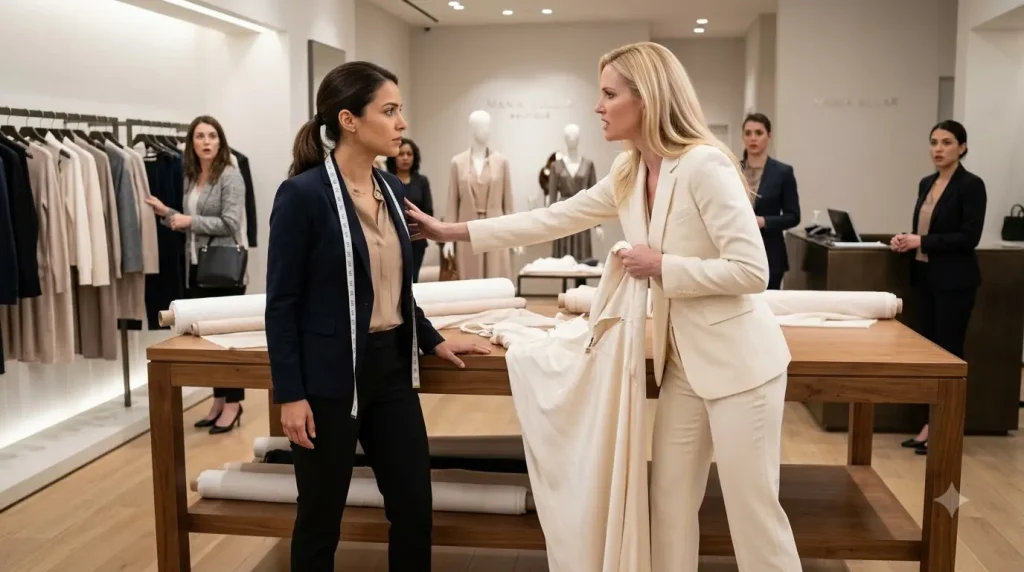
“Mr. Harlan,” Vivian said, turning toward him with immediate relief. “Thank goodness. Get this woman away from me.”
The regional manager, Daniel Harlan, did not move.
“Vivian,” he said quietly, “what happened?”
“She destroyed my dress, and now she’s being insolent. I want her removed immediately.”
Daniel glanced at Elena.
“Are you hurt?”
“I’m all right,” Elena replied.
His eyes remained on her for a fraction longer than necessary. Then he turned back to Vivian.
“I’m afraid there’s been a misunderstanding.”
“There is no misunderstanding. She ruined a gown that cost more than her car.”
Daniel swallowed.
“Vivian, I need you to listen carefully.”
She folded her arms. “I’m listening.”
He looked at the employees and shoppers gathered around the tailoring table. His voice lowered, but the boutique had become so silent that everyone heard him.
“She isn’t the tailor anymore.”
Vivian gave an impatient sigh. “Then what is she? The assistant manager? I don’t care. She’s finished.”
Daniel’s eyes moved to Elena once more.
“She owns this store.”
For a moment, Vivian appeared not to understand the sentence.
Then she laughed.
It was a brittle, incredulous sound, utterly out of place beneath the chandelier.
“Don’t be ridiculous.”
Daniel did not smile.
“She completed the purchase of the entire fashion company yesterday afternoon.”
The laughter vanished.
Elena stood beside the tailoring table, one hand resting lightly against its polished edge. Her hip still throbbed where it had struck the wood, but she felt no need to show it.
Vivian stared at her.
Then at Daniel.
Then back at Elena.
“You’re joking.”
“No,” Daniel said. “I’m not.”
Vivian’s eyes narrowed. “Who is she?”
“Elena Marquez,” Daniel replied. “The new owner and chief executive.”
The boutique seemed to tilt around Vivian.
She glanced at Elena’s blazer, the measuring tape, the tiny gold earrings, the simple black shoes. She looked at the woman she had just insulted, shoved, and threatened to have fired.
Then she looked at the dress in her own hands.
For the first time since entering the store, Vivian seemed unsure what to do with them.
Elena gently extended her hand.
“May I have the gown back, please?”
Vivian hesitated.
“Now,” Daniel said.
The blonde woman released the fabric.
Elena accepted it carefully, supporting the bodice with both hands. She placed it flat on the tailoring table, smoothing the satin without touching the torn seam.
Then she looked toward Sophie.
“Could you bring the incident log and the garment intake record, please?”
Sophie blinked. “Yes. Of course.”
“And Mr. Chen, would you photograph the damage before anyone attempts a repair?”
The tailor nodded.
Elena turned back to Vivian.
“Please remain here while we establish what happened.”
Vivian’s lips parted.
“You can’t speak to me like that.”
Elena’s eyes were calm.
“I believe I can.”
And with that, the boutique’s old order began to unravel.
Three weeks earlier, Elena Marquez had stood in the basement of the same building, surrounded by garment racks, cardboard boxes, and the low mechanical hum of the climate-control system.
She had been there after closing, wearing jeans, a gray sweater, and a pair of worn leather boots. Her hair was loose around her shoulders, and she had a notebook tucked beneath one arm.
The basement smelled faintly of cedar, starch, and the paper tags attached to hundreds of garments.
At the far end, a row of dresses waited for alterations. Some were simple cocktail dresses, others elaborate gowns covered in crystals, feathers, or hand-sewn embroidery. A few had been returned from customers with small stains or loose threads. One had a broken zipper. Another had a missing button.
Elena examined each garment as if it were a page in a book.
She had spent much of her adult life learning how clothes were made, sold, altered, repaired, and sometimes discarded. She understood that a luxury label was not simply a name stitched into a collar. It was a network of people: pattern makers, cutters, embroiderers, tailors, sales associates, stockroom workers, cleaners, delivery drivers, managers, and customers.
A beautiful dress could pass through dozens of hands before it reached a fitting room.
A company’s reputation could be destroyed by a single careless moment.
And sometimes, Elena had learned, the most revealing thing about a luxury business was not how it treated its wealthiest customers.
It was how it treated the people who worked there.
Her phone vibrated.
The message came from her attorney, Rebecca Sloan.
Closing documents are ready. Final review at nine tomorrow.
Elena read it twice, then slipped the phone into her pocket.
She was not supposed to be in the basement that evening.
She was supposed to be at home, preparing for the acquisition that would change her life.
Instead, she was standing between garment racks, studying the work orders.
One in particular caught her attention.
It was attached to an ivory evening dress, a design from the company’s signature collection. The tag listed a customer appointment with Vivian Ashford, a prominent philanthropist and investor who had been purchasing from the boutique for years.
The note read:
Urgent alteration. Client demands same-day completion. Do not charge. Escalate any concerns to regional management.
Beneath that, someone had written in red ink:
Client has been difficult with staff. Keep interaction brief.
Elena frowned.
She had seen notes like that before. Not just in this store, but in other luxury businesses. Customers who were known to be difficult were sometimes treated as special cases, while the employees expected to absorb the consequences were left without support.
She turned the tag over.
The garment had been inspected at intake. A faint notation recorded tension along the side seam. The tailor had recommended a structural assessment before any adjustment.
The recommendation had been crossed out.
In its place was another note:
Client refuses delay. Proceed with fitting.
Elena stared at the words.
She had seen enough to know that the dress itself was only part of the problem.





