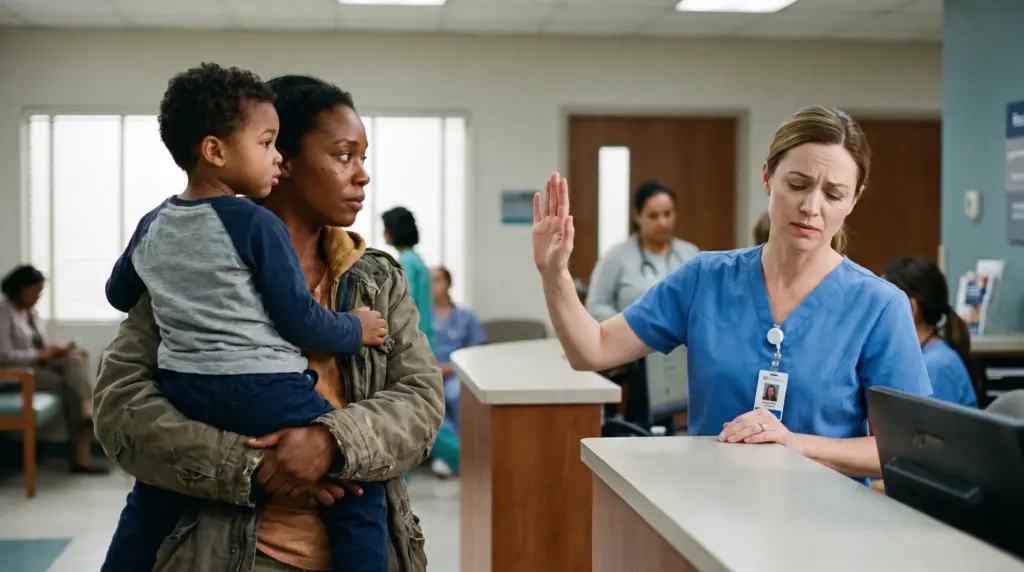
“I was listening at the desk too,” Alana said. “Listening wasn’t the missing piece.”
Omar’s face tightened in understanding. He checked the tubing and left them the quiet gift of not explaining her experience back to her.
That afternoon, while Andre napped upright in the recliner and Florence walked the corridor for coffee that would disappoint her, Alana sat on the edge of Devin’s bed and played a game of “good breath, better breath” that she had invented for anxious Meridian families and never expected to need for her own child. Devin took it seriously. He counted on his fingers. He asked whether the pulse ox fairy was real, and Alana said no, but the machine was honest, which was better than magic. When a nursing student came to practice listening to lungs, Alana watched the student’s hands tremble and felt an unexpected tenderness. Everyone was learning something in this building. Some lessons cost more than others.
Dr. Okonkwo stopped by near shift change with a printout of trends and a blunt kindness Alana trusted. “If he were my kid,” he said, “I’d still be angry about triage. Anger and gratitude can share a room. Don’t let anyone tell you to pick one for their comfort.”
A patient advocate named Holly Pruitt came by at 10:15 with a clipboard and an expression that suggested she had been hired to translate institutional regret into actionable forms without promising the moon. Alana told the story without embroidery. Andre sat beside her and did not interrupt except to add the time stamps he had reconstructed from texts and the warehouse clock-out log. Florence, in the corner chair with knitting she was too angry to use, said only, “Write down that another patient had to speak up before anyone moved. Write down that a security guard had more sense than triage. Write it so someone reading it in a year cannot pretend it was unclear.”
Holly wrote it down. Her pen made small, serious sounds.
“There will be a review,” Holly said. “Staffing, clinical decision-making, any bias concerns. You can also file with the state if you choose. I can walk you through both. You do not have to decide today.”
“I’ll file here first,” Alana said. “And I want it in writing that I identified respiratory failure signs and was told to take a number. I want the pulse ox values in the record next to that sentence.”
“It will be in writing,” Holly said. She hesitated, then added, “For what it’s worth, charge nurse Chen already opened an event report before I arrived. That does not fix anything by itself. It means the hospital cannot claim ignorance.”
After Holly left, Alana walked down to the lobby to get coffee that tasted like burnt ambition and found Edith Crowe near the exit with a fresh splint on her wrist and a rideshare app open on her phone.
Edith smiled a tired, crooked smile. “Me. Distal radius fracture. Annoying. Not interesting. How’s your boy?”
“Better. Step-down. Eating grapes like they are currency.” Alana hesitated. “Thank you. For standing up. I keep replaying it. If you hadn’t—”
“Then someone else should have,” Edith said, shrugging with the shoulder that did not hurt. “I taught third grade for thirty-nine years. I know what it looks like when an adult decides a child is inconvenient. Also, I could hear him from my chair. Anyone who couldn’t was choosing not to. That’s the part that will stay with me—not your son’s wheeze. The choosing.”
Alana’s eyes burned. She blinked hard. “Can I get your number? In case they ask for a witness.”
Edith gave it without ceremony, reading it aloud twice, old-school. “They’ll ask. Or they should. If they don’t, call me anyway. I already filled out their little form, but forms are shy. People aren’t.”
Nora Spalding slept four hours in a dark bedroom that smelled faintly of laundry detergent and the lavender spray her sister kept sending even though Nora never used it, a scent that tried too hard to mean calm. She woke to a text from Rita Chen: Meeting at 2. Quality and Risk. Bring your notes.
Nora stared at the ceiling crack that had been there since the second year of her mortgage. She thought about her mother, Ellen Spalding, who had died eleven years earlier after a clinic had shrugged at early cardiac symptoms and sent her home with antacids and a smile that said women exaggerate. Nora had been a new nurse then, still believing that competence was a shield. She had learned, in the ugly way people learn, that systems failed. She had also learned a worse lesson, one she had never said out loud at a funeral or in a break room: that urgency could be performed, that volume could be a tactic, that if you believed every alarm you would drown in other people’s fear. The lesson had calcified into habit. Habit had become posture. Posture had become the woman at the desk saying wait your turn while a child’s oxygen fell through the floor of acceptable risk.
On the dresser sat a photo of her daughter, Britt, at college orientation, grinning beside a suitcase Nora had packed too tightly. Britt texted rarely these days, which Nora told herself was independence and sometimes feared was distance born of years when shifts ate dinners. Nora had become, without noticing the exact date, a person who rationed tenderness at work until there was little left for anyone, including herself. Burnout was not a dramatic collapse. It was a slow permission to stop imagining other people’s interiors.
She showered until the water ran lukewarm. She put on clean scrubs that felt like a costume for a role she no longer trusted. She drove to Harborview with the radio off, counting exits like breaths.





