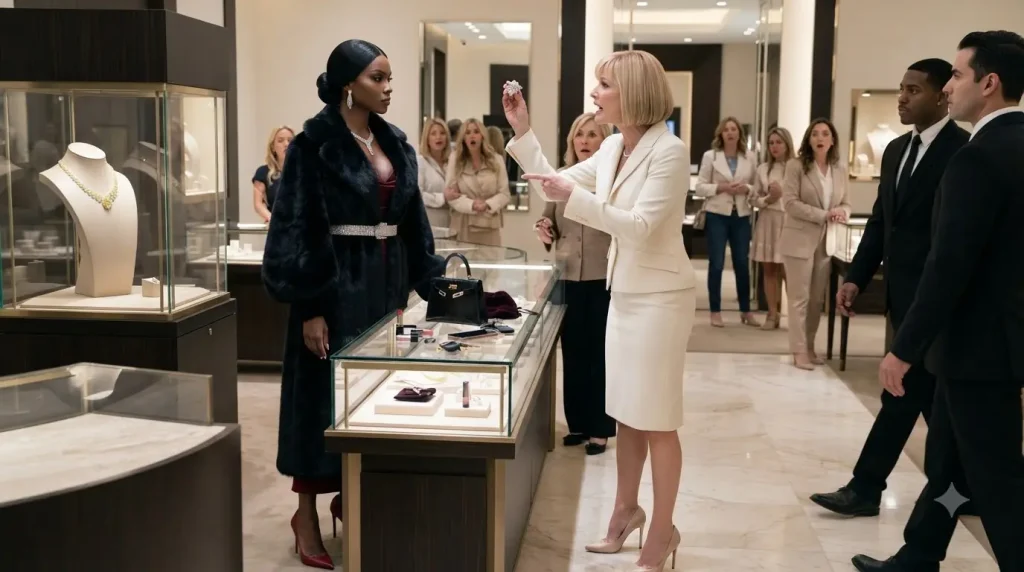
The youngest of them—a third-generation gemologist named Maya Chen, whose quarterly client satisfaction scores had crossed Victoria’s desk in New York with a handwritten note of commendation—lifted her chin. Their eyes locked through the polarized tint of Victoria’s lenses. Maya took half a step forward, her fingers instinctively smoothing the lapel of her charcoal wool uniform jacket.
Then Maya’s gaze flicked forty-five degrees to the right.
At the elevated mezzanine desk that overlooked the sales floor like a sentry box, the flagship director was adjusting the collar of an ivory double-faced wool suit.
Maya’s step died on the marble. Her shoulders rounded inward, barely a quarter-inch, but to Victoria’s trained eye, it was as loud as a dropped tray of flatware. The young woman lowered her eyes to a tray of platinum eternity bands and began polishing a stone that had already been cleaned twice.
Workplace terror was an unmistakable scent. It was not the dramatic panic of an armed holdup or a cracked hydraulic line; it was the quiet, calcifying dread of young professionals who had learned that a supervisor’s bad mood could wipe out six months of pipeline commissions and turn a scheduled transfer to the Place Vendôme salon into a permanent exile behind the silver-polishing wheel.
Victoria slid her glasses down the bridge of her nose with a single, gloved forefinger, folded the tortoiseshell temples with a soft click, and slipped them into her coat pocket.
Her skin was the color of roasted chestnuts, her jawline severe, her mouth painted in a dry, matte bordeaux that brooked no debate. At thirty-three, she was the youngest sole managing trustee in the one-hundred-forty-year history of the house, though her public profile had been scoured from digital registries with the systematic thoroughness only eight-figure legal retainers could buy. Her grandfather had believed that a true jeweler was seen only in the brilliance of his cuts; her father had believed an owner should be an invisible hand; Victoria believed that when an owner became a celebrity, the balance sheet became a stage play.
She walked slowly toward the North Gallery.
The rotunda housed the everyday commercial lines—the five-figure pavé hoops, the triple-row tennis bracelets, the mechanical chronographs designed for men who bought yachts over the telephone. But the North Gallery was different. The ceiling there dropped by three feet, lined in dark, sound-absorbent ribbed alcantara. In the center of the room, isolated on a plinth of unpolished black basalt beneath an anti-reflective glass bell, sat Solstice No. 4.
Forty-one carats of natural fancy intense yellow diamonds, anchored by an eleven-point-two-carat cut-cornered rectangular modified brilliant that had taken nine months of laser-guided cleaving in Tel Aviv to liberate from an octahedral rough found in the gravels of the Orange River.
The retail price had not been loaded into the global point-of-sale system. It existed only on an encrypted ledger sheet Victoria had signed with a hardware token forty-eight hours ago: $375,000.
Victoria leaned forward, her breath stopping an inch from the vitrine.
The setting was wrong.
She did not touch the glass. She narrowed her eyes, tracing the metal beneath the girdle of the center stone. Two weeks ago, the design studio in Geneva had attempted to economize on labor hours by utilizing standard four-claw corner prongs. Victoria had personally vetoed the blueprint, marking up the digital render in red digital ink: The stone has a slight feathering along the lower pavilion facet. Claws will concentrate shear stress during thermal fluctuation. Utilize a split-pillar concealed architecture with secondary collet support.
The ring before her did not have the split-pillar. It had standard claws. They had polished them down to mimic the prototype, but the corners were rigid, blunt, and ugly.
Behind her, the sharp, rapid cadence of Christian Louboutin pumps struck the stone floor. Tack-tack-tack-tack. The speed was not that of an employee arriving to be of service; it was the hurried, territorial march of an administrator whose fence had been hopped.
“Excuse me.”
Victoria did not turn immediately. She kept her eyes on the pavilion of the yellow stone, letting the woman’s presence fill the alcove until the scent of tuberose and expensive dry-cleaning chemical crowded out the room’s cedar base.
“Yes?” Victoria asked, turning her head with deliberate slowness.
Claire Morgan stood three feet away. She was forty-eight, razor-thin, with ash-blonde hair cut to a blunt, swing-chin line that had cost eight hundred dollars on Wilshire Boulevard. Her ivory suit was pristine, accented only by a single South Sea pearl pinned to her left lapel and a gold-trimmed nameplate: CLAIRE MORGAN — FLAGSHIP DIRECTOR.
Claire’s eyes performed an instantaneous, three-point triage: no visible shopping bags from neighboring luxury houses; an oversized coat that concealed the silhouette; high-gloss red shoes that could have been purchased on credit; and an unbranded handbag held casually in the crook of an arm, devoid of the gold-plated logos that usually signaled high-margin vanity to Beverly Hills floor staff.
“May I ask who is assisting you this morning?” Claire’s smile was a masterpiece of cold, corporate laminate. It exposed exactly eight upper teeth while keeping the muscles around her pale blue eyes completely dead.
“No one,” Victoria said.
Claire’s gaze flickered toward the rotunda, where Maya Chen was desperately re-arranging velvet trays. “And how long have you been in the gallery?”
“Six minutes.”
A microscopic tremor tightened the skin around Claire’s nostrils. It was not contrition for a lapse in service; it was the sharp, administrative calculation of who would receive the written reprimand before noon.
“The North Gallery,” Claire said, stepping forward so that her shoulder subtly blocked the light falling onto the basalt plinth, “is currently restricted to private viewings. The stanchions are being serviced this morning, which is the only reason the archway was open.”
“There were no stanchions,” Victoria remarked mildly. “Only light.”





