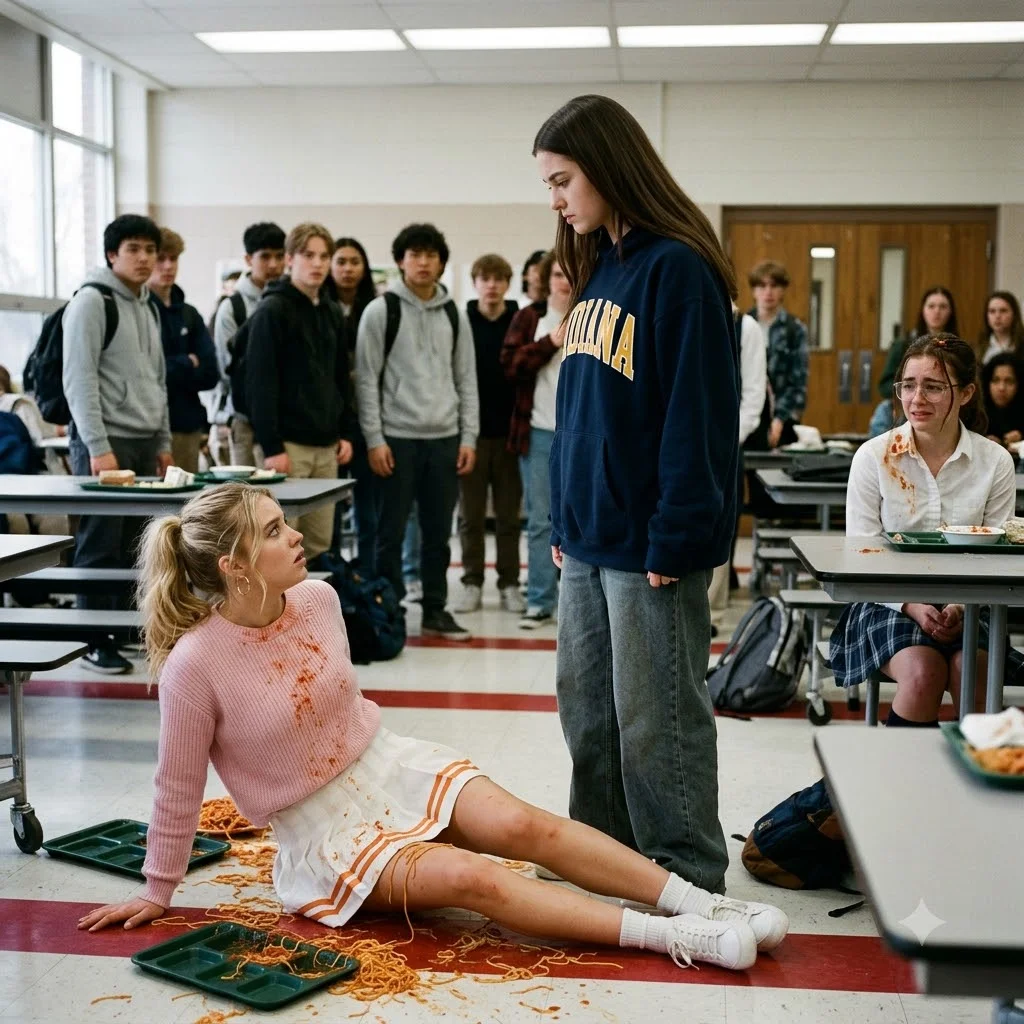
Lily looked at Maya through damp lashes, a tremor still in her hands, before taking the napkins and whispering a quiet, breathless, “Thank you.”
Around them, the cafeteria slowly began to murmur again, though the tone had fundamentally changed. Nobody was laughing at Lily anymore. Nobody was looking at Chloe with fear. As Mr. Henderson began demanding explanations from a stammering Tessa and a silent, humiliated Chloe, Maya calmly gathered Lily’s soaked notebooks, closed the copy of The Glass Menagerie, and stood beside her chair—quiet, steady, and entirely unbothered by whatever came next.
In the autumn of her seventeenth year, Maya Lin learned that silence has different weights depending on who carries it.
There was the silence of the hardware store on Route 9 after the last contractor left at six o’clock, when the fluorescent tubes buzzed above bins of galvanized bolts and the scent of cedar shavings settled into the concrete floor. There was the silence of her mother’s kitchen at midnight, when the radiator ticked like a slow metronome and Maya sat beneath a single desk lamp, taping ice packs to her knuckles or working through AP Calculus problems until her eyes burned.
And then there was the silence of Oakhaven High School—a thick, complicit quiet maintained by four hundred students who had learned, through years of subtle conditioning, exactly which way to look when someone else was being dismantled.
Oakhaven was a town built on old timber money that had quietly transitioned into real estate development and private equity. Its high school sat at the top of Ridge Road like a monument to civic pride: red brick, white limestone trim, and a sweeping glass atrium funded largely by the Sterling Foundation. Everyone knew the name Sterling. It was etched onto the brass plaque beside the auditorium doors, printed across the back of the varsity lacrosse jerseys, and embossed on the letterhead of the school board’s finance committee.
Chloe Sterling wore that name the way other girls wore cashmere—effortlessly, as though she had been born wrapped in it and never once wondered who had woven the wool.
At eighteen, Chloe possessed the kind of curated beauty that looked accidental until you noticed the maintenance behind it. Her chestnut hair fell in smooth, glossy waves that defied the damp October drizzle. Her laugh was bright, musical, and calibrated to stop precisely half a second before it became ungraceful. To the faculty, she was the poised senior class treasurer who organized the annual canned food drive and smiled warmly during parent-teacher nights. To the student body, she was the weather system: when Chloe was pleased, the hallways felt lighter; when Chloe was bored, someone was going to get rained on.
Maya had spent fourteen months staying completely out of the forecast.
When her family relocated from Chicago to Oakhaven at the start of her junior year—following her father’s quiet, unceremonious layoff from a logistics firm and her mother’s decision to take a nursing supervisor position at the county hospital—Maya had arrived with two suitcases, a scarred acoustic guitar she rarely played anymore, and a rule she had written on the inside cover of her planner: Keep your head down. Graduate. Leave.
In Chicago, she had spent three years training at a cramped, sweat-stained gym on Western Avenue under an uncle who believed balance, footwork, and emotional stillness were the only things standing between a young woman and a world that liked to push. In Oakhaven, nobody knew she had ever stepped onto a mat. They knew her as the quiet transfer girl who ran the four-hundred-meter dash in the spring, worked twenty-five hours a week lifting fifty-pound bags of mortar mix at Miller’s Hardware, and ate lunch alone near the courtyard doors.
Neutrality was comfortable. Neutrality kept her out of the vice principal’s office and kept her mother from having to take unpaid hours off from the night shift at St. Jude’s.
The trouble with neutrality, Maya was beginning to realize, was that it required looking away at increasingly shorter intervals.
It had started in September with Daniel Morales, a quiet freshman who spent every study hall sketching architectural facades in a leather-bound notebook. Chloe had intercepted him outside the gym doors on a rainy Wednesday, feigning a stumble that sent his sketchbook skidding across the wet asphalt straight into a muddy tire rut. When Daniel knelt to retrieve it, Chloe’s heeled boot had come down cleanly on the spine, grinding the soaked pages into the gravel while her friend Brooke recorded the whole thing for her private story.
Two weeks later, it had been Lily Vance.
Lily was the sort of girl who seemed perpetually apologetic for taking up oxygen. Seventeen, slight, with pale skin and dark, watchful eyes behind tortoiseshell frames that perpetually slid down the bridge of her nose, Lily lived three streets over from the train tracks in a narrow duplex with her grandmother. She worked weekends shelving books at the public library and wore the same oversized charcoal cardigan almost every day—a heavy, slightly pilled knit that swallowed her narrow shoulders whole.
Lily’s crime, as far as Maya could tell, was simply existing within Chloe’s line of sight without offering tribute. Lily didn’t flatter Chloe, didn’t follow her social media accounts, and had once, during junior-year AP English, quietly corrected Chloe’s misattribution of a line from The Great Gatsby in front of Mr. Alvarez.
Chloe had never forgiven her for it.
Last month, Lily’s geometry binder—containing six weeks of handwritten proofs and the only copy of her take-home midterm—had vanished from her desk during sixth period, only to be found soaked in cold coffee at the bottom of the third-floor recycling bin. Lily hadn’t cried. She hadn’t reported it. She had simply stayed after school for three nights straight, redoing every single proof from memory at a back table in the library.
Maya knew because she had seen her there when she stopped by to return a reference manual. She had watched Lily’s small, ink-stained fingers move steadily across the lined paper, her jaw tight, her shoulders curled inward like a seashell closing against the tide.
“You know they have cameras in the third-floor hallway,” Maya had said quietly as she paused beside Lily’s table that evening.





