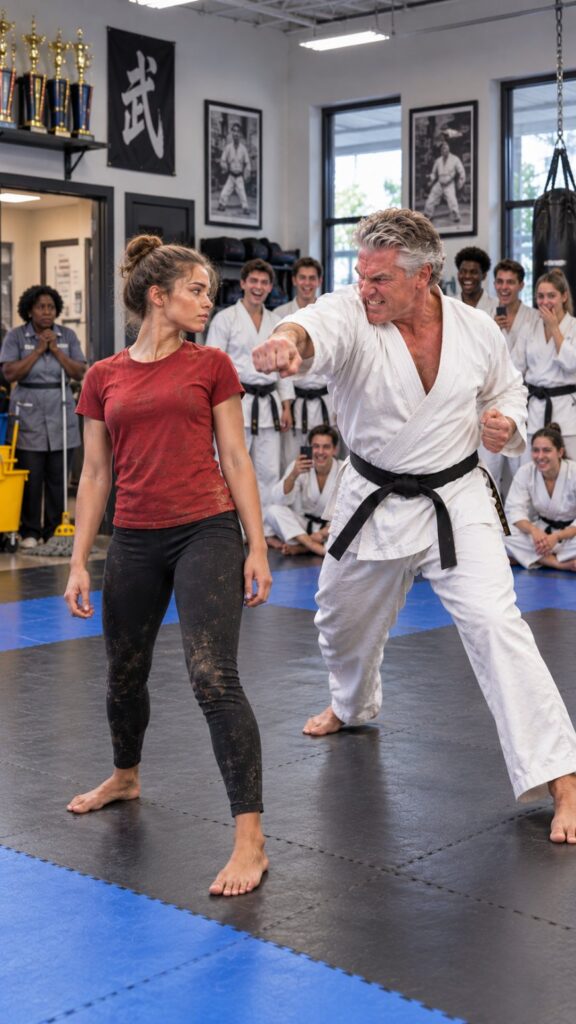
Ten minutes later, the entire academy stood in a tight circle around the central mat. The air was suffocating. Tyler wore his pristine black belt uniform, his face twisted in tension and aggression. I stood opposite him, my eyes steady, sinking into the rhythm of my own breath.
“Begin,” Master Dylan called out, acting as the referee.
Tyler didn’t waste a millisecond. He rushed in with a full-force, sweeping roundhouse kick aimed directly at my head, intending to knock me out instantly. I didn’t raise my arms to block. I simply tilted my body, stepping back a half-beat, and let his leg slice through the air an inch from my nose.
The crowd held its breath. Tyler spun, using his momentum to follow up with a vicious left hook. I tilted my head exactly two centimeters. His fist grazed a loose strand of my hair. Another miss.
Over the next thirty seconds, Tyler launched more than eight massive, explosive attacks. Hooks, crosses, low kicks, knees. Every single one missed. I didn’t counter. I just dodged, observed, and kept my distance. My face remained as calm as glass. My feet moved fluidly, like water slipping through a clenched fist.
Tyler’s face grew bright red. His breathing became ragged. He snarled like a cornered animal and charged in with a devastating straight right punch, throwing his entire body weight behind it. It was the exact move he had used to knock out three opponents in the regional tournament.
But this time, I didn’t step back.
As he lunged, overcommitting his weight, I stepped forward—a short, precise step inside his guard. Caught completely off guard by my forward movement, Tyler tried to adjust, but it was too late. I pivoted subtly on my heel, shifted my hips, and placed my hand lightly against the inside of his elbow, guiding his punching arm just a fraction out of its trajectory.
Tyler’s body was instantly pulled off balance. The massive kinetic energy he had generated had nowhere to go but forward. His own violent momentum betrayed him. He pitched forward, both feet leaving the mat, and slammed chest-first into the ground with a bone-rattling crash.
He lay sprawled on the mat, staring up at the ceiling in utter, paralyzing confusion. I hadn’t hit him. I had just let him defeat himself.
The dojo exploded in a shocked, solemn silence. Master Dylan stepped forward and raised my hand.
Tyler slowly pushed himself up to his knees. The three years of arrogant confidence he had built up had completely collapsed. He looked at me, his chest heaving, his eyes searching my face.
“Tyler, you lost,” Dylan said sternly to his student. “Not because you’re weak. But because you didn’t understand the deeper purpose of standing on this mat. We train to restrain the ego, to control our power, and to calm our minds.”
Tyler bit his lip, his shoulders trembling. It was a brutal battle against his own pride. But then, he raised his head. For the first time since I had met him, his eyes were no longer arrogant. They were clear.
“I apologize,” he said softly, his voice echoing in the quiet room. He turned to face me fully. “I insulted you. I dismissed the value of a lineage I never understood.”
I nodded, light but firm. “No one is born understanding everything, Tyler. What matters is whether, after you fall, you stand back up with humility.”
Tyler looked at me for a long moment, then slowly bowed his head until it touched the mat in a traditional, deeply respectful martial salute. That single act rippled through the dojo like wind through a forest. One by one, the rest of the students—the ones who had mocked me, the ones who had ignored my mother—stepped onto the mat and formed a line, bowing and apologizing for their disrespect.
Two weeks later, my mother and I stood in front of the rotting, abandoned storage shack on the edge of our poor neighborhood. The wooden door was hanging off its hinges, the tin roof was riddled with holes, and the walls were decayed. This was the place where my grandfather had spent ten years training me in the dark.
“Are you sure you want to rebuild this place?” my mother asked, touching a splintered beam.
“This was once Grandpa’s home,” I replied. “It was where he taught me how to never bow to prejudice. If I’m going to start again, I want to start here.”
We began clearing the debris that afternoon. To my surprise, an hour later, a pickup truck pulled up. Tyler Brennan stepped out, wearing work gloves and carrying a toolbox. He didn’t say much; he just quietly started removing the rusted roofing sheets. By the end of the week, other students from Arlington followed. Some brought fresh lumber, some donated high-quality training mats, some brought paint.
Within two weeks, the once-ruined shack had been transformed into a beautiful, ash-gray dojo. Above the door, Tyler helped me hang a hand-carved wooden sign: Carter Lineage. Forge character before combat.
We opened the doors to anyone, without fees or contracts. My first students weren’t elite athletes or arrogant fighters. They were a ten-year-old boy with severe anxiety, a single mother looking for a safe space, an overweight teenager who was ruthlessly bullied at school, and Tyler, who stood in the back row, relearning everything from scratch. They came to learn how to stand firm, how to not be knocked down by their own fears, and how to realize they had never been weak to begin with.
Our quiet resurgence brought light to the neighborhood, but it also drew unwanted attention. Master Rodrik Kaine, the famous, heavily muscled founder of the Vanguard Combat Institute—a multi-million dollar franchise known for its aggressive, high-speed, win-at-all-costs philosophy—saw the viral video of my match with Tyler.





