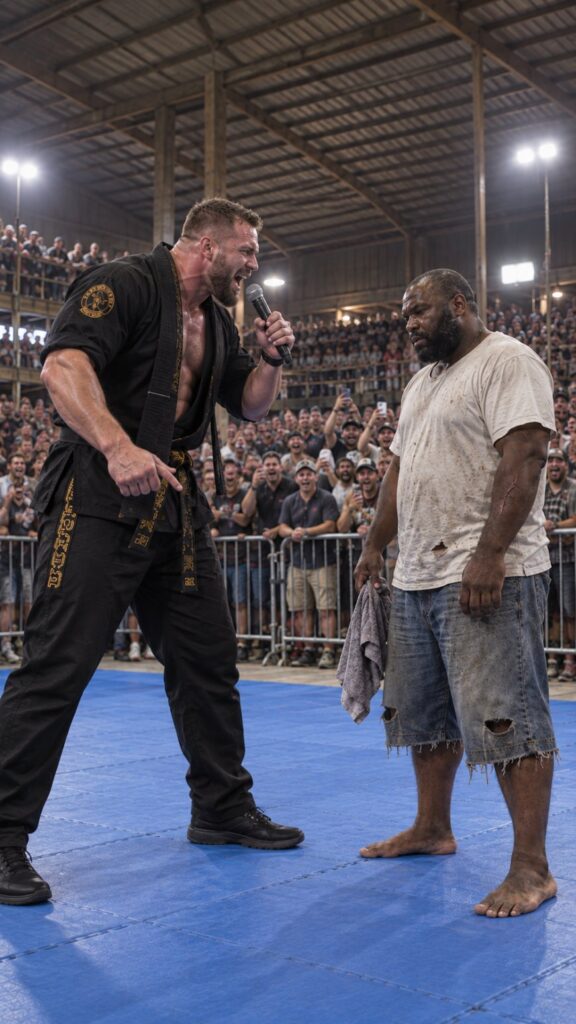
Bryce Holden arrived ten minutes late, maximizing his entrance. He wore a charcoal gray suit, a crisp white shirt with no tie, and his left arm was heavily strapped into a fresh navy-blue sling. He walked down the center aisle with a slow, exaggerated limp, wincing audibly as he carefully lowered himself into the plaintiff’s chair.
His lawyer, Gavin Wells, sat beside him. Wells was a man with perfectly coiffed silver hair, expensive gold cufflinks, and the smug aura of a man who billed four hundred dollars an hour and had never lost a civil case in his life.
Andre sat at the defense table on the opposite side. He wasn’t wearing a suit. He couldn’t afford one. He wore the same clean, faded flannel shirt he wore to church on Sundays. Beside him sat his court-appointed public defender, a young woman named Sarah Winters. She looked exhausted, overwhelmed, and completely outgunned. She had seventeen active cases on her desk, and this was the biggest media circus she had ever seen. But she believed Andre, even if she didn’t know how to save him.
Judge Patricia Dawson entered the room. She was a no-nonsense woman in her late sixties, wearing thick reading glasses on a silver chain. She had zero tolerance for legal theatrics. She took her seat, banged her gavel once, and looked down at the docket.
“Proceed,” she commanded.
Gavin Wells stood up, buttoning his suit jacket. He walked to the center of the floor like a preacher taking the pulpit.
“Your Honor,” Wells began, his voice dripping with practiced gravity. “My client, Mr. Holden, is a respected small business owner in this community. He organized a lawful, consensual, and highly regulated athletic exhibition. It was meant to be sport. What he received in return was a vicious, calculated, and entirely unprovoked attack by a man possessing deeply dangerous, undisclosed combat training.”
Wells paused, letting the words hang in the heavy air of the courtroom. He walked over to the evidence table and picked up two large glossy photographs, holding them up for the judge to see. One was a picture of Bryce’s arm, heavily bruised and swollen. The other was a medical MRI scan.
“Mr. Quinn did not engage in sport,” Wells continued, his voice rising in righteous indignation. “He utilized techniques consistent with advanced military close-quarters combat. He used them on an unsuspecting civilian. In a public venue. In front of hundreds of witnesses, including young children. As a direct result of this brutal assault, my client has suffered severe ligament damage, acute nerve compression, and lasting, debilitating psychological trauma.”
Wells walked back to his table and placed a hand gently on Bryce’s good shoulder. Bryce looked down at the floor, looking remarkably like a broken man.
“Mr. Holden has been unable to teach his classes. He has been unable to train. He has been unable to earn a living. His livelihood, his passion, and his bodily autonomy have been utterly destroyed by a man who hid what he was, and used it as a weapon against his community.”
Wells sat down. A low murmur of agreement rippled through the gallery. The narrative was working perfectly.
Sarah Winters, the young public defender, stood up. Her hands were visibly trembling as she gripped her yellow legal pad, but when she spoke, her voice held steady.
“Your Honor, my client, Mr. Quinn, accepted a highly publicized challenge with explicitly clear terms. A consensual bout for a cash bet. Mr. Holden set the rules. Mr. Holden chose the venue. Mr. Holden aggressively promoted the event and collected the ticket revenue. Mr. Quinn simply showed up, defended himself within the confines of the ring, and won the match.”
“He nearly killed my client, counselor!” Wells interrupted loudly, half-standing from his chair.
“You will get your turn, Mr. Wells. Sit down,” Judge Dawson snapped, her voice cutting through the room like a whip. She looked back at Sarah. “Continue, counselor.”
But Sarah didn’t continue her speech. She turned and looked toward the back of the courtroom. Tamara Collins, the journalist, was sitting in the third row. Tamara gave a single, sharp nod, opened her laptop, and plugged a flash drive into the courtroom’s digital projector system.
“Your Honor, the defense would like to submit new, previously unseen digital evidence to the court,” Sarah said, handing a copy of the drive to the bailiff.
Judge Dawson raised a skeptical eyebrow. “Proceed.”
The large projector screen mounted on the wall behind the witness stand flickered to life.
“Defense Exhibit A,” Sarah said. “The unedited video from the Colton County Fair. Not the edited version Mr. Holden posted to his social media to mock my client, but the original footage filmed from a bystander’s alternate angle.”
The video played. It showed Bryce Holden marching up to Andre’s vegetable stand. But this angle clearly captured the audio. It showed Bryce grabbing Andre’s shirt collar. It showed Bryce violently shoving Andre backward. It showed Andre keeping his hands down, never raising a fist, never stepping forward. The aggression was entirely, undeniably one-directional.
“As you can see, Your Honor,” Sarah said, gaining confidence, “the aggression and the initial physical assault were entirely initiated by the plaintiff.”
Gavin Wells scoffed. “Irrelevant to the injuries sustained in the ring, Your Honor.”
“Defense Exhibit B,” Sarah continued, ignoring him. “Sworn, certified court records from Oconee and Madison counties. Two prior civil lawsuits filed by Mr. Bryce Holden within the last thirty-six months.”
Judge Dawson leaned forward, peering over her reading glasses. “I’m listening.”
“Both lawsuits follow an identical pattern to this case,” Sarah explained, her voice ringing clear in the silent room. “A public fighting challenge made to a financially disadvantaged minority man, a cash bet, a brief physical altercation, followed immediately by a civil suit claiming severe emotional and physical injury. Both previous cases were settled out of court, resulting in the financial ruin of the defendants.”





