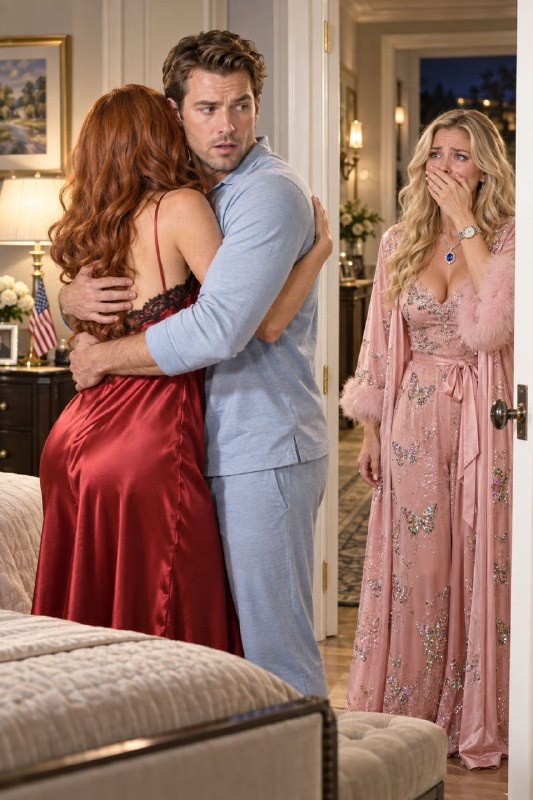
“She wasn’t answering her phone,” he said softly from the doorway, his voice heavy with manufactured exhaustion. “I drove past her place twice. The lights were off. I’m worried sick about her.”
“I’m going to bed,” I said, rising from the table and rinsing my cold mug in the sink.
I didn’t ask where he had really been for four hours. I didn’t smell his collar for her vanilla perfume. There was no point in asking a liar for the time when you were standing next to a clock.
The next morning—Sunday—the house was taut with an artificial, brittle quiet. Michael made coffee, offered me a cup I declined, and announced around nine-thirty that he needed to run to the hardware store in Tustin to pick up a new latch for the side gate. He lingered in the mudroom for a beat too long, waiting for me to start the fight he had rehearsed all night. When I simply turned a page of the newspaper, he sighed and slipped out the door.
The moment his Audi cleared the end of the driveway, I stood up and walked straight to his home office.
Morning light slanted through the plantation shutters, illuminating dust motes above the heavy oak desk. The locked drawer sat on the bottom left, tucked neatly beneath a stack of neatly labeled tax binders. In twenty-six years, I had never once tested that lock. I had called it trust.
Now I understood that trust wasn’t a virtue. It was just the blindfold you wore before someone forced you to take it off.
I walked back into the kitchen and opened the narrow utility drawer beside the refrigerator—the graveyard of batteries, rubber bands, and small metal keys Michael assumed I had thrown out years ago. I lifted the tangled steel ring of spare keys and carried it back to his desk.
If that drawer held nothing but his father’s yellowing estate papers, one of these keys would open it, and I would close it again and apologize to the empty room.
And if it didn’t hold old estate papers, it was going to hold the truth.
Chapter Four
The first key was too thick—the old spare for the side garage door. I slipped it aside. The second belonged to a rusty luggage padlock we hadn’t used since our twentieth anniversary.
The third key was small, flat, and tarnished brass, its teeth worn smooth at the edges. I had no memory of where it came from, yet the moment I lined it up with the keyhole on the bottom-left drawer, it slid home with an effortless, almost eerie precision.
I turned my wrist. The bolt clicked open without a sound.
I pulled the drawer out slowly. There were no dusty estate binders. No faded tax returns from Michael’s father. Resting right on top of a stack of pristine bank envelopes was a single, thick manila folder. Written across the tab in Michael’s razor-sharp, methodical accountant’s script were two initials.
E.M.
Emily Marie.
My pulse hammered once against my ribs, slow and heavy. I sat down in Michael’s leather swivel chair, set the folder squarely on the blotter, and opened it.
The first document was a residential lease agreement for a one-bedroom apartment on Birch Street in Irvine—not the little rented bungalow in Costa Mesa where the shower had been held, which I suddenly realized must have belonged to a friend, or perhaps a place she had moved out of months ago. No, I looked closer at the dates: the Birch Street lease was dated fourteen months ago, signed by Emily Marie Carter, and renewed on a month-to-month addendum just last August.
At the bottom of the guarantor page sat my husband’s signature, bold and unmistakable.
It wasn’t a loan. It was an unconditional payment guarantee, accompanied by printed confirmation receipts for automated monthly wire transfers covering the entire $2,650 rent, every first of the month, for fourteen consecutive months.
Beneath the lease lay a neat, paper-clipped sheaf of medical invoices from a women’s clinic and an OB-GYN group in Santa Ana and Newport Beach. Every single statement was stamped PAID IN FULL. Scrawled neatly in the upper right corner of each page was a check number—a sequence I recognized instantly from the checkbook of our joint household account.
I counted eleven paid invoices before my eyes began to sting and I stopped counting.
Behind the medical bills were store receipts, taped carefully to blank sheets of printer paper the way Michael organized deductible business expenses. BuyBuy Baby. Pottery Barn Kids. A high-end convertible stroller. A white wooden crib. And, on a receipt from a boutique in Newport Coast, a cashmere-blend pale pink knit blanket—the exact blanket that had been draped artistically across the gift table yesterday afternoon, the one I had lifted between my fingers and praised, asking Emily where on earth she had found something so soft.
She had smiled at me and said a coworker gave it to her.
I flipped past the receipts, my stomach knotting tighter with every page, until my fingers hit a heavy cream envelope tucked at the very bottom of the folder. It was unsealed, its flap creased from being opened and closed before.
Inside was a single sheet of thick paper bearing the embossed letterhead of a urology practice in Newport Beach.
I pulled it out and read the heading. Then I read the date.
Ten years ago. April.
It was a surgical summary and follow-up clearance for a bilateral vasectomy, performed on Michael Thomas Gallagher, followed by a laboratory confirmation six weeks later verifying complete sterility. Zero motility. Zero sperm count.
I stood up abruptly, my chair rolling backward against the bookcase, and planted both palms flat on the oak desk to keep the room from spinning out from under me.
April. Ten years ago.