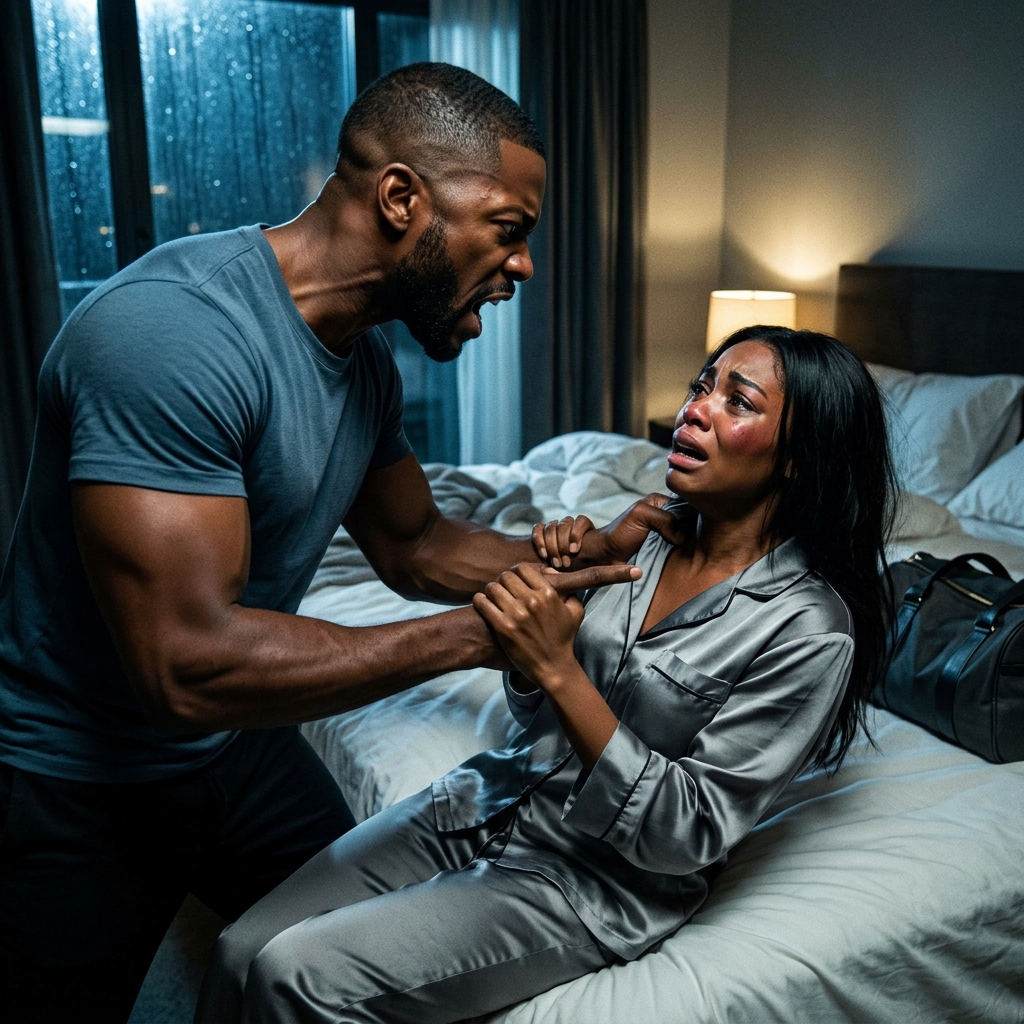
The room tilted. A dull, rhythmic throb began behind her left ear—the pressure of blood leaking into the subcutaneous tissue of her cheekbone. The silk pajamas were cold against her ribs where the rain had soaked through her trench coat, and her left shoulder felt jammed, the tendon screaming where it met the collarbone.
She reached down, took the strap of the duffel bag, and dragged it off the mattress. It fell to the floor with a soft slap of canvas against wood.
Damon did not move from the foot of the bed. He stood with his arms crossed over his chest, his legs braced wide, staring past her toward the black river. His face had gone entirely blank—the mask of absolute indifference that men like him wore when they had decided that someone had ceased to be human and had become merely an administrative error.
Kendra pulled her coat together over the torn silk of her pajamas. She did not button it; the horn buttons were broken. She wrapped the belt twice around her waist, tied it into a hard, uneven knot with trembling fingers, and stood up.
Her boots slipped slightly on the parquet. She bent, scooped her bag by its nylon handles, and walked toward the bedroom door.
She did not look back at him. She did not look at the bed where three hours ago she had thought she could lie down and pretend that the smell of Julian’s cedar soap was not still clinging to the skin behind her ears.
As she reached the hallway, Damon’s voice caught her from behind:
“Don’t call Claire. She changed the gate code on the farm at midnight.”
Kendra stopped, her hand resting against the cold brass handle of the front door. She did not turn around. She did not ask how he knew. In the small, vicious circle of their shared existence, transactions were made with the speed of an electronic wire. Julian’s sister had not called to help; Claire had called to ensure that the mother who had left Julian three years ago would never again have a key to the house by the river.
“I won’t call her,” Kendra said.
Her voice sounded hollowed out, like an old tin cup dropped down a dry well.
She pushed down on the handle. The latch disengaged with a click, and she stepped out into the carpeted silence of the forty-fourth floor, pulling the heavy mahogany door shut behind her until the deadbolt fell into place with a dry, mechanical clack.
The car was cold.
The dashboard illuminated her face in the rearview mirror as she sat in the underground stall: the left side of her face was already twice the size of her right, the skin beneath the cheekbone mottled in shades of plum, raw liver, and dark amber. Her eye was a swollen slit through which the overhead fluorescent tubes seemed to bleed like fractured halogen tubes.
She reached into her purse for her phone.
The battery was at eighteen percent.
There were three missed calls. None from Damon. None from Julian.
Two were from an unlisted number in Henrico County—the legal aid clinic where she worked as a paralegal thirty-two hours a week. The third was a voicemail from Julian’s landline, left at 9:43, while she had been standing on the gravel driveway outside his kitchen, listening to the creek rush through the culvert in the dark:
“Kendra. Maya’s fever broke. Claire took her down to the cottage because she thought… well, she thought it was better for the girl not to be confused by you staying in the guest room. You shouldn’t have come inside tonight. It wasn’t fair to her. And it wasn’t fair to me. Leave the house keys on the milk box by the post.”
She deleted the message without listening to the end.
She put the car in reverse, the tires barking once on the sealed concrete, and drove out through the automatic gate into the Richmond mist.
The city was empty. At one in the morning, Broad Street was an unlit canyon of boarded storefronts, wet asphalt, and amber traffic signals swinging in the river wind. She did not drive toward the highway. She had sixty-two dollars in cash in her purse, a quarter-tank of regular unleaded, and a debit card that Damon had co-signed as the primary cardholder on an account that had probably been suspended by an automated fraud alert thirty seconds after she left the apartment.
She turned north, crossing the tracks behind the old freight depot, toward the industrial flats where the tobacco warehouses had been converted into small, unheated storage units and radiator repair shops.
She pulled the car behind a shuttered dry-cleaning plant, into the shadow of a row of rusted shipping containers, and killed the engine.
The heat died from the vents within five minutes.
The silence that settled into the cabin was total, save for the slow, rhythmic ping-ping-ping of the catalytic converter cooling against the wet leaves beneath the frame. Kendra pulled the duffel bag onto the passenger seat, reached inside, and found Maya’s yellow cardigan.
She held the sleeve against her face.
It smelled of Julian’s woodsmoke, of apple peel, and of the cheap strawberry shampoo she had bought for the girl at the pharmacy three weeks ago. She pressed the wool hard against her swollen cheek, feeling the dull, agonizing pulse of the bruise through the knit, until the pain was the only clean thing left in her skull.
She had believed she could have both.





