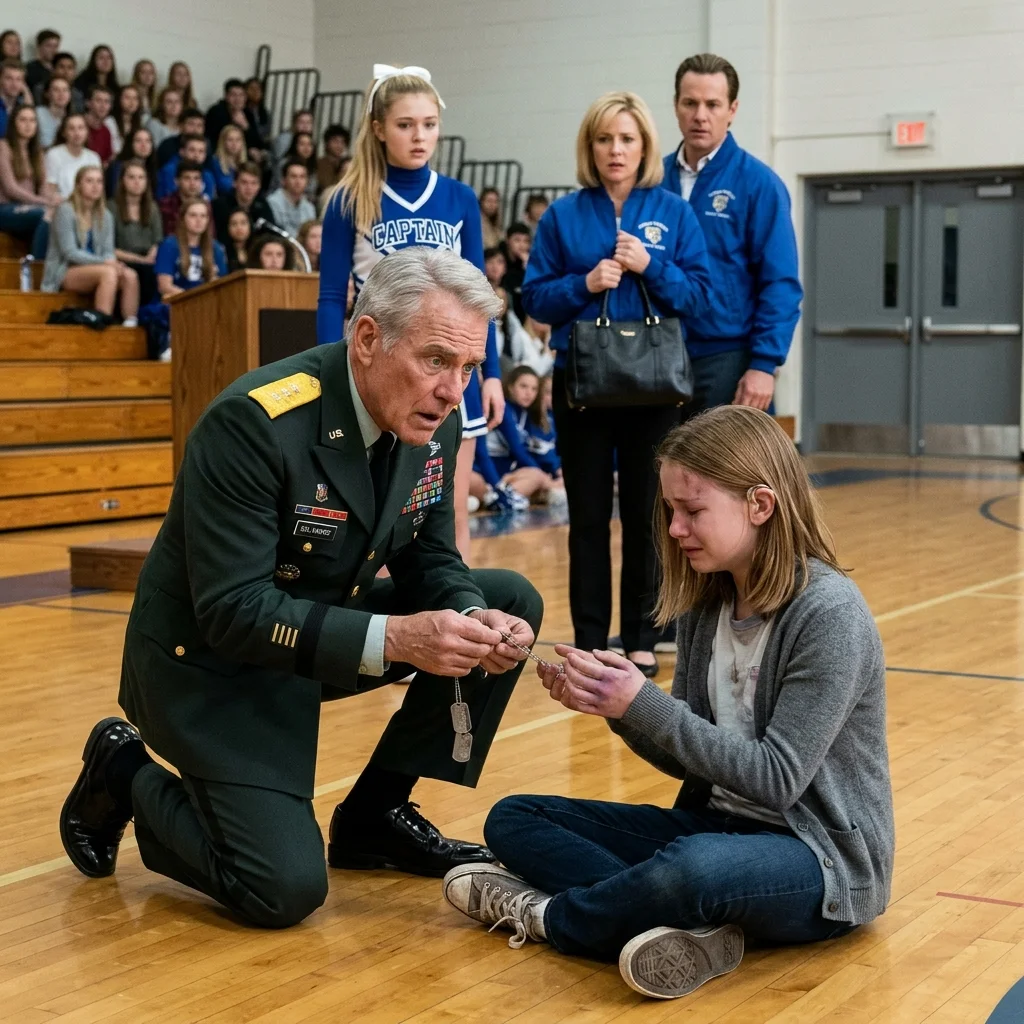
Whitaker stopped four feet from the press table leg. Slowly, keeping his spine straight despite a slight stiffness in his right hip—an old war wound that made him favor his left boot by a fraction of an inch—the two-star general knelt down on one knee on the dusty hardwood floor.
Twelve hundred people held their breath as the decorated commander reached down with a large, scarred hand and gently picked up the broken halves of my blue left-ear processor from beside the steel table leg. He cradled the cracked plastic casing and the detached earmold on his open palm, studying the sheared brass hinge of the battery compartment and the tiny white radial stress mark where the rubber toe of a sneaker had struck the shell.
Then he stood up and turned those cold flint eyes onto Nadine Bradford.
For the first time in her sixteen years on earth, Nadine’s posture buckled. The arrogant tilt of her chin evaporated; she took a half-step backward toward her cheer squad, only to find that Kelsey Vane and the rest of the girls had quietly retreated three yards behind her, leaving their captain standing completely alone on the painted crimson line.
“I have worn the uniform of the United States Army for forty-one years,” General Whitaker said, his voice cutting cleanly through the cavernous hush of the gymnasium. He didn’t look at the bleachers; he looked solely at Principal Miller, Uncle Barry, and Nadine. “In those forty-one years, I have spent considerable time sitting in elevated observation posts watching human movements across wide perimeters. When you spend your life watching terrain, Principal Miller, you learn that people rarely look at the person who is speaking. They look at the movement on the flanks.”
He held up his palm, showing the crushed blue hearing aid to the front rows.
“From the moment I stepped up to that lectern four minutes ago,” the general continued, his voice dropping half an octave into an arctic register that made the varsity football coach wince ten feet away, “I watched this young girl in the navy sweater standing quietly by the curtain. She did not make a sound. She did not fidget. And then I watched your cheer captain whisper to her teammate, walk twelve feet out of formation, reach behind this child’s head with both hands, and rip her medical prosthetics violently from her ears.”
A collective gasp rippled across the upper bleachers as the hundreds of students who had only seen the tail end of the scuffle suddenly understood what had happened.
Aunt Pamela’s face went the color of sour milk. “General—surely from the stage you misunderstood—Nadine was simply trying to help her adjust—”
“Do not insult my eyesight or my integrity, madam,” Whitaker said softly, turning his gaze onto Aunt Pamela for two terrifying seconds before shifting back to Nadine. “After she threw this child’s hearing aids onto the basketball court, I watched her grab a steel chain from around the girl’s throat, snap it in half, plant her shoe on top of the girl’s bleeding hand when she knelt to recover her property, and then deliberately kick a four-thousand-dollar piece of medical equipment into a steel table leg before calling her own cousin a deaf retard within earshot of fifty students.”
Principal Miller looked as though the floor had just opened beneath his wingtips. Uncle Barry’s mouth worked silently, his eyes darting toward the Oak Ridge Sentinel reporter, who was no longer taking polite PR snapshots of the scoreboard—the reporter had his digital Nikon raised and was firing rapid-shutter frames of the general holding the shattered hearing aid in front of Barry Bradford’s horrified face.
General Whitaker turned away from the adults entirely and took two measured steps toward me.
Seeing a tall man in uniform approaching my blind left side, I instinctively turned my head thirty degrees to the left so my surviving right processor and my eyes could keep his lips centered in my field of view. At the same time, my right hand tightened inside my cardigan pocket around the two loose steel ovals and the broken chain, pulling my knuckles tight against my ribs to make sure nobody else could touch them.
General Whitaker stopped three feet away. And then, instead of towering over me the way every teacher and principal in Oak Ridge always did when addressing the “deaf girl,” the general went back down on one knee on the hardwood so his eyes were dead level with mine.
More astonishingly, he didn’t just speak aloud.
He raised both of his large, weathered hands to chest height and began to sign in crisp, fluent, military-grade American Sign Language while speaking in a low, clear baritone timed perfectly for lip-reading.
Are you injured, soldier? his hands asked, tapping two fingers gently toward my scraped right knuckle. “And do you read my lips clearly on your right side?”
My mouth fell slightly open. Across the front rows of the bleachers, total silence reigned as the entire student body watched a two-star general communicate with my silent language on his knees.
I read you clearly, sir, I signed back with trembling hands, speaking aloud at the same time. “My right processor still works. My father taught me to read lips and sign when I was little.”
A flicker of warm understanding crossed the general’s weathered features. My oldest granddaughter in Virginia was born with bilateral cochlear implants, he signed back smoothly, his voice carrying clearly in the quiet gym. “Any officer worth his salt learns the comms protocol his family uses. What is your name?“
“Holly Bowman, sir.”
At the sound of the surname Bowman, the slight smile vanished from General Whitaker’s face.
His hands paused in mid-air. The deep creases around his eyes tightened with sudden, fierce concentration. Slowly, his gaze dropped to my right fist, which was still half-tucked inside the sagging wool pocket of my cardigan, where a single four-inch tail of broken stainless-steel bead chain dangled over the hem.





