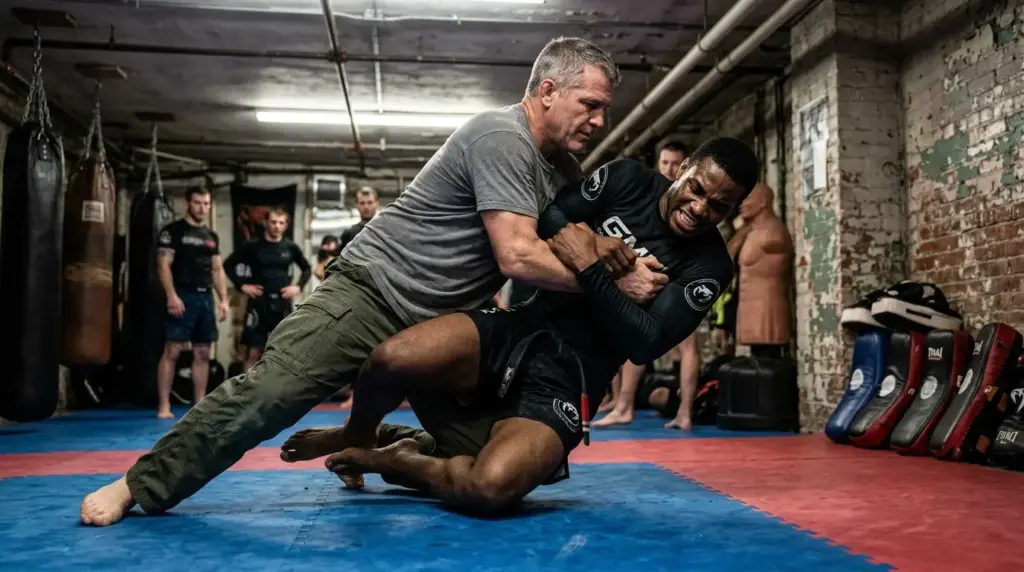
He pushed. His core engaged. He dragged his hips backward, keeping his ruined right arm pinned tightly against his stomach to prevent it from swinging. He made it to a seated position, his chest heaving, his face a mask of pale, sweating terror. Keep going, Hayes demanded.
Declan looked at the faces of the class. They were watching him not with the awe he was used to, but with raw, unvarnished pity. He hated it. He used that hatred. He planted his left foot, posted on his left hand, and drove his hips up.
It was the ugliest, most uncoordinated tactical stand-up he had ever performed. He staggered, nearly pitching forward as the shift in blood pressure made the room tilt. But he found his footing. He stood. He was slouching heavily to the right, cradling his arm, breathing like a dying engine, but he was on his feet.
He looked at Hayes, his eyes wide, dilated, and brimming with tears. “I’m up. ” Declan whispered, his voice trembling. Hayes stared at him for a long, silent moment. The tension in the room was pulled so tight it felt like the air itself might snap. Slowly, Hayes nodded.
He reached into his pocket, pulled out the brass key, and tossed it to Chloe. It hit the mat by her feet with a dull clink. “Call the medics. ” Hayes said, turning away and walking toward the gym bag in the corner. He dug around and pulled out a wide roll of white athletic tape and a pair of trauma shears. He walked back to Declan, who was still standing, swaying slightly on his feet.
“You survived. ” Hayes said, his voice surprisingly gentle as he began to quickly, efficiently wrap the tape around Declan’s right arm, binding it securely to his torso to act as a makeshift splint. “The belt didn’t save you. The technique didn’t save you. Your mind saved you. ” Declan didn’t say anything. He just stared at the bloodless white knuckles of his good hand.
For the first time in his life, he understood exactly what it meant to fight. It wasn’t a game. It wasn’t a sport. It was just a desperate, ugly refusal to die. Hayes had finished taping the arm, patting Declan’s good shoulder once.
“Ambulance is 3 minutes out. Sit down before you fall down, kid. Class is dismissed. ” The hospital smelled like rubbing alcohol and boiled linen. It was an aggressive, sterile odor that did nothing to mask the underlying scent of human panic. They cut Declan’s shirt off with trauma shears.
The emergency room doctor, a tired woman with deep bags under her eyes, took one look at the distorted angle of his humerus and immediately ordered a cocktail of fentanyl and midazolam. The drugs didn’t erase the pain, they just pushed it to the other side of a thick pane of glass. Declan lay on the gurney staring at the acoustic tiles on the ceiling, listening to the heavy rhythmic thumping of his own heart on the monitor. Surgery happened 4 hours later. When he woke up, his right arm was encased in a massive, heavy block of white plaster and fiberglass from his knuckles to his armpit.
His mouth tasted like pennies and old cotton. A surgeon named Miller came in holding a tablet. He didn’t offer a reassuring smile. He just showed Declan the X-rays. It was a spiral fracture.
The bone had snapped and twisted, leaving jagged, vicious splinters. “We had to go in and stabilize it, ” Miller said, pointing to the ghostly white lines on the screen. “One titanium plate, nine screws. You’ve got a lot of soft tissue damage. Muscle tearing, tendon strain.
It’s going to be 6 weeks before the cast comes off and another 4 to 6 months of aggressive physical therapy before you get functional mobility back. ” Declan swallowed the dry lump in his throat. “When can I train again? ” Miller looked at him over the rim of his glasses. It was the exact same look Hayes had given him. “You don’t. Not this year.
Maybe not ever, if you want to avoid chronic arthritis by the time you’re 30. You need to understand, son, this wasn’t a sports injury. Your arm was subjected to the kind of torque we usually see in motorcycle crashes. ” Declan spent the next 3 days in a haze of oxycodone and daytime television. When he finally went home to his apartment, the reality of his new existence set in. Everything was a battle.
Opening a jar of peanut butter required trapping it between his knees and awkwardly twisting the lid with his left hand. Showering meant wrapping his cast in two trash bags and taping them down, only to stand shivering under the water, feeling utterly pathetic. He couldn’t tie his shoes. He couldn’t drive his manual transmission car. He slept in a recliner because lying flat caused a deep, agonizing ache to settle into the marrow of his collarbone.
2 weeks into his recovery, he stopped taking the painkillers. He wanted his mind sharp, even if it meant his body ached. He found himself staring at the medals hanging off the corner of his bedroom mirror. Gold, silver, bronze, regional championships, state opens. They clinked together when the air conditioning kicked on.
They looked cheap now, pieces of stamped metal hanging on ribbon. 6 weeks passed. The cast came off. That was worse than the break. When the technician split the fiberglass and pulled it away, Declan almost threw up.
His arm didn’t look like his arm. The sculpted bicep was gone, replaced by a flaccid, pale strip of atrophied meat. His skin was yellowed and flaky, covered in dark, coarse hair. Running down the outside of his triceps was a vicious, angry, red scar, 9 inches long, puckered and stitched like Frankenstein’s monster. He tried to make a fist.





